


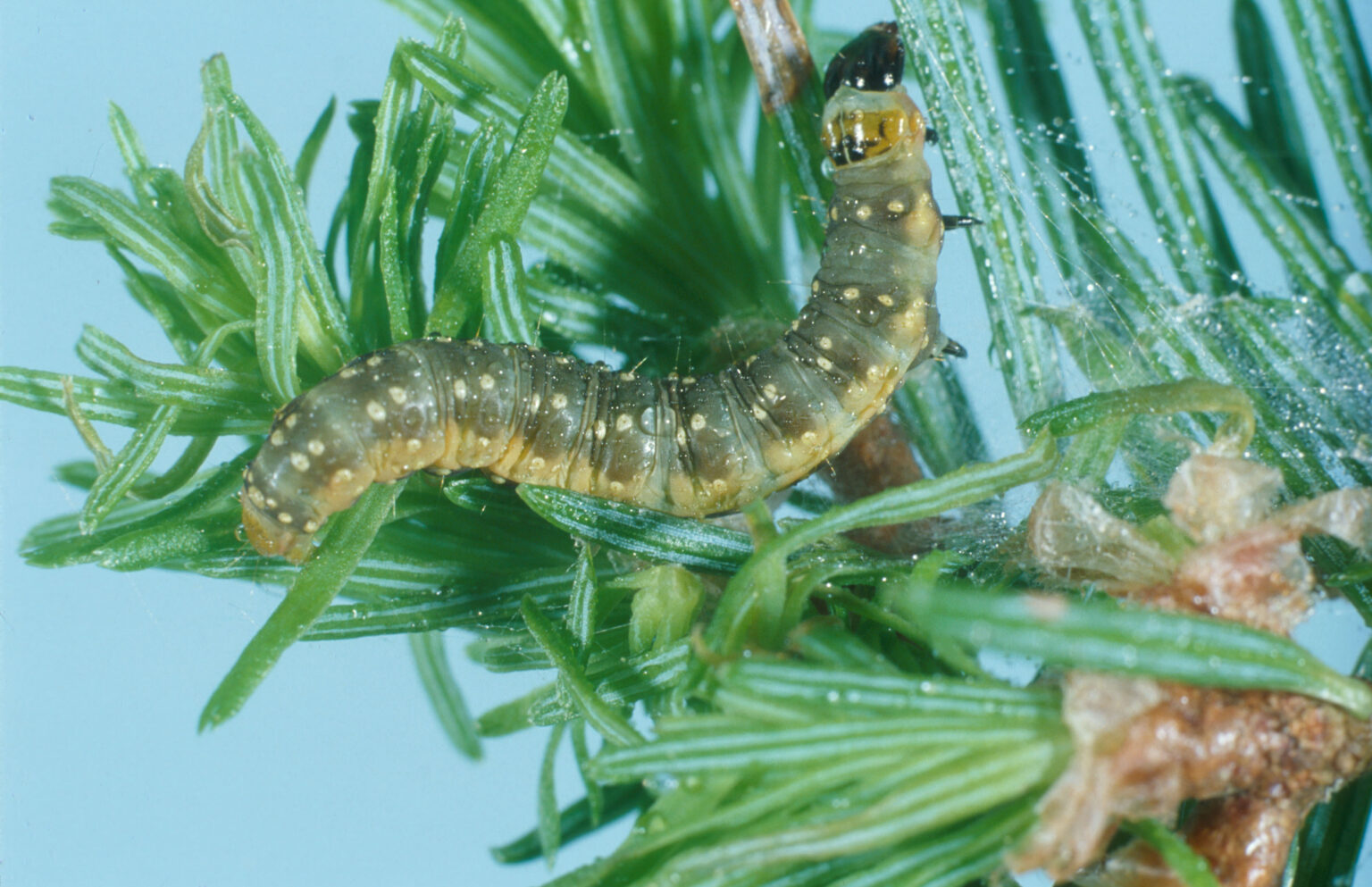
Researchers are using atmospheric patterns and bug traps to predict the spread of a tree-killing insect that has been destroying entire Canadian forests.
“The spruce budworm is the most damaging forest pest in the boreal forest,” said Jean-Noël Candau, a quantitative ecologist with the Canadian Forest Service.
Learning more about how these insects spread could help forest managers better fight the spread of an insect that causes losses to the logging industry and increases the risk of wildfire near homes, as dried-out, dead trees are more prone to burning.
In research published in Ecological Entomology, Candau and his colleagues conducted the first study that they know of tracking the source of a spruce budworm swarm and reconstructing its long-range migratory flight.
Pestilential moth swarms
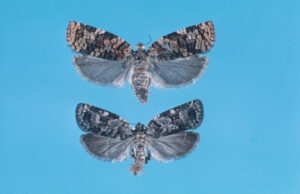
Eastern spruce budworms (Choristoneura fumiferana) aren’t usually a problem. They spend their larval period feeding on the fresh needles of spruce and balsam fir trees. But they go through long-term cycles—every 30-40 years, their populations shift from very low to very high numbers that can be deadly to their host trees. “They don’t kill the trees right away, but after a few years of heavy defoliation from the insects, the trees start to die,” Candau said.
Later in the summer, when the larvae convert into adults, swarms of sometimes billions of moths cloud the sky, and businesses in some small towns have resorted to using small bulldozers to clear the carcasses of dead moths from sidewalks. Roads have even become dangerous during swarms—visibility was low due to the sheer quantity of insects, while some areas of New Brunswick have seen car crashes as vehicles slid on the goo of dead moths on the pavement.
“The outbreaks spread like a contagious disease,” Candau said.
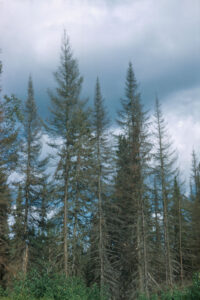
Ecologically, budworms aren’t really a problem—they are a native species, and the forest has evolved with these large boom and bust cycles. Like periodic fires, even large tree kill-offs reset the forest cycle and provide food for birds and other creatures.
But these outbreaks are occurring alongside other human-caused processes like climate change, habitat disturbances and changes in the fire cycle that can lead to problems for the humans that live in these areas.
Budworm boom time
Eastern Canada is experiencing a boom period that started in late 2008—Candau believes the area is just past peak population boom.
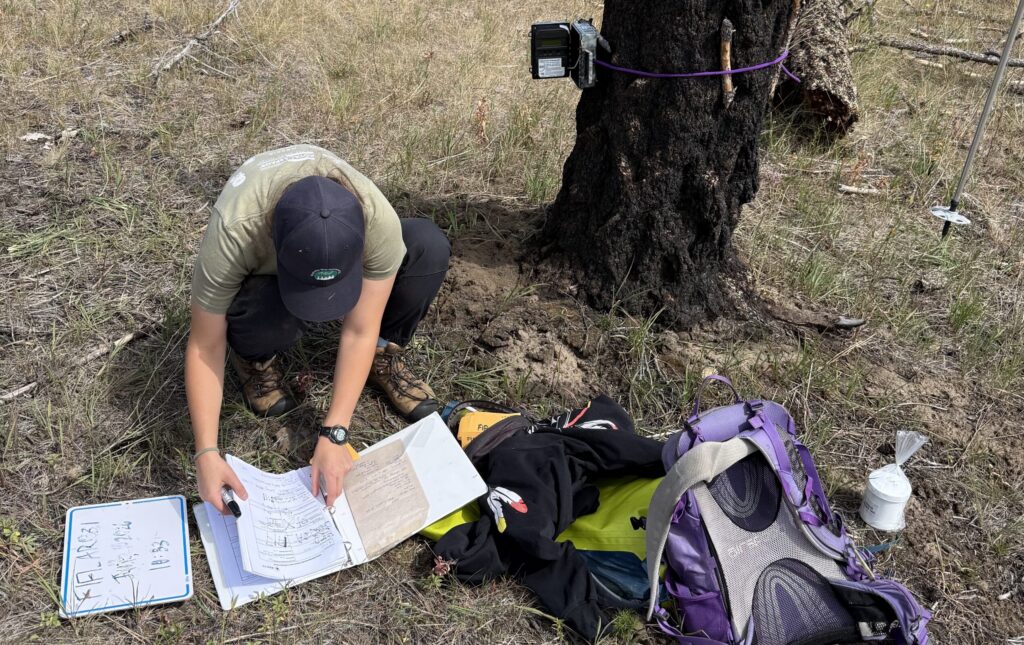
Candau has been tracking the insects for years using different traps that capitalize on artificial moth pheromones—chemical signals that approximate those that females use to attract males. Once inside the trap, which sits atop a pole, cameras take images of the moths inside, transmitting them to Candau by satellite. A huge uptick in trapped males can reveal where swarms might have landed. “We distribute those traps all throughout eastern Canada,” Candau said.
But it’s been hard to track where swarms go or where they came from once they land. To get ahead of the problem, Candau worked with Philippe Barnéoud, a meteorologist with the Canadian Center for Meteorological and Environmental Prediction, to test if they could use atmospheric models, which use data about wind, temperature and humidity, to better predict the trajectory of moth swarms. The team also used data taken from a colleague who had detected a moth swarm in Sally’s Cove in Newfoundland near Gros Morne National Park in July 2017.
The team set out to rebuild the environmental conditions around Sally’s Cove when the swarm arrived to predict where it originated. They looked at factors like wind speed and direction, temperature and humidity.
They predicted that the most likely place the swarm came from was on the Quebec island of Anticosti, about 400 kilometers to the west of Newfoundland and across the Gulf of Saint Lawrence. While researchers had theorized this was possible based on anecdotes they found in other studies, this is the first time scientists confirmed such a long flight for these insects.
The team used weather data radars, which can detect swarms if they are large enough, to confirm that this was the likely path of the moths that ended up in Sally’s Cove. Aerial survey data also confirmed signs of defoliation on trees in Anticosti, indicating that the budworm larva had begun their life cycle there.
Spruce budworm moths aren’t strong flyers—they are carried away passively by the winds. Barnéoud said that the reconstructed migratory flight could explain why the moth swarm landed in Sally’s Cove. Since adults can only fly above a certain temperature, low temperatures prevailing over Sally’s Cove area when the swarm arrived abruptly stopped the moths’ journeys.
Reconstructing this moth flight is a proof of concept, Barnéoud said. Now that they have demonstrated that atmospheric models can be used to reproduce a historical migratory flight, they could also use this technique to predict the trajectory of moth swarms in the future.
Candau said that this might help control budworm outbreaks. It’s not always easy to see where the larvae are before the damage is done. But if researchers can better track swarms to where they breed and lay eggs, they can treat these areas with pesticides to limit further damage. All of this information can help managers determine areas where moth larvae are most likely to thrive in general.
“The conclusion was that yes, we can efficiently use atmospheric models and special methodology we used in this study to simulate long-range migrations and to have a better understanding of the environmental conditions that favor the long-range migrations of the spruce budworm,” Barnéoud said.
Article by Joshua Rapp Learn