


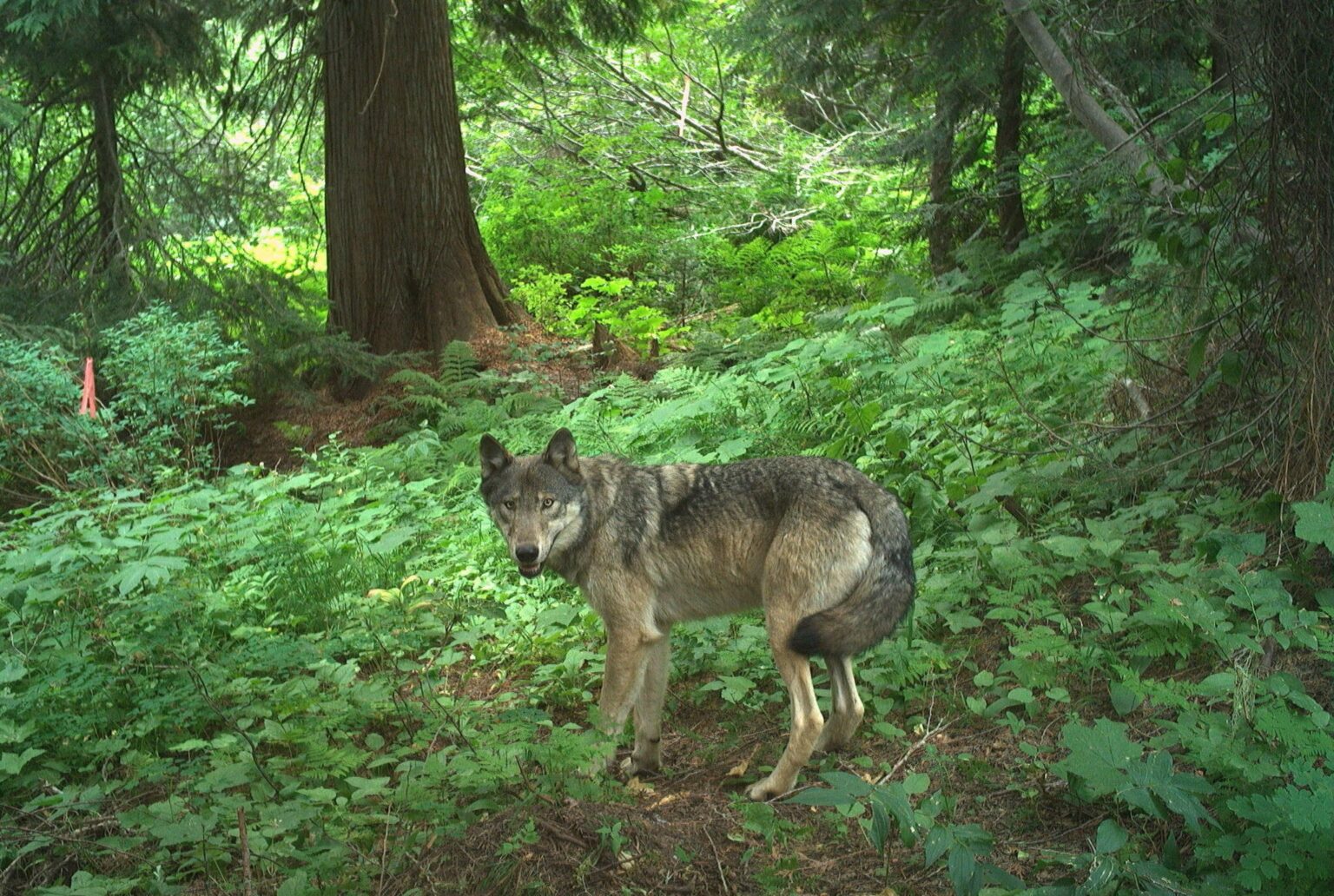
Should they stay or should they go? How young wolves make this decision has less to do with them clashing with their families and more to do with food availability and wolf density.
Paradoxically, young wolves are more likely to leave the territories where they grew up—their natal range—when there is plenty of prey available and fewer wolves around them. Human hunting, meanwhile, didn’t seem to push them around one way or another.
A better understanding of the factors that influence these decisions can help wildlife professionals improve pack management.
“Wolf dispersal is incredibly important to wolf populations,” said TWS member Kat Petersen, a research specialist with the U.S. Geological Survey’s Cooperative Fish and Wildlife Research Unit housed at the University of Idaho.
In a study published recently in the Journal of Animal Ecology, Petersen and her colleagues examined wolf dispersal data by analyzing the genes of legally hunted wolves across Idaho for more than a half-decade.
The Idaho Fish and Game Department requires hunters to take and submit tissue samples and teeth from wolves hunted in the state. Between 2017 and 2023, Petersen and her colleagues analyzed samples from hundreds of hunted wolves.
Teeth and tissue
The team first examined the teeth—layers on the enamel indicate a wolf’s age at the time of death. Since most wolves that disperse leave their natal territory after they’re one year old, the researchers separated their samples into those that were less than a year old and those that were older.

They then analyzed the genes of the wolves from the tissue samples. They found 595 wolves related to at least one other wolf in their database. This total comprised 182 sibling groups. Some 224 of these wolves were less than one year old and assumed to have been killed in their natal range. In some of these cases, the team found multiple siblings in the same area, helping them establish the limits of a given native range for a sibling group.
In other work, researchers have estimated the average natal range of wolves to be 686 square kilometers. If that range were a circle, it would be about 15 kilometers wide. So, the authors considered any wolf hunted more than 29.6 kilometers—twice the average range width—from the place its sibling was hunted as having dispersed.
Of the older wolves, 138 stayed near their natal range, while 86 dispersed away from their siblings by these standards. More wolves likely dispersed than those, but the authors didn’t examine wolves hunted outside of Idaho.
The wolves that emigrated dispersed an average of 81.8 kilometers from their natal range. They also found that, similar to the findings of other studies, males dispersed slightly more than females, though the difference was minimal enough that it didn’t really affect the likelihood of emigration. Females moved farther, though, when they did disperse—the maximum distance a female emigrated in the state was 330.9 kilometers, while a male’s max dispersal was 264.7 kilometers.
Good food and company? Let’s get out of here
The results revealed that wolves were less likely to emigrate from their natal range in areas where the overall wolf density was high. While this might seem counterintuitive, Petersen said that the reason might have to do with the relative danger of movement in a territorial species. If a wolf’s natal pack is surrounded by other packs in all directions, it’s a little more dangerous for a solo wolf to strike out on its own. “[Other wolf packs] are acting almost like a literal fence, a barrier to dispersal,” Petersen said.
Food availability also influenced wolves’ decisions to move out. Wolves actually emigrated out of their natal range more often when there were plenty of prey. This also seems counterintuitive—at first. But Petersen believes it has to do with preparation. When wolves leave the territory they are familiar with, where they have a pack that helps them hunt, it’s often going to be harder to find prey. She speculates that wolves that do leave often do so more when they are well provisioned—if you’re going to set out on a long, solo trip, you need to be well provisioned at the outset.
It’s also possible, she said, that the wolves born in areas with plenty of prey resources have more experience hunting than those that don’t. This may give them a better chance of success when they set out alone.
Both of these factors—wolf density and food availability—were more important than human hunting. The intensity of humans hunting wolves or lack thereof in a given natal range didn’t seem to play a role in whether wolves chose to disperse elsewhere.
Petersen said that these findings can help wildlife agencies make decisions about how they want to manage populations.
Article by Joshua Rapp Learn