


Good morning TWS,
I have always enjoyed the summer. Well, if I’m being honest, I enjoy all seasons, but there is something about the summer that I particularly love and seems to be missing from all the others—the apparent slow passage of time. Life seems less hurried in summer, and days are less rushed. In this season, characterized by lemonade stands and lightning bugs, we seem to find ourselves doing more of the things we enjoy and less of the things that busy our lives.
This summer, I found myself in the heart of the Davis Mountains of western Texas. Although I was there for research, my time in the field brought me much-needed rest and renewal. To be honest, the past year had worn on me a bit. The daily grind had me feeling overworked. However, deep in the forested ridges and canyons of Mexican pinyon pine (Pinus cembroides), gray oak (Quercus grisea) and Texas madrone (Arbutus xalapensis)—far removed from all things familiar—my mind was able to roam freely and ponder whatever thoughts emerged. I was reminded of the importance of being idle and the benefit of taking time to step away from daily tasks.
My reflection reminded me of an article that had crossed my desk last spring. Unfortunately, I was only able to scan it given that my work schedule did not permit for more in-depth reading. The irony was that the article began with the sentence, “Does it seem that most people you interact with professionally say they are too busy?” The article, “Taking time to think: The tyranny of being ‘too busy’ and the practice of wildlife management,” was written by Dan Decker, a professor emeritus at Cornell University and a longtime member of TWS. Decker and colleagues contemplated why most people, including wildlife professionals, shared a common sentiment of being too busy. They explored possible causes for this phenomenon and discussed the implications for our profession.
Decker and colleagues proposed the idea that effective wildlife management required professionals who were not only critical thinkers but also had time to reflect on their actions. Through several workshops over the years, they had observed that effective wildlife professionals were those who continuously built the skill of critical thinking and applied this skill to reasoning and judgement processes. However, both of these qualities—critically thinking and reflectively evaluating—required time to develop and decluttered schedules, neither of which wildlife professionals seemed to have. Several factors contributed to this tyranny of being too busy. These included organizational frameworks that equated activity with productivity, a focus on outputs rather than outcomes, a bias toward “doing something” rather than “solving an issue” and, unfortunately, an apparent normalization of the problem by society. Decker and colleagues argued that the danger of being too busy not only jeopardized our profession’s ability to achieve conservation goals and meet societal needs, but it also risked burnout of our wildlife professionals. One of their solutions was purposefully making time for reflection and unstructured thinking.
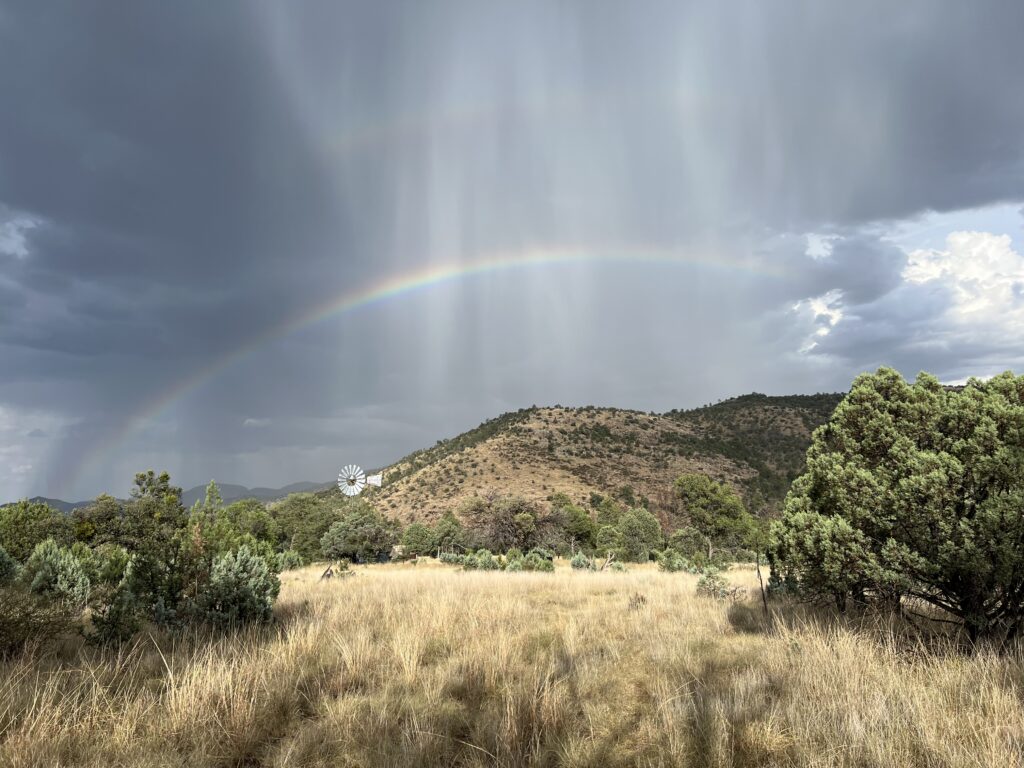
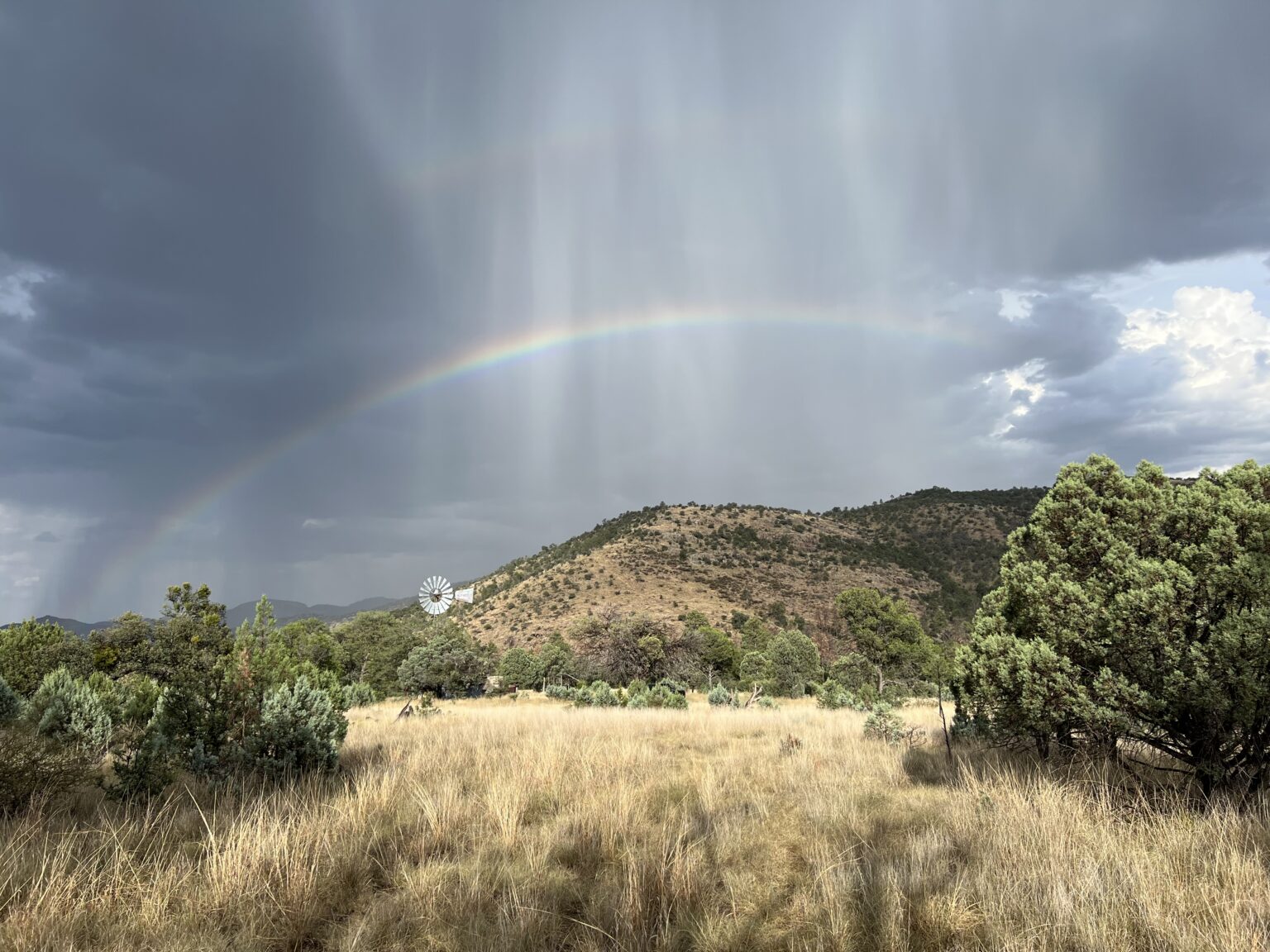
Unbeknownst to me, I accidentally had stumbled across this remedy while in the Davis Mountains. Far removed from my office and desktop, I neither thought of my daily tasks nor of the minutiae that often plagued my days. My mind wandered, and I began feeling rested. Part of this renewal resulted from my time for unstructured thinking, but it also resulted from my just being in nature. I was able to enjoy a long-forgotten childhood experience—the joy of getting caught in a summer downpour—and see one of the most beautiful rainbows I have seen. I share it with you here, but like all moments captured through a camera lens, the photograph does not do the life experience justice.
As summer draws to a close and lemonade stands become replaced with scarecrows and pumpkin patches, I encourage you to step away from your daily tasks every now and then and make time for unstructured thinking. Meet up with a colleague for coffee. Go for a walk at a local park. Spend some time enjoying the last of the summer wildflowers. Not only will these actions benefit you professionally, but being outdoors or in the company of a friend will refresh your spirit.
I leave you with these two closing thoughts. First, the conference planning committee has been busy organizing a wonderful annual conference for this autumn in Des Moines, Iowa. Below I share with you the plenary lineup, but please check out the website (link here) for the latest conference news. Second, if you are an officer at the student, state, provincial, or section level, please consider forwarding this missive to your membership. Otherwise, affiliate members within your chapter or section may never hear from TWS. Feel free to pass this letter along to anyone you think may enjoy these musings. You never know; you just may help recruit a new member or inspire a future conservationist. Thank you for your time and service to TWS.
Until next time, buen camino.
Fidel Hernández
TWS President
Article by Fidel Hernandez