




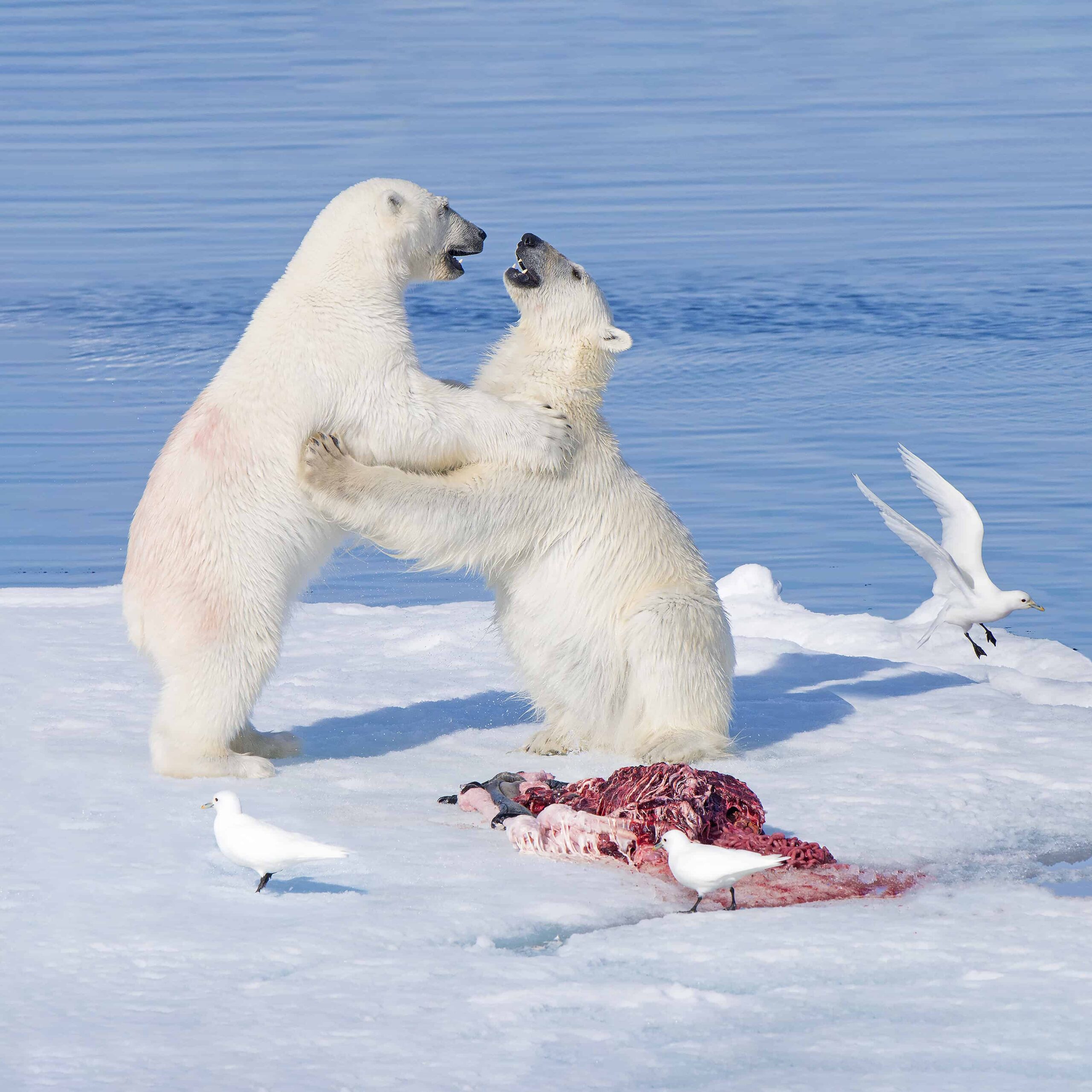
Polar bears have a voracious appetite—but they still leave so many scraps that they provide food to nearly a dozen other species in the harsh Arctic ecosystem.
“They kill a lot, feed once and leave a lot out for others,” said TWS member Holly Gamblin, a doctoral candidate at the University of Manitoba.
Polar bears (Ursus maritimus) hunt along the Arctic sea ice for energy-dense meals like ringed seals (Pusa hispida). They want the most bang for their buck, so they typically strip off layers of fat and blubber and leave the rest behind. Even though they don’t cache it for later, the leftover carrion doesn’t go to waste. At least 11 species of animals, including arctic foxes (Vulpes lagopus), gulls and even juvenile polar bears, will scavenge the remains.
In warmer climates, bacteria, microbes and other decomposers make quick work of carcasses. But ambient Arctic temperatures are nature’s meat cooler, which keeps the remains from degrading for weeks or even months. Once the sea ice melts, anything left over gets returned to the ocean. “There are multiple phases where the carcasses from polar bears provide resources to other animals,” Gamblin said.
Gamblin presented some new and ongoing research at the 2025 Annual TWS Conference in Edmonton, Alberta, highlighting the important yet understudied role of polar bears as marine carrion providers.
Counting the scraps
In a review recently published in the journal Oikos, Gamblin and her coauthors estimated exactly how much carrion polar bears are leaving behind.
They started by multiplying the average size of a ringed seal—the representative animal they chose for the study—by the average number of polar bear kills per year. They subtracted what would be typically consumed by the polar bear and the weight of the animal’s skeleton, leaving just what energy resources would be available to the scavenger. They then estimated that 30% of the seal’s biomass would be left over. Based on these calculations, the team estimated that polar bears around the world leave at least seven million kilograms of carrion resources for other animals. This amounts to about 39 million megajoules of energy available for scavengers.
While this number is large, Gamblin said it’s a conservative estimate. Because they’re the primary prey of polar bears, the model only took into account ringed seals. But in reality, polar bears kill much larger animals like bearded seals (Erignathus barbatus) and beluga whales (Delphinapterus leucas).
There’s not much else they know about which species rely on the carrion, or when. There have been no systematic studies of scavenging on the sea ice—only opportunistic observations during other Arctic expeditions.
Gamblin has launched a new phase of the project to understand what factors influence carcass use. She has two experimental sites: one in the low Arctic in Churchill, Manitoba, and one in the high Arctic in Pond Inlet, Nunavut.
In those areas, Gamblin works closely with a local Churchill hunter who harvests ringed seals. She takes these carcasses to stage simulated kill sites. She then monitors the carcasses with camera traps to determine which animals scavenge and when.
At the conference, Gamblin presented a preliminary analysis of the first two years of experiments. So far, she’s seen plenty of arctic foxes, gulls and ravens. She’s also seen grizzly bears and “plenty of mom and cub activity” scavenging on the seal carcasses.
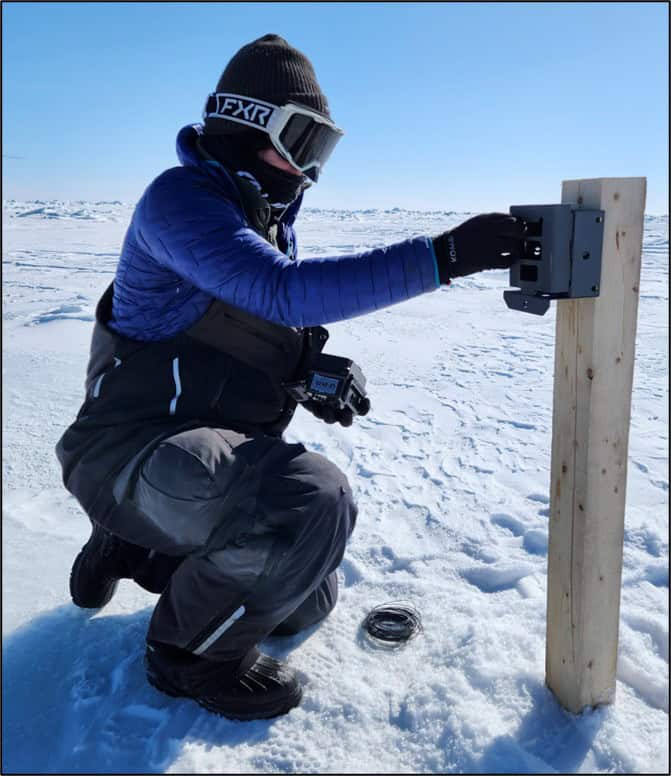
Gamblin is also interested in several variables that she thinks might affect the use of carcass sites, including distance to shore, year and season. So far, she’s found eight species at each study area, with more species diversity closer to the shoreline. She thinks that terrestrial species are less likely to venture far onto the sea ice.
There are also several complicating factors, including time of year. Polar bear hunting strategies are seasonal—in the spring, they bulk up while the sea ice is strong and suitable for hunting. They eat constantly in this time to rebuild fat reserves, leaving more carcasses out on the ice. Some of their prey are migratory and only sometimes in the area, like beluga whales. Carcass scavengers, like gulls, can also be seasonal.
In this ecosystem, stable, landfast sea ice—or ice that is anchored to the shore—is an important platform for terrestrial scavengers. And now, the Arctic is warming at four times greater than other areas, causing sea ice loss in a way that will impact not just polar bears but also the species who rely on their kills for food. “When we lose sea ice, we’re going to be losing not just polar bears, but essential scavenging resources and marine subsidies,” Gamblin said.
Article by Olivia Milloway