


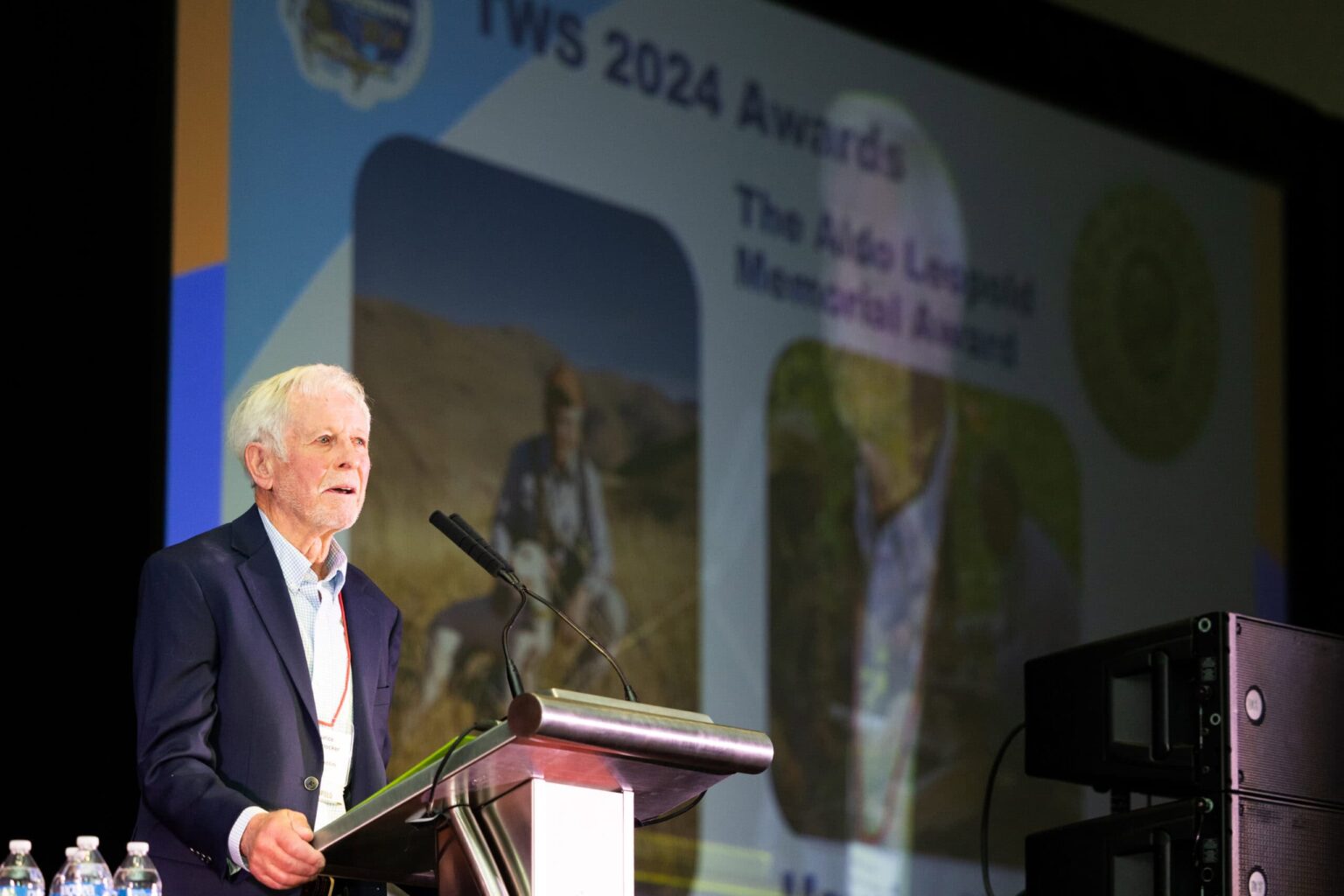
Remembering Leopold’s Wilderness Laboratories will help guide today’s wildlife conservation, 2024 Aldo Leopold Memorial Award recipient Maurice Hornocker told wildlifers in his keynote speech at the 2025 Annual TWS Conference in Edmonton, Alberta.
“Wildlife is an integral, important and essential component of any wilderness ecosystem,” Hornocker said. “Why hasn’t threatened or endangered wildlife seen more attention in wilderness?”
Wilderness areas, Hornocker argued in a prerecorded address to the crowd at the conference, are critical in providing baseline data and offering a venue for necessary basic research before these areas fall victim to anthropogenic change.
Hornocker spoke about the knowledge that has been unlocked from wilderness areas in the past, such as his work on mountain lions (Puma concolor), showing that predation on mule deer (Odocoileus hemionus) and elk (Cervus canadensis) was crucial in maintaining ecological stability in the central Idaho wilderness.
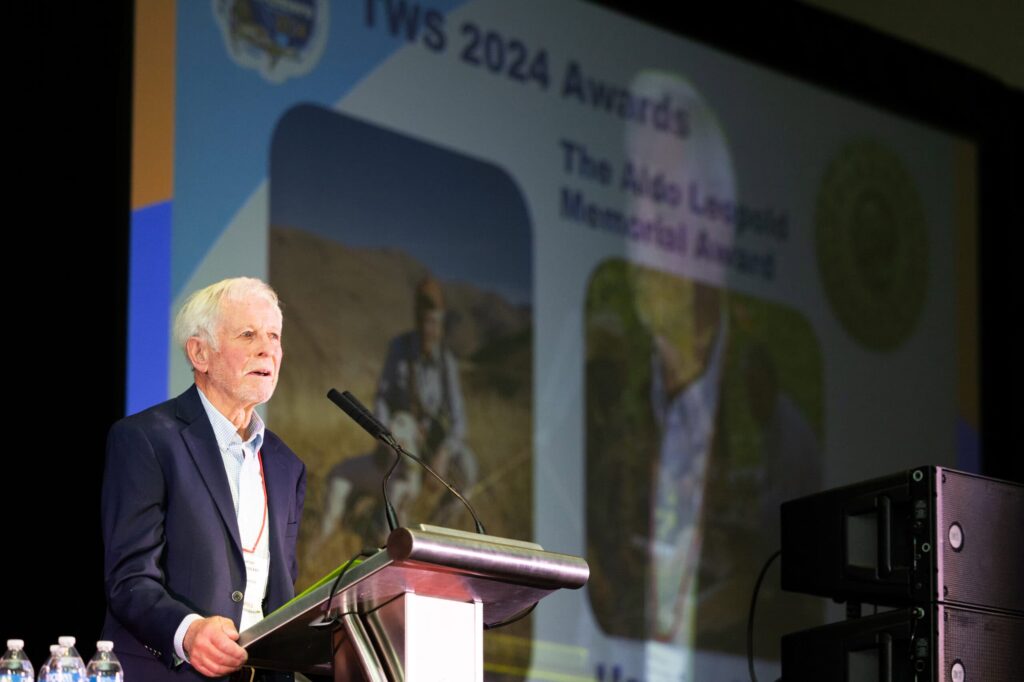
Although researchers have uncovered numerous important findings in wilderness areas, Hornocker argues that they are underutilized in part due to their lack of prioritization by federal law. “Wildlife is a critical factor, yet we have seen little attention paid to associated wildlife within officially designated areas,” he said. “These huge areas with their wealth of diverse wildlife could be likened to a modern, multimillion-dollar unused chemistry laboratory.”
In calling for solutions, Hornocker highlighted the Wilderness Act and Wilderness Preservation System as tools that can be used to elevate wilderness areas to the level they need to be to continue to support wildlife research and protection. Hornocker called for an amendment to the Wilderness Act that would assign high priority to wildlife in wilderness areas—the original language of the act only mentions wildlife once.
He also mentioned the difference in priorities among the U.S. Forest Service, the Bureau of Land Management, the National Park Service and the U.S. Fish and Wildlife Service, who administer different wilderness areas. “Each of these agencies has its legal responsibilities. Each is subject to economic and political constraints and realities. And each is steeped in a different strong, traditional philosophy,” he said. “Therefore, no agency is able, or as yet willing, to support the kind of long-term, deep-digging, basic research that is so sorely needed.”
He also called for continued support for long-term basic research from universities and federal granting organizations like the National Science Foundation so that researchers can spend their valuable time on their research—especially basic research that can be used to help support species before they become extinct.
He also pointed out that the role of wildlife biologists is not in simply protecting remnant species once they have been whittled away by anthropogenic change—but in preventing species from becoming endangered in the first place. “Leopold’s Wilderness Laboratories offer beautiful opportunities to accomplish this, but we must provide the framework in which it can be done,” he said.
“Our profession is blessed with numerous examples of glorious hindsight,” Hornocker said. “As the human population grows, as wilderness outside officially designated wilderness diminishes, we should certainly be blessed with more examples.”