


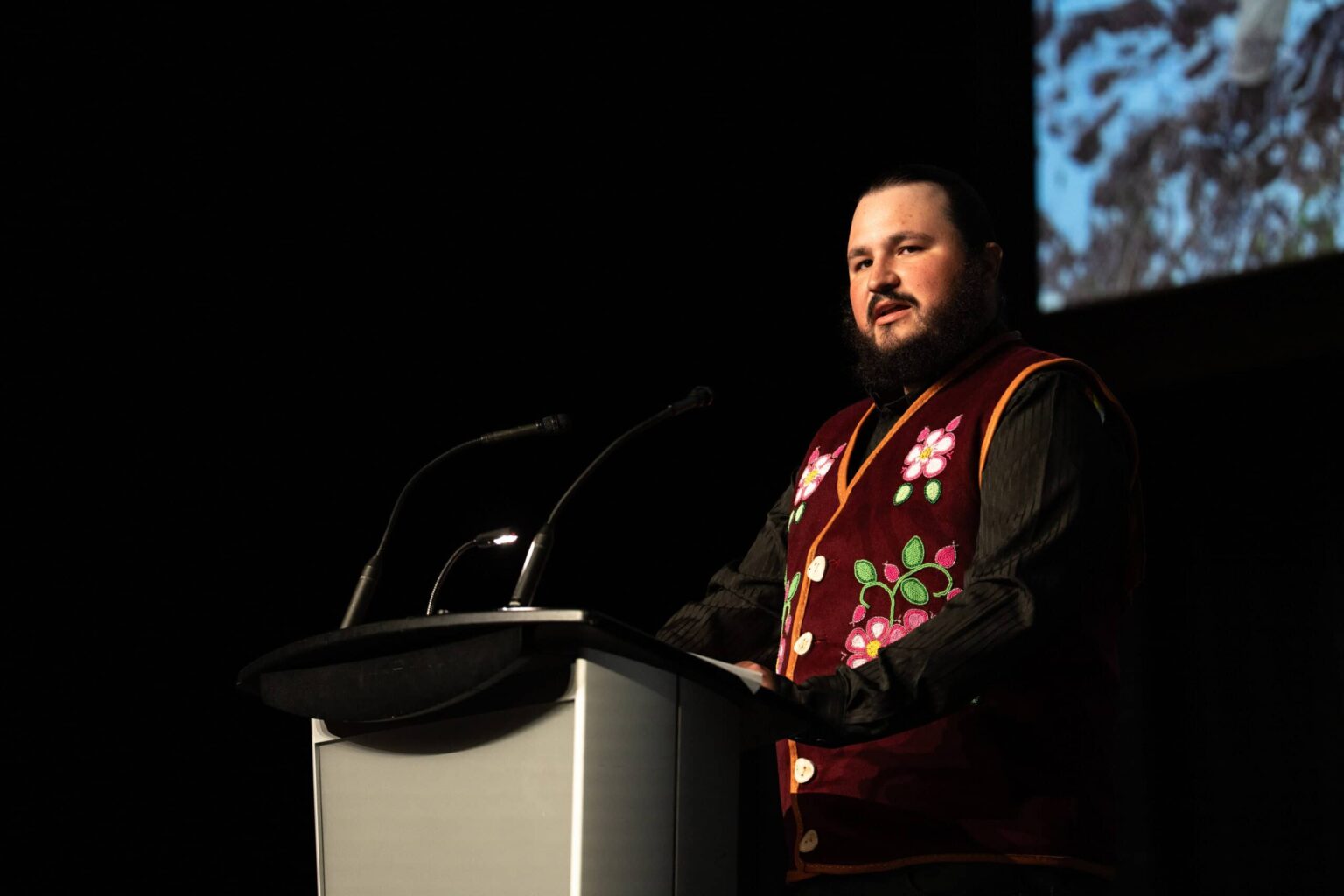
The braiding of Indigenous knowledge with Western science can improve the outcomes and success of wildlife management across the continent.
“Sometimes we get bogged down in the path and the perspectives,” said Allyson Menzies, an assistant professor in biological sciences at the University of Calgary, during the plenary presentation at The Wildlife Society’s 32nd Annual Conference in Edmonton, Alberta. But, “we gain leverage when we work together.”
To kick off the plenary, TWS CEO Ed Arnett said that defending the integrity of wildlife science and Indigenous knowledge is a “cornerstone” of wildlife management. “We are bigger and better than the politics that sometimes drive us,” he said.
Francis Whiskeyjack, a Saddle Lake Cree elder, asked attendees to join him in a Cree prayer—“The Way of the Spirit”—as a traditional invocation before the rest of the talks.
Menzies, who is of mixed Métis and settler ancestry, then talked about her work with moose (Alces alces) in Treaty 2 territory in southern Manitoba. “I didn’t necessarily choose to study moose,” she said. “I’d say that moose chose me.”
While moose used to be more abundant in the area, the species has become rarer over Menzies’ lifetime. While the Métis used to hunt moose in the area, and it was a common staple of her diet, Menzies said that she rarely eats the large ungulate anymore.
This shift from relative abundance to scarcity has led to conflict over harvesting rights between Métis and other First Nations, as well as Western scientists who dispute the best way to manage the population. “We’re all left fighting for crumbs in a world full of scarcity right now,” she said.
But by working across more systems of knowledge—both Western science and Indigenous—stakeholders may find better ways to improve the management of the species. “Conflict happens when values clash,” she said. Meanwhile, “populations continue declining while we argue over what decisions we should be making.”

At the end of the day, all stakeholders want the same thing, though—healthy moose for the future. This common ground should be the focus of shared efforts, she said.
In her talk, Julie Thorstenson, executive director of the Native American Fish and Wildlife Society, spoke about the braid being a “significant symbol” in many Indigenous cultures. It’s present in basket weaving, hairstyles, sweetgrass braiding and even the umbilical cord.
She stressed the importance of meaningful collaborations in wildlife management between Indigenous people and Western scientists—bad collaborations can sometimes be just as bad as no collaboration at all. This is especially true when organizations or scientists look to partner with Indigenous groups to push their agenda rather than really collaborate. In these unsuccessful collaborations, the groups often just speak instead of listening.
Building good working relationships takes time to build trust. “Communication is literally the make or break of partnerships,” said Thorstenson, Lakota on her maternal side.

Remington Bracher, a Nêhiyaw (Cree) member of Muskoday First Nation, spoke about the struggle it takes to reconnect with cultural roots under the legacy of a cultural system that tried for so long to oppress Indigenous ways of life. Many people with Indigenous heritage struggle to reconnect with their identity due to the “extirpation of culture” caused by the residential school systems in North America.
This extirpation of culture was combined with the extirpation in many areas of buffalo (Bison bison), a cornerstone of various Indigenous cultures in western North America. But Indigenous people are working hard to restore buffalo to the landscape while restoring cultural identity into society. “For many of us, reclaiming and reliving that identity is an act of resistance in itself,” said Bracher, a wildlife biologist, hunter, angler, trapper and graduate student at the University of British Columbia Okanagan.
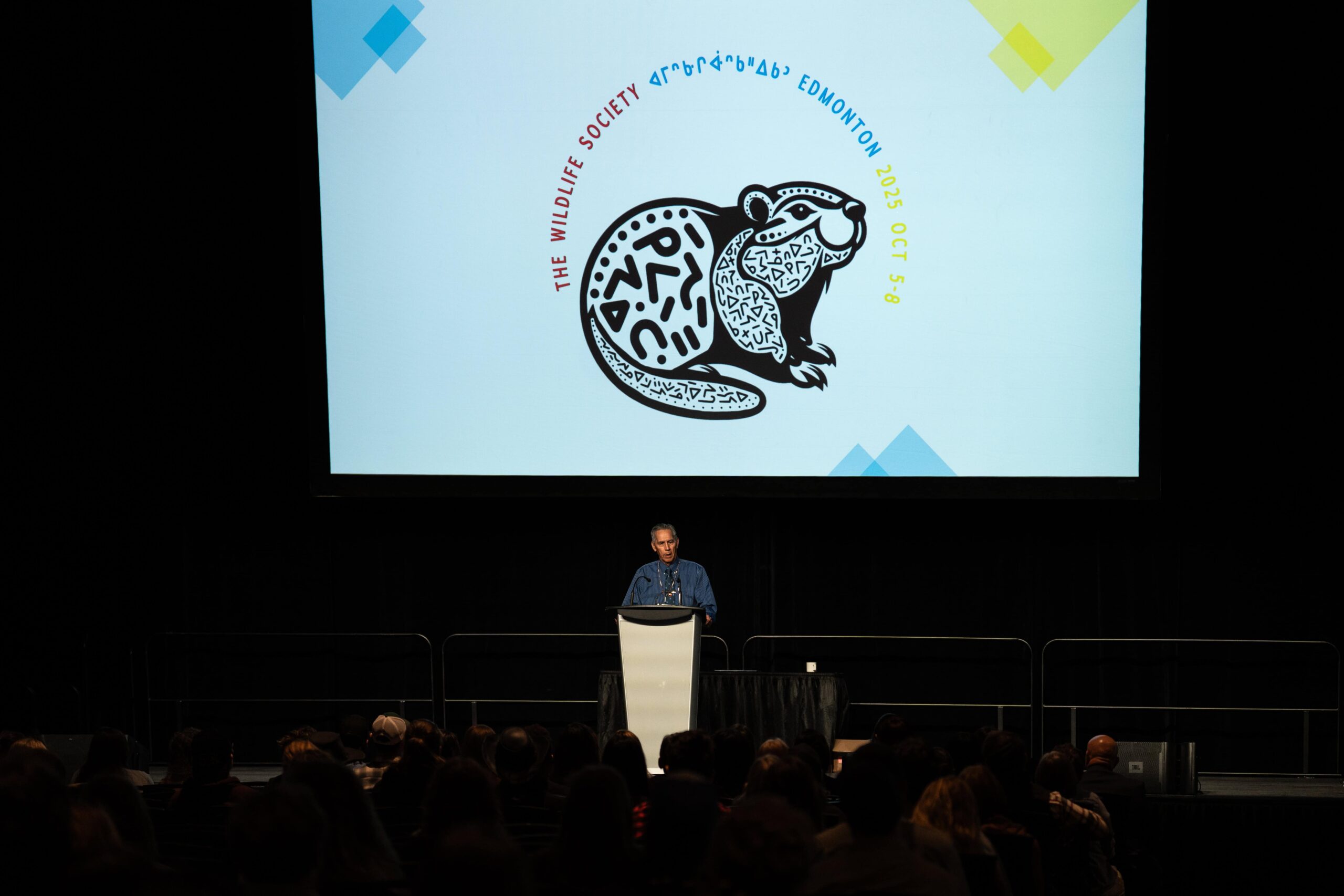
He echoed the problems caused by the failure of Western scientists to take Indigenous knowledge seriously. But he lauded efforts that TWS made to include Métis dancers to kick off the keynote event on Sunday, Oct. 5; the use of Indigenous art on the conference logo; and inviting elders like Whiskeyjack to invoke an Indigenous prayer as the “meaningful acceptance” of Indigenous culture and knowledge.
To wrap up the plenary speech, Luis Antonio Tarango Arámbula, president of the Mexico Chapter of TWS and a professor at the Colegio de Postgraduados, Campus San Luis Potosí, spoke about the great diversity of his country’s wildlife. Despite this richness, he noted that there was a mismatch in investment between the richer central and northern regions of Mexico versus the poorer south. This mismatch is unfortunately matched by the proportion of Indigenous land in the country, whereby the south has a much higher Indigenous demographic than the north.

However, he pointed to the example of an Indigenous-led project spearheading the conservation of the uninhabited nature reserve home to an endemic subspecies of mule deer (Odocoileus hemionus sheldoni) on Tiburon Island in the Gulf of California. The Seri people of the area administer the island, managing the hunting of introduced bighorn sheep (Ovis canadensis) there in partnership with the Mexican federal government.
Article by The Wildlife Society