
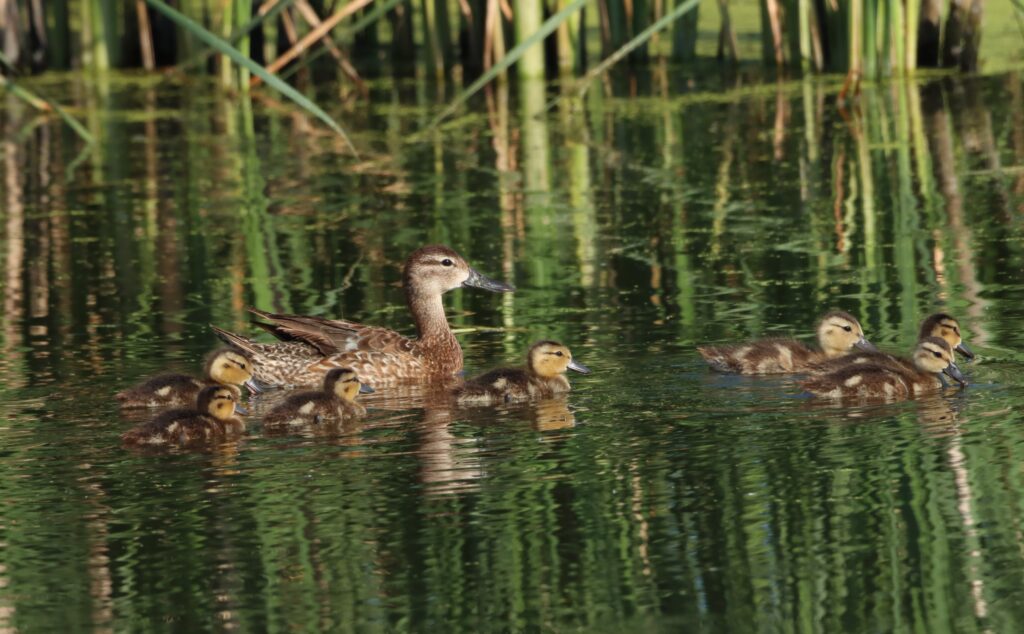
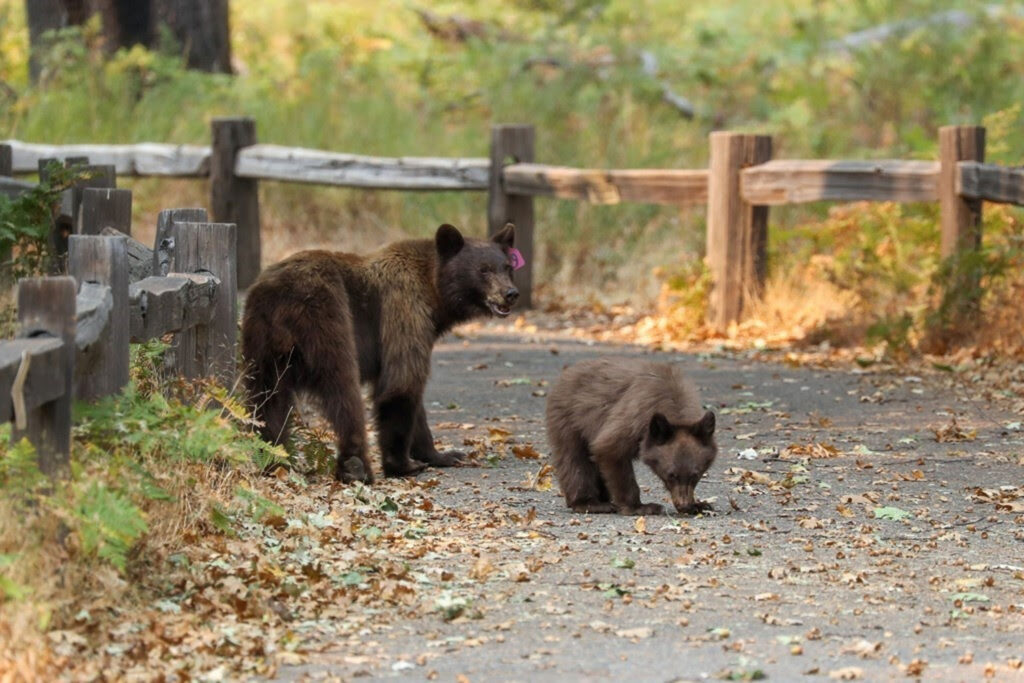
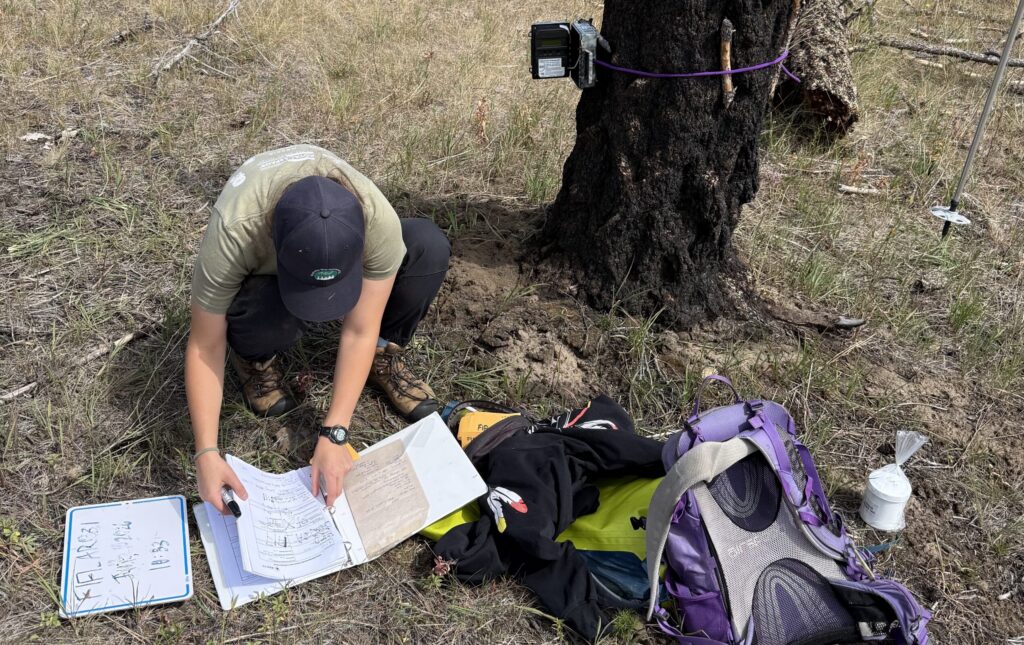
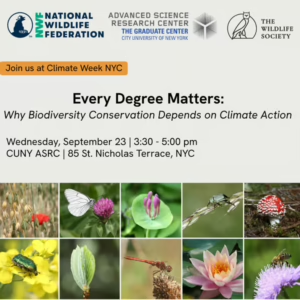
Rapid biodiversity loss and accelerating climate change are connected crises. Under the worst case scenarios for greenhouse gas emissions in the 21st century, up to 30 percent of wildlife species could go extinct. Weather and climate influence almost every aspect of animal life and behavior, from reproduction and life cycles to species interactions and distribution. Yet all too often, wildlife conservation and climate action have been treated as separate disciplines, with separate solutions.
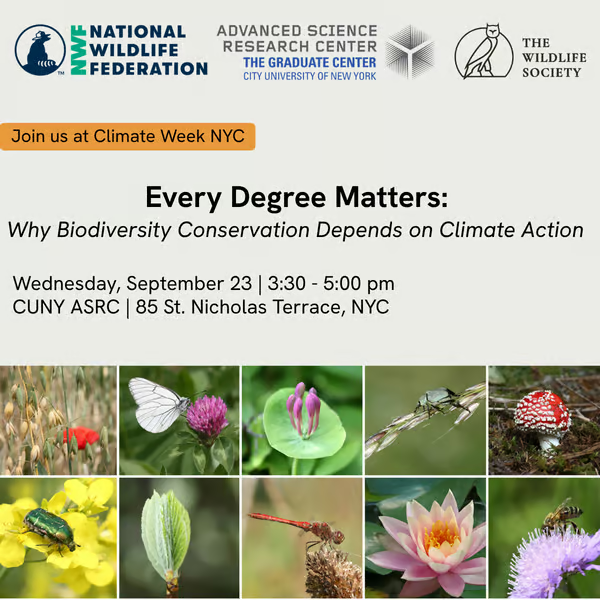
Join the National Wildlife Federation, The Wildlife Society, and CUNY’s Advanced Science Research Center Environmental Science Initiative to discuss the urgency of climate action for conservation – what the latest science says about the intersection between climate change and biodiversity, and what solutions are available to both help wildlife adapt to climate change, and to mitigate future effects, and why every fraction of a degree matters for species.
Speakers include:
Dr. Peter Groffman, Professor, Environmental Sciences Initiative, CUNY ASRC
Peter’s research focuses on terrestrial biogeochemistry with a focus on nitrogen dynamics, especially gases. Projects have ranged across multiple scales from microbial/molecular scale analyses to field/ecosystem scale measurement of fluxes using geochemical and isotope approaches, to landscape and regional scale work using remote sensing, geographic information systems and simulation models. Much of his research is focused at two National Science Foundation funded Long Term Ecological Research sites; Hubbard Brook, New Hampshire and Baltimore, MD. During his career, he has authored over 300 publications, with more than 85 as primary author. Peter was a Convening Lead Author for the 2013 U.S. National Climate Assessment Chapter on Ecosystems, Biodiversity and Ecosystem Services and a lead author for the Second (Wetlands) and Third (North America) Assessment Reports of the Intergovernmental Program on Climate Change (IPCC).
Dr. Diane Pataki, Chief Scientist and Vice President for Science, National Wildlife Federation
Trained as an ecologist, Diane’s work has spanned the impacts of climate change on ecosystems, the role of human and biological processes in air and water resources, and interactions between urbanization, landscape management, and biodiversity. Her recent projects have been focused on nature-based solutions for sustainable cities and communities. Diane has a B.A. in environmental science from Barnard College and an M.S. and Ph.D. in ecology from Duke University. She is the former Director of the Arizona State University (ASU) School of Sustainability, the founder and former Chief Strategy Officer of the ASU-led and National Science Foundation-supported Southwest Sustainability Innovation Engine (SWSIE), and a Foundation Professor in the ASU School of Sustainability. She has also served as the Associate Vice President for Research, Associate Dean, and Professor of Biology at the University of Utah, and the founding director of the University of California, Irvine Center for Environmental Biology and the Steele-Burnand Anza Borrego Desert Research Center.
Dr. Amanda Rodewald, Garvin Professor and Senior Director of Center for Avian Population Studies, Natural Resources and the Environment Section, Cornell University
Amanda is the Garvin Professor and Senior Director of the Center for Avian Population Studies (CAPS) at the Cornell Lab of Ornithology, a Faculty Director with the Cornell Atkinson Center for Sustainability, and a faculty member in the Department of Natural Resources and the Environment at Cornell University. Prior to joining Cornell in 2013, she spent 13 years as a professor at Ohio State University. Since 2000, she has published >190 scientific papers, an Ornithology textbook, 10 book chapters, and >75 popular articles and commentaries, and has served as the primary advisor for 10 post-docs, 20 Ph.D. students, and 19 M.S. students. Amanda is a fellow of the American Association for the Advancement of Science (AAAS) and the American Ornithological Society, from which she received the William Brewster Award in 2022. She serves on the Science Advisory Board of the U.S. Environmental Protection Agency, has testified before Congress about conservation issues, and is regularly featured in radio programs, short films, podcasts, and news articles.
Sarah Grimké Aucoin, Chief of Education & Wildlife, NYC Parks
Sarah’s tenure in NYC Parks spans 25 years of innovation and programmatic expansion in the areas of environmental education, outdoor adventure, active conservation and wildlife management. As Chief of Education & Wildlife, she oversees the Urban Park Rangers, Teaching & Learning Support, and the Wildlife Unit, whose mission is to promote coexistence between people and urban wildlife in New York city. As an informed resource for citizens and policymakers, the Wildlife Unit serves as an ambassador for New York City’s diverse wildlife communities and seeks to create a future where wildlife is a familiar, understood, and indispensable part of New York City’s urban landscape. She has a rich and accomplished academic background that includes a Bachelor of Arts degree in Biology from the University of California – Santa Cruz, and a Master of Science degree in Ecology from the University of Louisiana. She is an accomplished writer and researcher, having written and published a number of peer-reviewed monographs on subjects including the behavior of larval amphibians, the philosophy of declining amphibian populations, and the sexual bias in studies of animal behavior. Sarah has been a member of The Wildlife Society and the Urban Wildlife Working Group since 2015, and a board member of the Urban Wildlife Working Group since 2018.