

Commercial anglers don’t want to catch turtles, and reducing the impact of these interactions can help turtles.
For the commercial angler, catching a 500-pound turtle can mean lost time fishing and the need to remove hooks and lines from an animal in potentially rough seas. For sea turtles, the hook and fishing line can lead to serious injury or death. It can be a lose-lose situation.
In 2004, a portion of the Atlantic pelagic longline fishery in the Northeast Distant Waters region exceeded the number of sea turtle interactions allowed, triggering fishery closure. It represented the worst-case scenario for both conservation outcomes and fishery operations.
“Their livelihood depends on being able to go out and fish,” said Lesley Stokes, a research fishery biologist at the National Oceanic and Atmospheric Administration’s Southeast Fisheries Science Center. “Our access to high-quality seafood relies on us keeping the fisheries open by minimizing protected species capture.”
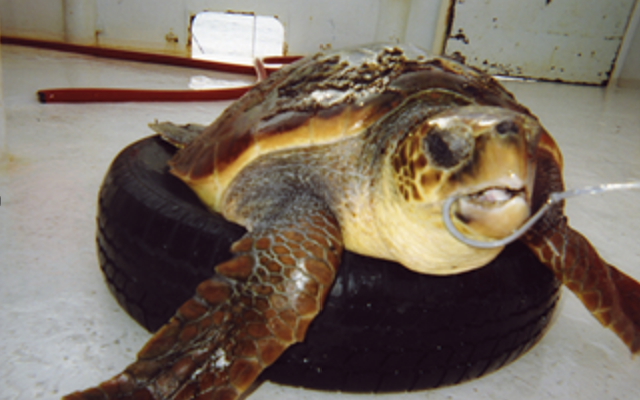
Since then, scientists, fishery observers and commercial fishermen have worked together to try to prevent and mitigate harm to leatherback (Dermochelys coriacea) and loggerhead (Caretta caretta) sea turtles caught as bycatch in the pelagic longline fleet throughout the Atlantic and Gulf of America. Although hooks may appear more concerning, the line presents a more serious risk of injury and mortality.
“Cutting the line as close to the hook as possible is essential,” said Stokes, who along with her agency colleagues and gear specialists, has worked collaboratively with fishermen to develop tools to remove hooks and reduce the amount of line left on the turtles when released.
Scientists and anglers collaboratively developed protocols based on some very simple tools: a seatbelt cutter that anglers can mount on a handle to extend overboard to cut line and a tire that an angler can use to hold a turtle still during gear removal. They adapted some of the tools from items that fishermen and fisheries observers already had on the ship.
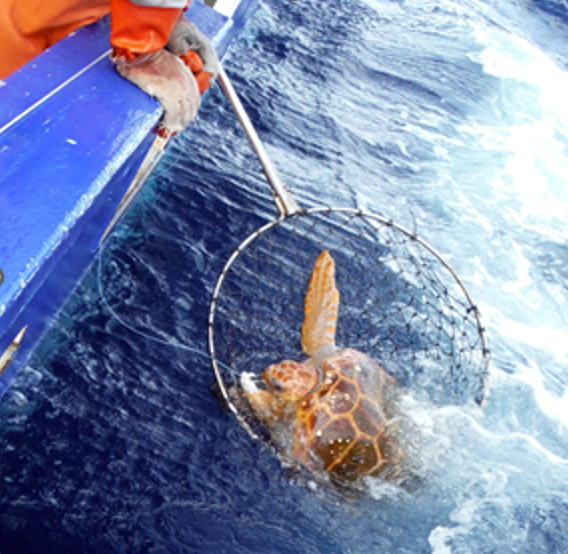
“The goal was to come up with practical solutions,” Stokes said, adding that they wanted solutions that kept anglers and turtles safe.
These efforts ultimately led to the implementation of mandatory sea turtle handling and release requirements across the fishery in the early-2000s. A new study published in Aquatic Conservation: Marine and Freshwater Ecosystems assessed the results of decades of work, finding that close collaboration were improving the outlook for incidentally captured sea turtles.
Measuring success
Fisheries observers are the eyes and ears on ships, collecting data on fishery interactions with protected species. In the study, Stokes and her collaborators used observer documentation of sea turtle interaction details, including hooking location, entanglement, handling during boating, gear removal and amount and location of gear remaining at release, to examine interactions with the pelagic longline fleet from 2014 to 2023.
“Fisheries observers data collection helped us to track performance against the expected mortality rates,” said Stokes.
Despite a 2020 Biological Opinion acknowledging that the U.S. pelagic longline fishery has not met targeted post-release mortality rates, this study’s findings revealed encouraging trends.
Commercial vessels were well-equipped with required release tools, and crews were generally proficient in safe handling techniques, routinely attempting to remove gear.
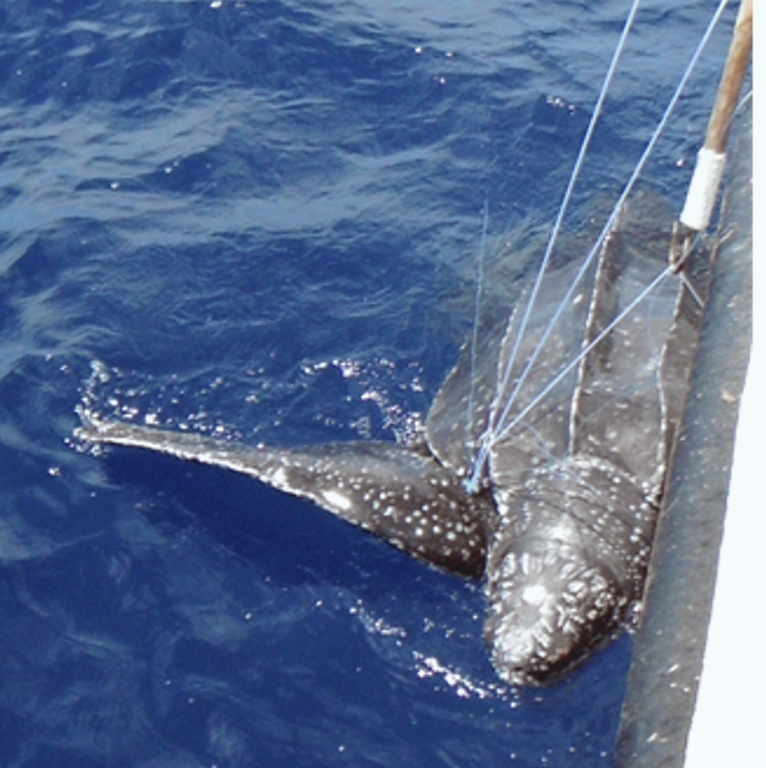
For loggerhead turtles, hook location impacted removal success. Turtles externally hooked on their limbs or shell were far more likely to have all gear removed than turtles hooked inside their mouth. For leatherback turtles, interactions were more regionally dependent, and those encountered in the Northeast Distant region waters had significantly higher probabilities of complete line removal than those encountered in the Gulf of America.
“To see the Northeast Distant Waters region shine in terms of maximizing gear removal for both species was really gratifying,” Stokes said.
The study’s findings emphasized that co-developing solutions with commercial anglers fostered trust and goodwill, thereby strengthening industry adoption of conservation practices.
Article by Kaylyn Zipp