

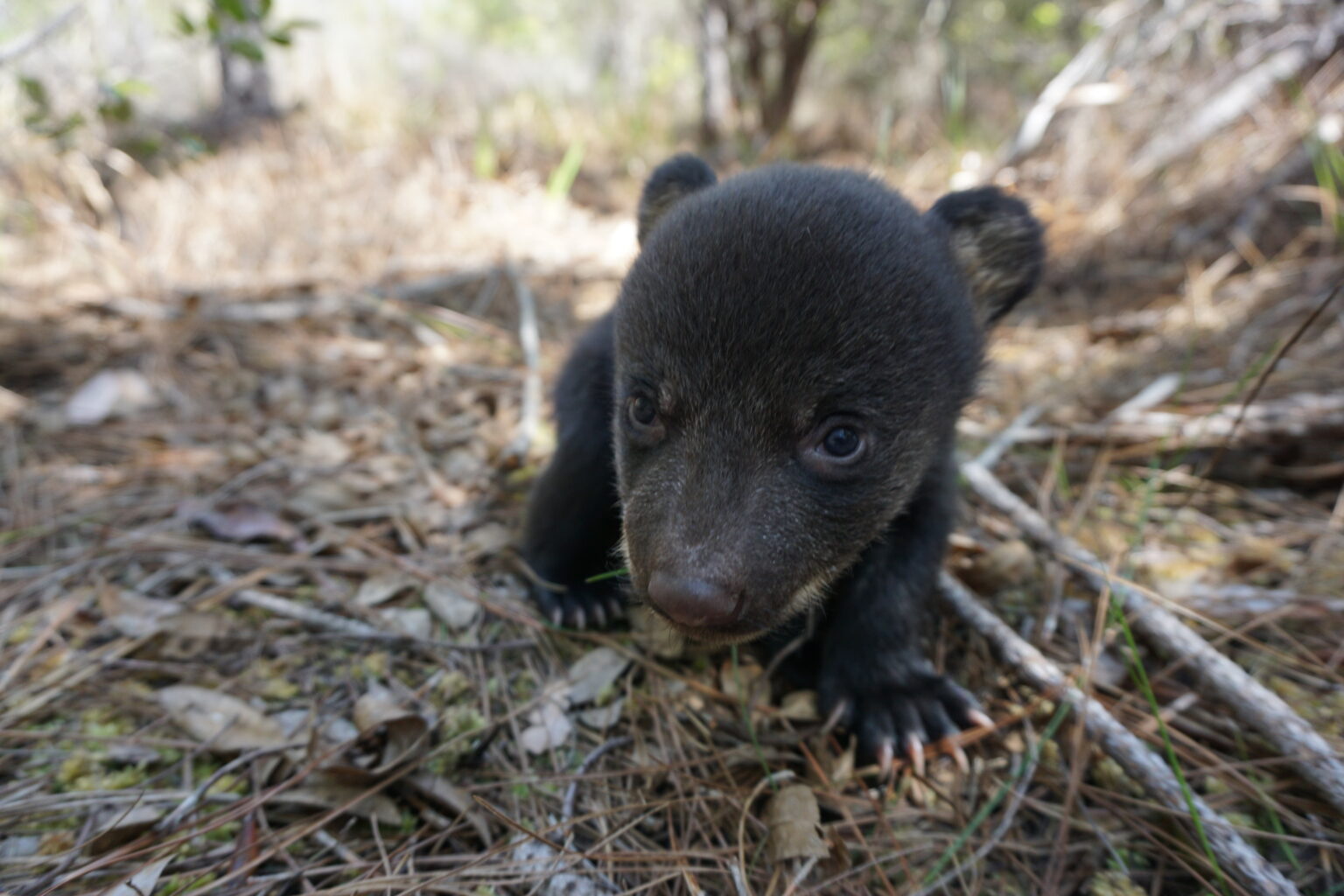
Ample habitat and legal protection have helped a subpopulation of bears thrive in Florida’s panhandle.
“We have a well-studied example now of how a bear subpopulation can come back from the brink of extinction if they’re given habitat and legal protections,” said TWS member Darcy Doran-Myers, lead author on a recent study published in The Journal of Wildlife Management studying the Apalachicola subpopulation of the Florida black bear (Ursus americanus floridanus).
Doran-Myers is a doctoral candidate at the University of Florida who studies how we use expert opinion in conservation decision making, using bears as her study system. From 2018-2022, she worked for the Florida Fish and Wildlife Commission (FWC) as the assistant Florida black bear research coordinator. She helped analyze and publish research that teased out why one population of black bears in the state is growing so rapidly.
“I think a lot of people would read the study’s headline and think, ‘Oh, bears must be doing fine across the entire state,’” said Doran-Myers. “But it’s more nuanced than that.”
Bears back on the brink
The Florida black bear has a fraught history. Once common across the state, populations bottomed out by the 1970s, when they numbered only in the hundreds. If a population gets below 200 reproductively active bears, there can be serious consequences. “Below that level, you start to see genetic issues arise,” she said. Problems could include things like missing toes, tails and testicles, and other genetic issues that aren’t visible to the naked eye.
The Florida black bear was added to the state’s list of threatened and endangered species in 1974 as part of a cultural and political push that led to the founding of the U.S. Environmental Protection Agency. Doran-Myers said conservationists lobbied to protect more land in the state around the time of listing. The agency then stopped legal hunting of black bears in 1994.
Some 95% of Florida black bear diet is made up of insects and vegetation. Doran-Myers said they need space away from people, roads and trash that would pull their attention away from their natural foraging behaviors. Land conservation measures helped the subspecies recover significantly over the years. In 2012, the Florida black bear was removed from the state threatened species list. “The best data that we have show that both bears and humans are expanding in Florida,” said Doran-Myers. Somewhere around 1,000 people move to Florida every day on average, but researchers don’t know as much about how bear populations are growing.
Today, there are around 4,000 black bears in the state. Black bears in Florida are separated into seven distinct subpopulations, each with different conservation realities. Florida’s deforestation and development rate is extreme, and only makes it more challenging to connect the subpopulations into one large self-sustaining population. One of the larger subpopulations of the Florida black bear is the Apalachicola subpopulation on the Florida panhandle.
Researchers from FWC wanted to learn more about the Apalachicola’s population dynamics to better anticipate the needs of the bears and humans to prevent increases in human-wildlife conflict. They also wanted to determine what factors were successful and could be applied to other subpopulations.
To hibernate or not to hibernate
In order to figure out the Apalachicola bear population’s growth rate, researchers needed to have a better grasp of the survival of different age classes of bears, including cubs. So, they attached GPS collars to the Apalachicola’s newest bear residents from 2016 to 2019.

Working with bears looks a little different in Florida compared to other parts of the world. Unlike more northern populations of black bears, those in Florida don’t fully hibernate in winter—it doesn’t get cold enough.
Instead, they typically sleep with their cubs in above-ground nests. Using GPS collars, researchers from FWC tracked the females to their dens. The bears woke up drowsy and confused, running away from their dens, so the researchers didn’t have to sedate the bears in order to collar the cubs. “It’s sort of like how a bird flushes off a nest,” Doran-Myers said, although it’s a bird that with two-inch claws.
The Florida woods are dense, full of foliage, and you can’t see very far, Doran-Myers said. In case a bear was abnormally territorial, which didn’t often happen with this subspecies, one member of the team stood as a lookout, peering through the woods to make sure the bear didn’t immediately come back. On average, though, it took seven hours for the bears to return to their cubs.
What’s good for the bears
By analyzing the data, the researchers found that the Apalachicola subpopulation was growing at a rate of nearly 12% annually, largely driven by high rates of adult female and cub survival. Adult female bears had a survival rate of around 92%, whereas cub survival was around 65.5% each year. Compared to other areas of the country, adult female survival is around 82% and cub survival was around 65%. “When you compound that year after year, that 10% difference in adult female survival turns out to be significant,” Doran-Myers said.
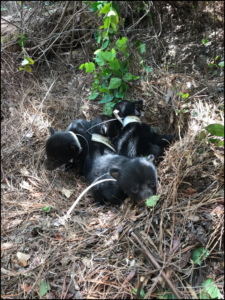
The researchers found that habitat and legal protections helped this subpopulation rebound. Doran-Myers said that land on the panhandle that was conserved decades ago has been protected long enough to start seeing dividends in the bear population. And legal protections, like preventing people from poaching bears, has led to high adult female survival.
“The more resources the mom has, the better care she can take care of her cubs,” Doran-Myers said. Space is also an issue when it comes to establishing and maintaining a safe territory to raise her cubs, as the biggest cause of death for bear cubs is infanticide from male bears.
Doran-Myers said that on one hand, the recovery and rapid growth of the Apalachicola subpopulation is in line with the conservation objectives laid out in the Florida Black Bear Management Plan. As the number of bears increases, the males will disperse and look for new territories and mates, connecting the subpopulations and helping to save the genetics of the smaller populations. But on the other hand, the expansion of bear populations alongside growing human development may lead to more human-bear interactions, including vehicle collisions. Bear conflict has actually been declining since 2013, Doran-Myers said. Continued public education and equipment like bearproof trash cans can help increase human-bear coexistence.
The state of Apalachicola bears—and all subpopulations—is particularly important since the FWC opened up bear hunting via a lottery system for the first time in a decade. A bear advocacy group filed a lawsuit requesting a temporary injunction on the December 2025 hunt, but it was ultimately rejected by a judge in late November. The group’s broader lawsuit alleging that the Florida bear hunt lacks scientific basis is still pending. Doran-Myers served as an expert witness in the lawsuit, calling hunting in Apalachicola the “most defensible,” as it is one of the healthiest of the seven subpopulations.
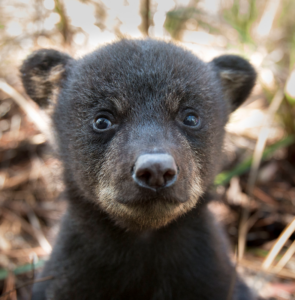
But the state of the Apalachicola subpopulation isn’t representative of all bears in Florida. The agency also gave out permits for the Osceola subpopulation, which is much smaller. Preliminary data released by the agency after they approved the hunt but before the hunt occurred revealed the Osceola subpopulation has shrunk by two-thirds in the past decade.
Doran-Myers said that moving forward, it’s important for the agency to incorporate up-to-date population data into harvest quotas and conservation decision-making.
FWC did not respond directly to questions about the bear harvest quotas, instead referring to the organization’s webpage.
Article by Olivia Milloway