


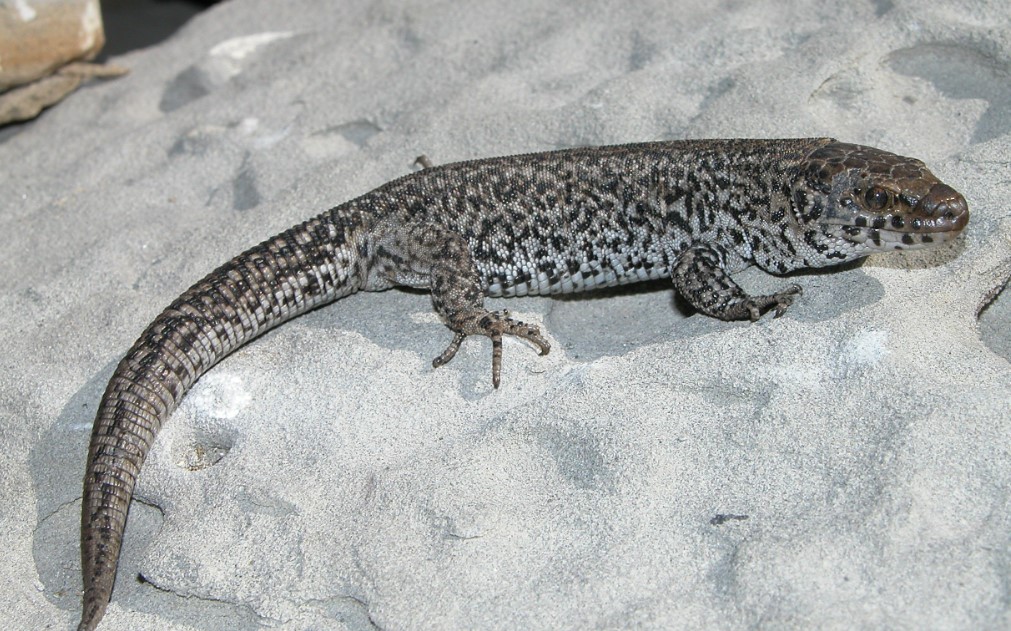
Wildlife managers are cautiously optimistic about the ongoing recovery of a formerly threatened lizard, though invasive ants continue to create problems for the reptiles.
“It’s also encouraging that in the face of the kind of drought conditions that we had during the monitoring period, populations were still resilient,” said Charles Drost, a research zoologist at the U.S. Geological Survey’s Southwest Biology Center.
The island night lizard (Xantusia riversiana) is only found on three of the Channel Islands of California. The U.S. Fish and Wildlife Service listed the species as threatened in 1977 under the U.S. Endangered Species Act due mostly to habitat loss and degradation on the islands and the encroachment of invasive species like feral cats (Felis catus). Due to widespread efforts to control invasive plants and wildlife and restore native habitat, the species recovered, and authorities delisted the lizards in 2014.
U.S. Geological Survey scientists have been monitoring the species ever since. In a study published recently in the Journal of Wildlife Management, they analyzed seven years of recent survey results, comparing them to earlier records going back to the 1990s.
According to mark-recapture studies, some of the same lizards have been with Drost since he began studying the species. “We don’t say as much in the article, but we’ve had recaptures of lizards that are at least 25 years old, and they probably live longer than that,” he said. “As a small species, night lizards are incredibly long-lived.”
How to catch a night lizard
The survey work involved researchers walking transects and flipping over artificial cover—or pieces of plywood—on San Nicolas Island. “These lizards are strongly oriented toward staying under cover,” Drost said. The team set out early in the morning when cooler weather ensured the lizards were slow enough to catch. The work had its perils, though. “You can count on coming back with multiple cactus spines after a field trip,” Drost said.
The team marked each captured individual by a unique set of toe clippings so they could identify them once again in future surveys.
For recaptured individuals, the team recorded growth rates and noted any reproduction or population losses.
Analysis revealed that the population of night lizards as a whole was “remarkably stable” over San Nicolas, despite population dips during the droughts the area has experienced over the past quarter century. “They are very sedentary. They have a very low metabolic rate—they can survive on limited food resources,” Drost said.
The only apparent cause for concern now is another invasive species that may be harder to control than feral goats (Capra hircus) and cats: Argentine ants (Linepithema humile). Some evidence reveals these aggressive insects, which also like the kind of cover provided by plywood boards, can kill lizards outright, but usually, they just cause enough of a nuisance to push them to find a new home range. This effect seems fairly long-term—Drost said that even when the ants are gone, lizards don’t typically move back to these areas for some time.
While some evidence shows that other lizard species will return to areas after the ants are gone, long-lived night lizards may hold onto their bad memories of these places. The USGS continues to monitor the effects of both ants and drought on night lizards.
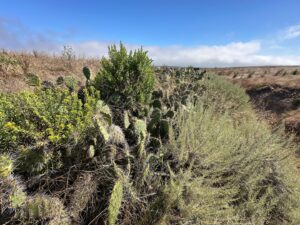
But overall, the lizards continue on a long-term trajectory of recovery ever since managers curbed the overgrazing of feral goats in past decades. The U.S. Navy continues to restore vegetation on San Nicolas Island, including plants like the prickly pear cactus that provide prime night lizard habitat. “They’ve been isolated for tens of thousands—hundreds of thousands—of years, potentially,” Drost said.
This article features peer-reviewed research originally slated for publication in the U.S. Fish and Wildlife Service’s now defunded Journal of Fish and Wildlife Management. The Wildlife Society has picked up these “orphaned” studies, publishing them in a special section of the Journal of Wildlife Management’s November Issue. Individual online access to all TWS journal articles is a benefit of membership. Join TWS now to read the latest in wildlife research.
Article by Joshua Rapp Learn