

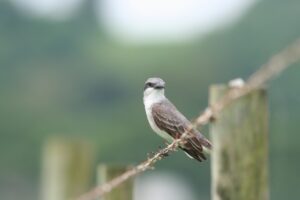
The forest was a mess of vines, fallen trees and dead leaves. It was cooler and more humid than the surrounding fields, with spotlights of sunlight shining down between gaps in the canopy. Each plant in this patch of forest within Hacienda La Esperanza nature preserve, which sits about 50 miles west of San Juan, struggled to outcompete the chaos. Fallen flores de maga (Thespesia grandiflora), the island’s national flower, littered the floor as a gray kingbird (Tyrannus dominicensis) called somewhere out of view, and a Puerto Rican woodpecker (Melanerpes portoricensis) bored into the hard bark of a nearby tree. To the untrained eye, the forest plot looks natural: a many-layered forest with a healthy understory, flush with birds and other wildlife. But in reality, it’s a baby forest—only six years old.
The few short years have been so successful that Alcides Morales-Pérez, the manager of the Hacienda La Esperanza nature reserve, backed off from management and let nature take its course. “This is the goal of every restoration site,” Morales-Pérez said.
Sugar and tobacco plantations destroyed 94% of Puerto Rico’s native forests in centuries past, causing drastic consequences for the island’s native flora and fauna. In this three-part series, we’ll explore the island’s endemic forests, birds and one very special species of toad and learn how, despite this history of colonial exploitation, biologists and conservationists like Morales are working to help them thrive.
Hope estate
Hacienda la Esperanza is a 2,200-acre nature preserve nestled on Puerto Rico’s northern coast. Once a busy 19th-century sugar cane hacienda, or plantation, the preserve’s land was utterly transformed to fit the needs of growing, processing and transporting sugar cane. European colonizers burned the forest and drained the wetlands. “All this land was completely deforested,” Morales said. “There was a lot of habitat destruction and devastation.”
In 1975, the Puerto Rican conservation trust, Para la Naturaleza, or “For Nature,” bought the land. During an era where luxury hotel and marina developers pressured landowners to sell, the state designated Hacienda la Esperanza as a nature reserve. It’s home to wetlands, coastal forests and important archeological sites from the Taíno, the Indigenous people of Puerto Rico and the Greater Antilles. It also contains some of Puerto Rico’s precious karst forest, a type of forest that grows over limestone deposits that harbor the largest fresh-water aquifer and is crucial habitat for critically endangered species like the Puerto Rican crested toad (Peltophryne lemur).
The reserve exists within a sea of pastureland, and most of its area has undergone natural succession, what Morales describes as “nature taking its course.” When Morales started as the reserve manager in 2016, one of his main goals was to restore the function of the landscape through connecting patches of forest.
But the year after Morales started his new job, Hurricane Maria hit the Caribbean. The Category 5 storm caused massive destruction across the island, including erosion and habitat destruction, and killed thousands of people. “We saw how much damage was done, but also how vulnerable the land was due to lack of forest cover,” Morales said.
With funding from the National Fish and Wildlife Foundation, the reserve has planted more than 100 acres of forest, including mangrove swamps. The plantings can preserve the livelihood of nearby communities by helping with erosion and debris control in the post-Maria landscape, Morales said, as Hacienda la Esperanza is a floodplain that becomes inundated during storm surge. The trees help shore up the shoreline and diffuse some of the energy from storm surge so the water is less dangerous when it makes its way to communities.
“We wanted to make the landscape more resilient to change because there’s a lot of pressure on it—more hurricanes, more often,” he said. And the island’s endemic birds are in particular trouble.
Thinking like a bird
Morales started reforestation efforts at Hacienda La Esperanza in earnest after Hurricane Maria. At first, he was frustrated by how little information existed about reforestation in the Caribbean. Colonialism and industry had decimated Puerto Rico’s native forests before anyone could document them. By the 1940s, only 6% of the island had been spared from half a millennium of deforestation, and these older forests are mostly at high elevations where the mountains were too rugged for plantations. According to Puerto Rico’s Department of Natural and Environmental Resources, it was one of the most heavily deforested areas on the planet.
“I have no clue how this forest looked 100 years ago,” Morales said. But today’s climate, landscape and biodiversity mean that interactions aren’t the same as they used to be. In other words, “the right pieces” to restore Puerto Rico’s forests to their original states are missing, he said, so he’s more inclined to focus on functions like nutrient cycling and plant and animal interactions.
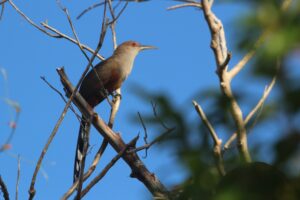
To address these problems, he thinks “like a bird.” Deforestation and habitat fragmentation negatively affect most of Puerto Rico’s endemic birds because they aren’t strong fliers. Living on an island with no mammalian predators, scientists think that birds were likely on their way to losing their ability to fly, like some species in New Zealand. As a result, many birds don’t like crossing big, open spaces. “The landscape is a sea of exotic pastures, and some birds are reluctant to cross that,” Morales said. One example is the Puerto Rican lizard cuckoo (Coccyzus vieilloti). It has rounded, small wings and behaves more like a squirrel, jumping up and down tree trunks in search of food.
To travel from one patch of karst forest to another, a bird would have to fly around 600 meters. But the coast is about two kilometers away—a long way if you’re bad at flying. Thinking of how he would move through the landscape if he were a bird, Morales began the long process of building a forest. He planted trees to fill gaps between separate patches and built long, thin corridors between forest patches that were farther apart. He also picked specific trees that would provide the most range of nutrients and resources to birds, especially since many birds rely on fleshy fruits.
These endemic species may be common on the island, but they aren’t present anywhere else. “By definition, an endemic bird is in danger of extinction,” Morales said. It takes only one devastating event, like a natural disaster or disease outbreak, to threaten the species. “You’ll lower your guard and all of a sudden they’re endangered,” Morales said. The best way to ensure population health, he said, is to “keep your common species common.” Migratory birds, necessarily stronger at flying, are less concerned about small-scale patch connectivity.
The bullfinch highway
By researching other islands in the Caribbean and taking years of his own notes and observations, Morales chose mostly fast-growing trees that could outcompete nonnative grasses, as well as species that encourage birds, bats and reptiles to come feed.
But there are other, slower-growing trees that are essential ingredients in the recipe of reforestation. One such tree is the Puerto Rican royal palm (Roystonea borinquena), a keystone species that blooms throughout the year. On the island, many birds starve in the wake of a hurricane. But while Puerto Rican royal palm leaves snap off during a big storm, their flowers and fruit persist. “Everyone goes to feed on a royal palm after a hurricane,” Morales said.
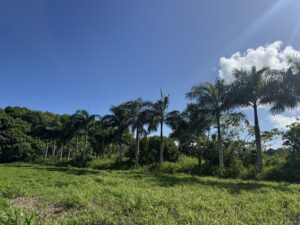
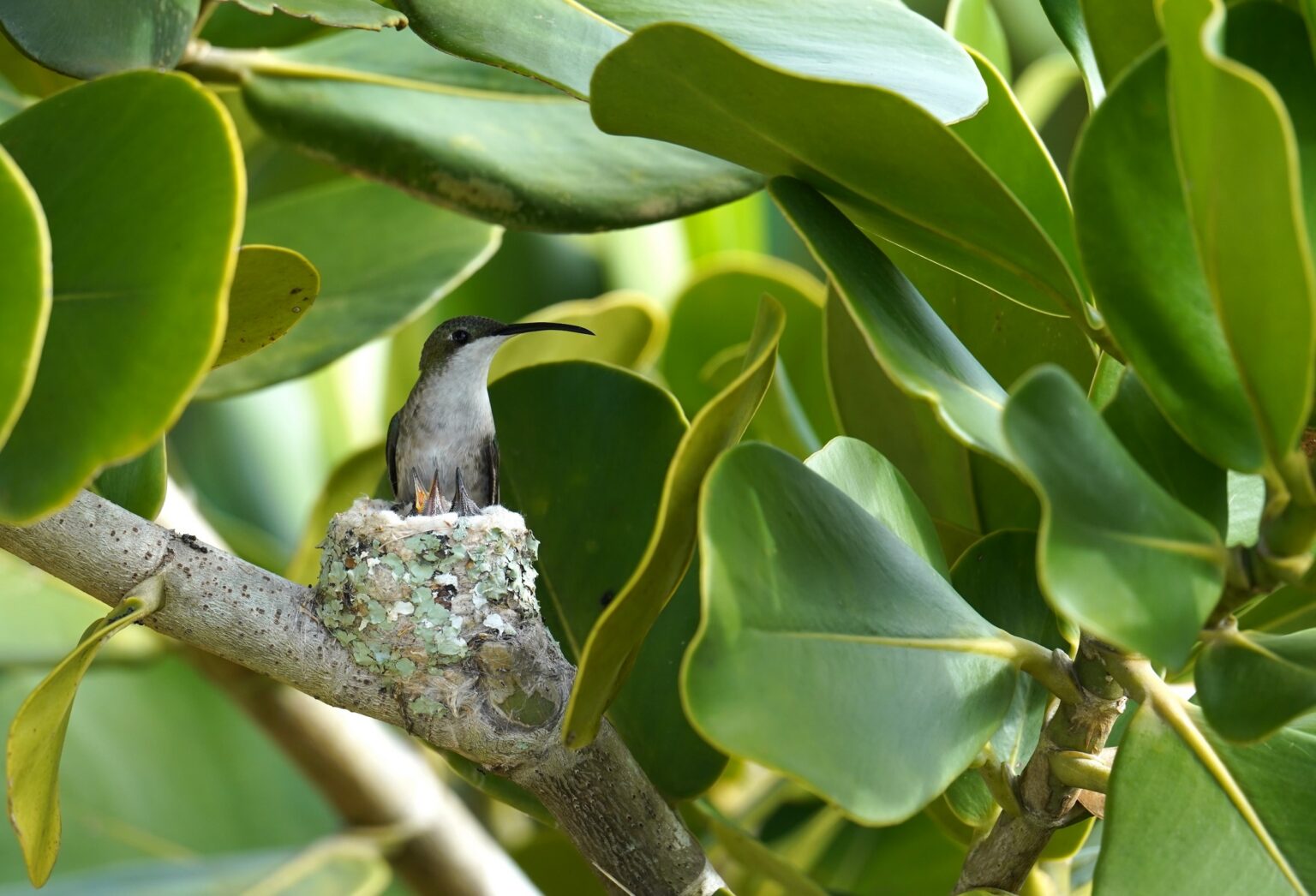
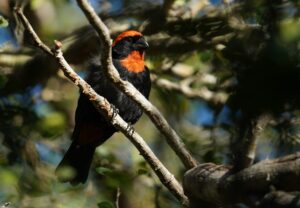
Royal palms, and other native trees, provide the food and cover that the Puerto Rican bullfinch (Loxigilla portoricensis) relies on. Listed as vulnerable by the IUCN and a species of conservation concern in Puerto Rico, the bullfinches are restricted to Hacienda La Esperanza’s karst forests on the southern side of the reserve. Morales wanted to expand its range into the northern part of the reserve’s coastal forests, so he created what he calls the “bullfinch highway,” a several hundred-meter-wide line of Puerto Rican palms and other native trees that bear fleshy fruits that runs across a pasture connecting two patches of forests.
But it takes the tree about seven to 10 years to start flowering—so he’s planted several to give them a head start. “Naturalization can take many decades before trees get there,” he said. “And we’re not exempt from the biodiversity crisis, so time is running out for certain species.”
Avian assistants
In consuming the fruits and seeds, Puerto Rico’s wildlife are helping Morales reforest the landscape. “We have a bird that does it all: that’s the gray kingbird,” Morales said. He participated in research that showed that resident populations of gray kingbirds and northern mockingbirds (Mimus polyglottos) are the most important seed dispersals on the landscape level because they’re generalists. The kingbirds eat small fruits and berries but also perch on fence posts in open areas to hunt for bugs. Sitting on the fence posts and searching for insects, they sometimes defecate, and their feces disperse the seeds into the field, a process called seed rain. “Once you plan for those two species, succession is on its course, because they’ll bring a lot of new things into your patches,” he said. “And then, other birds will start arriving.”
After planting more than 1,000 trees per acre, Morales will spend a few years tending to the patch to make sure vines and nonnative grasses don’t overwhelm the saplings. When the forest has reached five or six years old, Morales takes a step back and lets nature take its course.
Through this collaborative work with Puerto Rico’s seed dispersers, Hacienda la Esperanza has created a novel forest, different perhaps from the mystery of what used to be around pre-colonialism but still creating habitat for countless species.
Measuring success
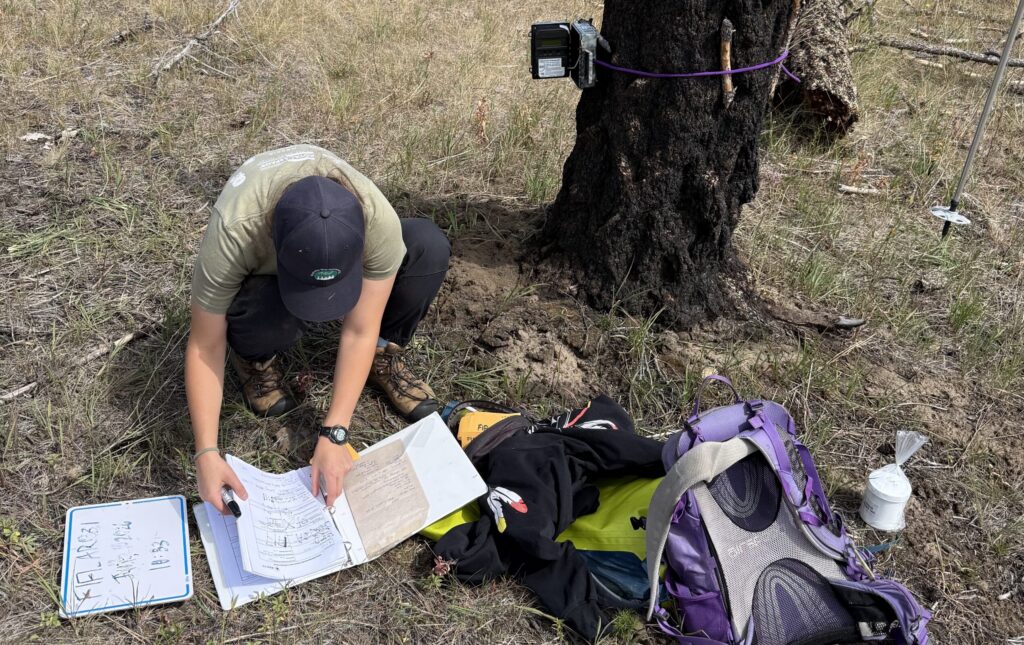
Morales is looking to see if his restoration efforts are successful, which he does through tracking the birds that show up in the forest. He does this by placing recorders to acoustically monitor birds before and after restoration. Some birds aren’t as vocal, so he also surveys species using his staff and citizen scientists.
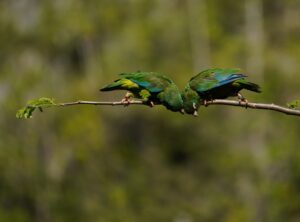
Of Puerto Rico’s 19 endemic species, Hacienda la Esperanza has documented around 13 species on the reserve. Last year, they first spotted a Puerto Rican lizard cuckoo in one of the new patches, which Morales described as “really encouraging” because the species was on their list of targets for restoration. He’s also dreaming big, hoping that the Puerto Rican Amazon (Amazona vittata), the only remaining native parrot in Puerto Rico, may one day come to the reserve. This critically endangered green, blue and red bird needs cover, fleshy fruit and hollow trees for nesting cavities.
“Forest takes a lot of time to recover to a mature stage,” Morales said. “But in my lifetime, I can see a forest that I planted.” And it’s a lesson the whole island—and region—can learn. Native forest cover in Puerto Rico has jumped back up around half. “That gives me a lot of encouragement that you can restore and have positive outcomes in a short timeframe,” Morales said. “You look at this, and you have the sense that there’s so much possibility.” Esperanza, after all, means hope.
This is part one of a three-part series on habitat restoration and wildlife management in Puerto Rico.
Article by Olivia Milloway