


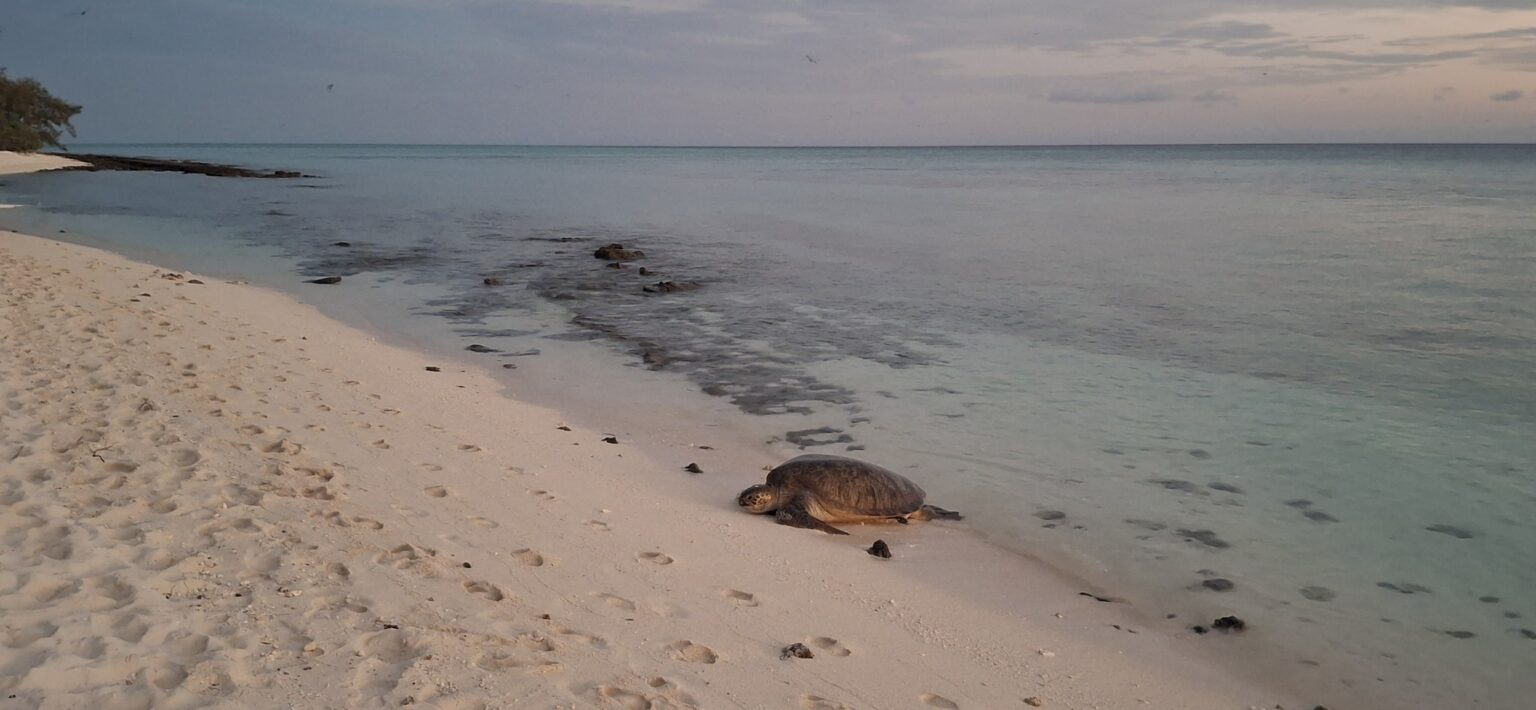
Conservationists that move sea turtle eggs higher up the beach to protect them from rising tides and temperatures may not be doing hatchlings any favors.
Researchers recently compared the success rate of green sea turtle (Chelonia mydas) nests left undisturbed on beaches in Heron Island, located on the southern Great Barrier Reef in Australia with the success rate of nests they moved higher up the beach. Half of those moved were given shade with a cloth to regulate temperatures, while half were left unshaded.
In research published recently in Marine Biology, scientists found that moved nests had lower hatching success and produced smaller baby turtles that couldn’t flip themselves off their backs as easily. “The difference shows up even when the shaded and natural nests are the same temperature,” said lead author Davey Dor, a sea turtle ecologist at the University of New South Wales in Australia.
Since temperatures are comparable, the researchers speculate that moisture levels in the sand, gas exchange, microbes and depth in the sand could all play roles in how well a nest succeeds.
“We need to understand these factors so we can give the turtles we’re trying to save the best possible chance of survival,” Dor said.