

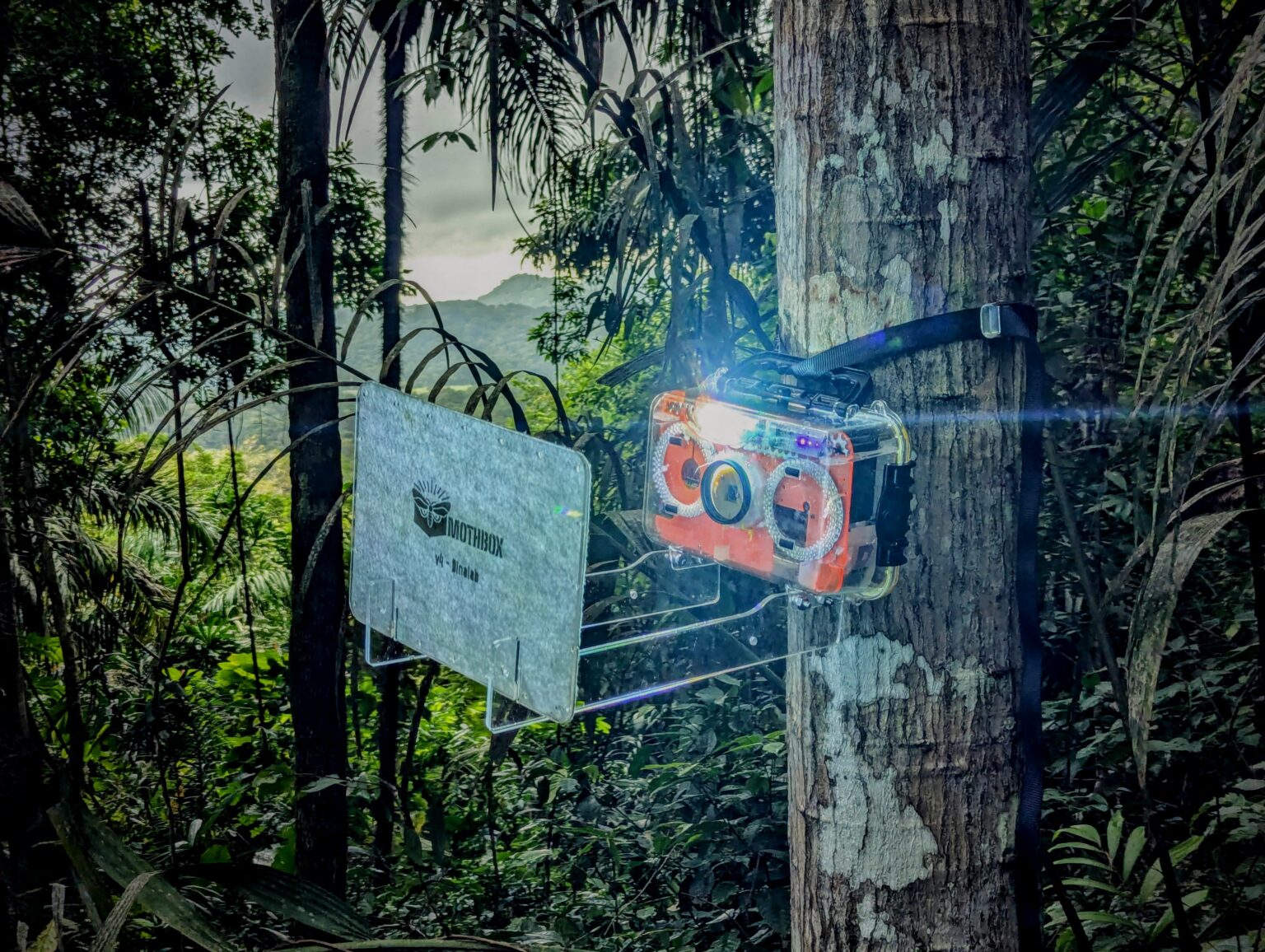
Insect monitoring usually means late nights, bright lights and white sheets—and often, lots of dead specimens. But a new technology developed in the tropical forests of Panama offers a new way to study the often-forgotten wildlife that play a crucial role in ecosystems across the globe.
In a new paper published in Methods in Ecology and Evolution, researchers demonstrated how the Mothbox—an open-source automated camera trap for insects—and the Mothbot—an artificial intelligence tool that can analyze data from the Mothbox—can help non-specialists learn more about the arthropods around them.
The Mothbox is small, portable and made out of 3D-printed materials and relatively inexpensive parts. The instructions for building a Mothbox, as well as the code for running Mothbot, are both available online for free. “We need open-source tools to make sure our science really works,” said Andy Quitmeyer, co-director of the Panama-based Digital Naturalism Laboratories and affiliate professor at the University of Washington who has worked on the device since 2022.
Through pilot studies, the team used the technology to monitor changes in insect activity and presence throughout the night at the same location, or how these factors vary among different habitats. “As the field of automated insect monitoring continues to develop, Mothbox provides an affordable entry point for a range of stakeholders,” the authors wrote.