



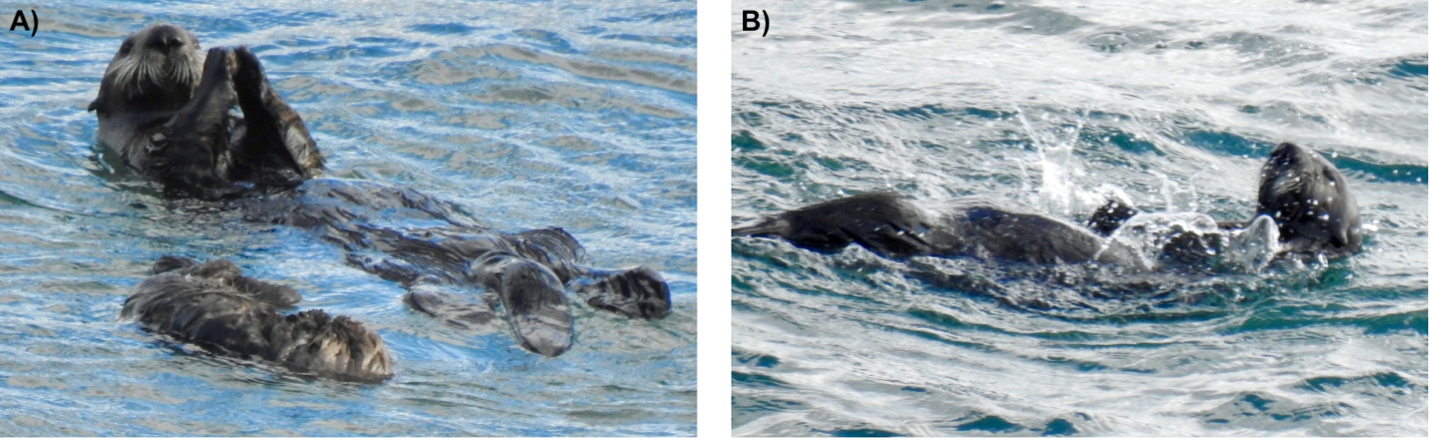
One might imagine silence reigning over Cape Kiritappu, a remote cliff in northern Japan. Quiet isn’t what you’ll find, though. The Cape is loud: crashing waves, whirring winds, fishing boats and constant chatter among seabirds. If you listen closely to this cacophony, sometimes you can make out a subtle but distinct series of clinks. Those noises belong to the Cape’s sea otters (Enhydra lutris), which—when handling hard-shelled prey—use tools to crack open their food.
The tap-tap of bivalves being hammered on belly rocks is music to my ears. That’s because in an area with so few otters, the cracking can be a useful acoustic cue that an otter may be close by.
My research involves collecting sea otter foraging data to help determine the extent of marine resource competition with fisheries around Cape Kiritappu in an effort to carve a path forward for human-sea otter coexistence in the area.
I took advantage of these unique noises and followed their sound to locate sea otters during my fieldwork. Most times, the strategy paid off, and I was rewarded with nearshore foragers easy to spot. From them, I could observe and record data for over 100 dives—enough to give us a preliminary understanding of the species’ foraging ecology at the Cape.
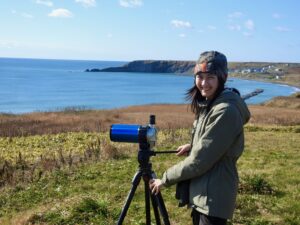
The information collected thus far offers some of the first insights into Japan’s sea otters. We’re beginning to get a sense of their prey preferences and what proportion of their diet is made up of commercially important shellfish.
We can also infer the current makeup of benthic communities from data on foraging success, dive times and tool use. Despite the progress made, more work remains. Continued observations will allow us to better grasp the nature of the resource competition between sea otters and fisheries.
Only then would it be possible to develop scientifically informed solutions that pave the way for coexistence between otters and local fisheries at Cape Kiritappu and other shared seascapes.
Next field season, I’ll again be listening for those recognizable clinks to guide my data collection. I never could have imagined that my ears would play a vital role in how I study and connect with sea otters, but listening, it turns out, is as fundamental to field science as observation.
And by learning to listen more closely, we can better tune ourselves to the rhythms of the coast and the wildlife returning to it.
Wildlife Vocalizations is a collection of short personal perspectives from people in the field of wildlife sciences. Learn more about Wildlife Vocalizations, and read other contributions.
Submit your story for Wildlife Vocalizations or nominate your peers and colleagues to encourage them to share their story.
For questions, please contact tw*@******fe.org.
Article by Samantha Hamilton