





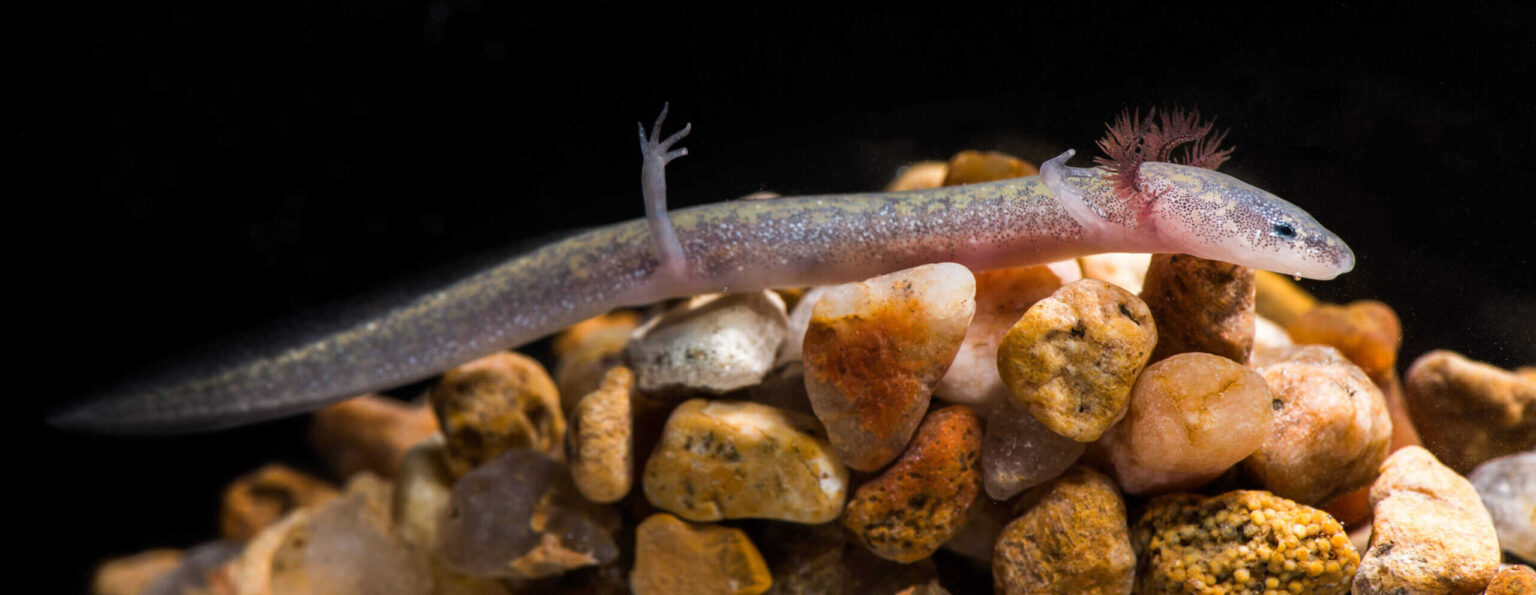
On the surface, the plight of the Barton Springs salamander seems dire. The small salamanders can usually only be seen in a collection of freshwater springs in the middle of downtown Austin. And some of these springs have been modified with concrete or turned into municipal swimming pools, making the habitat less suitable for the amphibians.
Now, wildlife managers are making small changes to miniscule springs less than half a city block in size. They hope these changes will have an impact on the wider, unseen population that lives deep under Austin.
“That little [spring] habitat was wildly successful in terms of increasing the abundance of that salamander,” said Nathan Bendik, a biologist with Austin Watershed Protection, a department of the city’s municipal government.
Surface springs don’t tell the full story of these amphibians, which spend much of their lives in underground aquifers far from human eyes. Since researchers can’t easily reach these often narrow and submerged underground passages, the best they can do is improve conditions on the surface.
New species, old problems
The Barton Springs salamander (Eurycea sosorum) was first described in 1993. Shortly after, it was listed as endangered by the U.S. Fish and Wildlife Service due to habitat changes in its relatively tiny natural range in downtown Austin. The species is most easily observed on the surface in a few springs that feed into Barton Creek, which flows through the center of town into the Colorado River. Heavily modified over the years, Barton Springs is a stretch of Barton Creek that has been turned into an outdoor natural pool that stretches for a few city blocks, open year-round. The water from these springs is fed by the Barton Springs segment of the Edwards Aquifer, a huge underground source of freshwater.
While the salamanders can sometimes be found in Barton Springs Pool, they’re more often seen in a series of smaller surrounding water bodies such as Eliza Springs, pictured above. Though now closed to swimming, Eliza was also heavily modified for swimming in decades past—the water lies in the middle of an oval-shaped concrete amphitheater no wider than 30 feet across and just a foot deep or less. Spring water had been redirected through a pipe so it emerges from Edwards Aquifer via a pipe below.
In a study published recently in Animal Conservation, Bendik and his colleagues describe how retrofitting Eliza Springs, the main surface habitat of the Barton Springs salamander, and its small outflow has helped to boost the population.
Salamanders’ rock
While the project has been in the works for about 20 years, physical work started in 2016. The first order of business: rock collecting. The Barton Springs salamander needs fist-sized rocks and gravel to hide and lay their eggs under. “We had to go rock shopping,” Bendik said.
The team searched for locally-sourced natural river rocks for sale but had no luck. They tried quarried rock, but the size was still too big. Then, the managers of Barton Springs wanted to clear out debris in the larger municipal pool after a recent flood. Bendik and his colleagues moved the rocks between the pools and it seemed to help. “We made this change and then all of a sudden we were seeing a lot more salamanders there,” Bendik said.
Next, they removed the inflow pipe so that water flowed up from the aquifer more naturally. They also retrofitted the outflow from Eliza Springs from a drainpipe into a more natural stream that flowed for about 70 feet along the surface, increasing the potential surface habitat of the species.
Wildlife managers have been surveying salamander numbers at Eliza Springs since 1996 by flipping all the rocks while snorkeling.
In 2014, they switched to a new method of tracking salamanders that improved accuracy. They photographed each individual, recorded if females had eggs, then released them back into the spring. Each salamander has a unique pattern on its head which researchers can use to identify individual salamanders from one another, allowing for a population estimate after each survey.
They also began capturing salamanders by sucking them up with a modified turkey baster, resulting in fewer injuries, then put them into floating nets for processing.
Springs surge in population
The salamander counts confirmed what Bendik and others had already noticed. The peak abundance for salamanders in Eliza Springs and the stream outflow before retrofitting was 1,200 in 2008. Peak abundances since restoration have been more than 2,000 in some years. Salamander numbers can ebb and flow naturally based on conditions above and belowground—biologists still aren’t even sure how and why Barton Springs salamanders sometimes get spit out of the Edwards Aquifer more some years than other years. “You get some highs and some lows,” Bendik said.
Despite the fluctuations, the average number of salamanders has increased from 354 to 1,051. The average salamander density, too, increased from 4.8 individuals per square meter before changes to 10.6 after. “Everything is looking very positive at that site,” Bendik said.
Making salamander-positive changes at the municipal pool is difficult due to its heavy use by residents and visitors. But Bendik and his colleagues are now trying to replicate their success at Old Mill Spring, another former swimming hole which sits just southeast of the municipal pool and sometimes has Barton Springs salamanders. They plan to reinstall a more meandering stream from the aquifer outflow. “We’re excited about that and we’re hoping we can get that done before the end of our permit term [in 2033],” Bendik said.
Article by Joshua Rapp Learn