

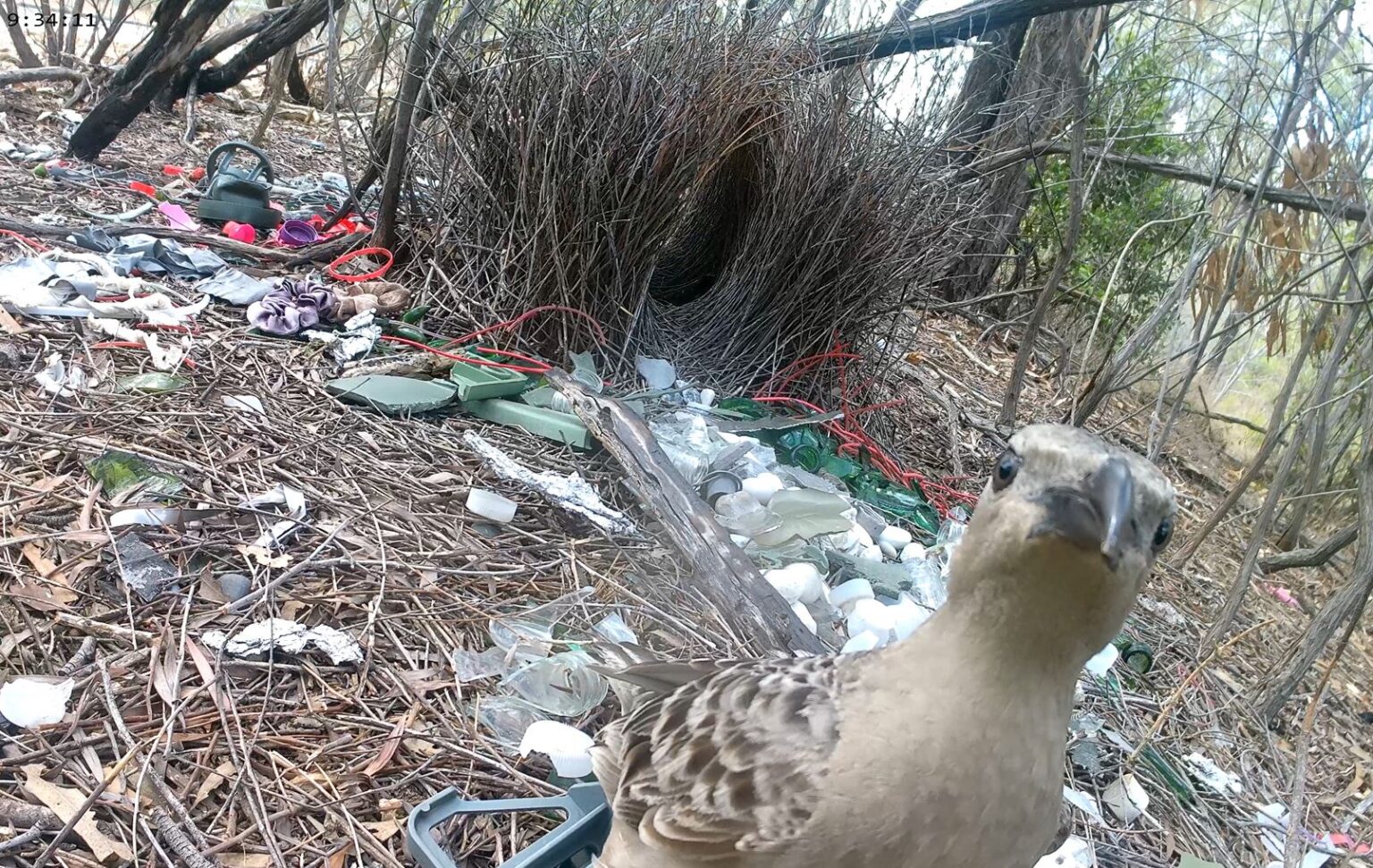
Bower birds create elaborate decorations with colorful fruits, sticks and leaves, all in the hopes of impressing a mate. Researchers have found that in urban areas, they use what humans discard—from scrunchies to glass to even handcuffs—as statement pieces.
Researchers from the University of Exeter monitored 61 bowers—essentially, a decorated display area—made by male great bowerbirds (Chlamydera nuchalis) in one rural and one urban site during the springtime breeding season in Queensland, Australia. They published their findings in Royal Society Open Science.
Males build these structures to attract mates, and the decorations were diverse. Near a hospital, researchers found bowers that incorporated a pair of handcuffs and medicine jars. Near a sports field, they found fluorescent mouth guards in bowers, University of Exeter co-author Caitlin Evans told Ars Technica.
In Townsville City, the urban site, bowerbirds showed a greater preference for green glass and red wire. At the rural site, the male birds showed a preference for green glass, leaves and seeds for decor.
Both rural and urban bowerbirds preferred human-made items. Decorations at urban bowers were more than 10 times as likely to be human-made compared to decorations at rural bowers. Urban bowers also had far more decorations, averaging 90 decorations compared to 20 at rural bowers.
Study coauthor Laura Kelley, also from the University of Exeter, said this study shows how the availability of human items affects the behavior of bowerbirds. “We don’t yet know whether this has any negative or positive impact on them, but it’s a reminder of how human activity is changing the natural world in unanticipated ways,” she said.