

Plastic Prisoners
Scroll
Impacts of plastic on wildlife in a wasteful world.
Four decades ago, on a remote volcanic island in the Bering Sea, a young Jason Baker walked through the mist among a shifting mass of bodies stretching out on the rocky shores of the Pribilof Islands. The rookery, a group of seals, constantly moved as animals caroused along the shore. A chaotic symphony of barks and bleats greeted the researchers amidst a backdrop of crashing surf and the cries of shore birds. Baker was there to study the largest population of northern fur seals (Callorhinus ursinus), monitoring how the rookeries grew and shrank through time. What he saw year after year was always jarring: seals ensnared in loops of plastic and fragments of netting, often struggling to survive.
While older seals often avoided entanglement, the young ones—curious and naïve—were often bound in marine debris. They dragged along bits of human-made junk as they continued their lives. This discarded plastic sometimes caused egregious wounds so bad that the research team would divert from their population survey work to capture and free them. The NOAA team Baker was a part of would round up a large number of males adjacent to rookeries and let them stream to the water in a controlled way to estimate the entanglement rate, catching, tagging, and in many years, disentangling the young males they encountered. Some disentanglements were simple and quick with scissors, while others approached crude field surgery as the researchers had to carefully cut many plastic strands from deep wounds.

Credit: Jason Baker
“Removing the nets and debris from seals is a rare thing that you do in our field where you know you really did something good,” said Baker, now a retired marine biologist formerly with the National Oceanic and Atmospheric Administration.
What began as a single rescue in a single rookery revealed a pattern throughout his career studying pinnipeds.
From Alaska to Hawaii, young seals faced the same struggle and carried the same scars. But the plastic problem goes far beyond seals.
The trash people leave behind continues to make its mark on our planet—Earth is truly becoming a plastic world. Plastic debris can strangle animals like sea turtles, whale fish corals and seals.
As plastic continues to fragment, it escapes the human eye but continues to mold the future of the planet, creating intestinal blockages in birds, altering an organisms’ ability to reproduce and changing frog developmental physiology.
From the depths of the ocean to the air we breathe, these forever particles alter how life persists and how the planet functions by contributing to climate change.
“Plastic pollution takes many forms, including climate pollution, and it happens through the entire life cycle of plastics, which is a life cycle that never ends because plastic never goes away,” said Holly Kaufman, the founder and president of both Environment and Enterprise Strategies and the Plastics and Climate Project, a nonprofit focused on educating about the climate impacts of plastic pollution.
The plastic problem
Plastic is a general term encompassing synthetic materials that can be formed and molded under heat and pressure to create objects. Chemists make plastics out of many different polymers, large building-block molecules that give objects their properties. Plastic has helped solved certain environmental problems—garbage bags reduce litter, and synthetic fur coats reduce the pressure on harvesting wildlife for the fur trade. Plastic also replaced the elephant ivory used for items like piano keys and pool balls.
Scientists invented Bakelite, the first fully synthetic plastic, in 1907 to insulate wires. But later, plastic production boomed because it gave fossil fuel companies a way to use waste materials from processing crude oil and natural gas to make money. Polyethylene, now the most common plastic, was invented 20 years later by accident and played a prominent role in World War II.
Now, plastic is a part of our everyday lives. From the moment we are in the womb, we are in reach of multiple plastics of varying types. Many animal researchers started their careers playing with tiny plastic animals and plants, imagining the fantastic world they would one day explore. Today, the fragments of those memories, called microplastics, have escaped toy boxes and landfills along with the near-infinite fragments of plastic bottles, synthetic clothing and food wrappers to inhabit every part of the ecosystem.
“They don’t ever break down—plastic can only break apart,” Kaufman said.

Credit: USFWS Pacific
These microscopic pollutants—the result of larger pieces breaking down—can be found in penguins in Antarctica as well as sensitive ecosystems in the deepest parts of the ocean, reachable by humans only by submarine.
Microplastics have a vast array of varying chemical properties, the fate of each depending on their chemical composition. Even smaller are nanoplastics—particles so small they can penetrate cells, cross the blood-brain barrier, and even enter the placenta in humans and wildlife.
Years later, we are now aware that these plastics have unintended consequences. As plastic merges into the fabric of our world, researchers work diligently to understand what this means for some of the most vulnerable wildlife.
Plastic frog soup
The consensus is that plastics are generally not good for species. The unknown impact of plastic and microplastic contamination is highly concerning for amphibians. According to the Global Amphibian Assessment published in Nature, amphibians are the most threatened vertebrate class, with 40% of identified species globally threatened, according to the International Union for Conservation of Nature.
Amphibians are threatened by disease, habitat loss and climate change, and now some researchers are asking if microplastics are another emerging threat.
But since many species are endangered or poorly understood, researchers like Raquel Salla, a postdoctoral researcher at the Federal University of São Carlos in São Paulo, Brazil, use more abundant species such as bull frogs (Lithobates catesbeianus) to gauge the impact.
Salla and her collaborators examined the earliest stages of bullfrog development, the transition from egg to tadpole, to determine how polyethylene microplastics and related nanoparticles affected development.
Credit: Raquel Salla
Titanium dioxide is a chemical found in many cosmetic and electronic products, or the bisphenols (BPA) used to make clear plastic coatings and durable objects like baby bottles.
The research published in Environmental Pollution showed that titanium oxide nanoparticles were lethal to eggs, and exposure significantly reduced hatching. Microplastics, however, showed a different pattern of impact. Bullfrog eggs are protected by a thick, jelly-like layer that allows oxygen to enter but prevents other substances, including microplastics, from getting in. The microplastic particles stuck to the embryos’ outer gelatinous layer.
“I was actually surprised that what happened was not really bad,” Salla said. “Their evolution was actually very efficient in protecting them at least from that kind of contaminant.”
In frogs that received both microplastics and titanium oxide nanoparticles, this coating appeared to shield them from some of the nanoparticles’ direct toxic effects. However, upon hatching, some tadpoles showed signs of stress. Those individuals had swollen stomachs, suggesting they may have difficulty maintaining balanced water and salt concentrations. Difficulties maintaining their salt and water balance may have been due to the jelly, which acts as a filter, becoming compromised. Tadpoles with these kinds of abnormalities do not survive.
As amphibian development continues, they transition from tadpoles to juveniles, and their exposure pathways change. Unlike eggs, tadpoles can directly consume plastic. The transition from aquatic to terrestrial life raises additional questions about plastic’s impact that Katharina Ruthsatz, a professor at Technical University of Braunschweig, and PhD student Collet Martin in her lab are trying to answer using African clawed frogs (Xenopus laevis).
Ruthsatz and her collaborators exposed African clawed frog larvae to polyethylene microplastics, allowing them to eat them, and monitored their development through metamorphosis into juveniles. They also examined the effect of temperature in combination with microplastics on the frogs’ development.
They found that as frog larvae transitioned into juveniles, early exposure to microplastics had a long-term legacy effect. Frogs that had eaten microplastics when they were younger were more stressed and had different body proportions than those that hadn’t. Microplastics also increases the frogs’ metabolism.
The effects of microplastics are not always straightforward. At higher temperatures, frogs that had consumed microplastics were less stressed. Ruthsatz and Martin have found that different plastic particles have different impacts on the same species.
In Martin’s PhD research, she and her colleagues fed African clawed frog larvae microplastic fibers under controlled stress and nonstress conditions to determine if they affected them. Martin and her collaborators found that environmentally realistic concentrations of microplastic fibers reduced growth in the larvae but did not alter physiological stress or aging biomarkers. Adding stress hormones in combination with microplastic treatments did not have a measurable effect.
“It’s not all bad—we need to be curious about what microplastics do,” Ruthsatz said. “From the amphibian perspective, it’s interesting to see how global change, the multi-stressor environment and their complex life cycle interact with microplastics,” Ruthsatz said.
Martin and Ruthsatz will continue the work, but on western spadefoot toads (Spea hammondii), examining the effects of biofilm-colonized microplastics on gut health and the potential for particle translocation as the frogs develop. Both researchers also emphasize that the effects will vary depending on the species of frog researched.
Mixed cocktails
Researchers like Roland Kallenborn, a professor at the Norwegian University of Life Sciences (NMBU) and the Nord University in Bodø, Norway, shift the focus from controlled laboratory experiments and single-species studies to the unknowns in tangled food webs and chaotic chemical cocktails in the natural environment.

Credit: Roland Kallenborn
“A point of frustration for me is that for the past 30 years, you’re gradually extending the list of potentially harmful chemicals,” Kallenborn said. “We need to develop strategies and also methods to avoid potential exposure situations.”
In research published in Environmental Science and Ecotechnology, his team examined 32 bisphenol compounds across 134 samples from plankton, fish, seabirds and top predators, including polar bears (Ursus maritimus). Bisphenols are industrial chemicals used to create polycarbonate plastics and epoxy resins. Many everyday objects we throw away contain bisphenols, including protective coatings on food containers, reusable water bottles, Tupperware and eyeglasses.
The cold of the Arctic affects how these substances change in the environment. Kallenborn was interested in bisphenols because they cause cancer and disrupt the endocrine system, negatively impacting developmental, reproductive, neurological and immune systems in mammals. In the early 2010s, the U.S. banned BPA in many children’s products due to the potential impacts.
His research found that these compounds are not only present in the Arctic ecosystem, but they are also accumulating in organisms at higher levels of the food web. Kallenborn and his colleagues demonstrated that even smaller Arctic human settlements cause an impact. In some polar bear tissues, total bisphenol concentrations reached orders of magnitude higher than those in crabs or fish. Local landfills were identified as a probable cause of the contamination.
But simply banning chemicals may not be the solution. When one bisphenol is banned or strictly monitored, like bisphenol A, another is created to take its place. A merry-go-round of replacement chemicals emerges, where new, similar chemicals cycle into production faster than researchers can study their effects, allowing similar pollutants to persist in the environment with similar impacts under different names and structures.
“Bisphenol A is obviously going down, but these new bisphenols have the potential to bioaccumulate,” Kallenborn said.
Plastic contamination doesn’t exist in isolation, though. Kallenborn has also used plankton, benthic organisms, fish, crab and glaucous gull (Larus hyperboreus) samples to examine poly- and perfluoroalkyl substances and found these chemicals also accumulating up the food chain. He said this finding emphasizes that outside experimental environments, organisms face a chemical burden that has the potential to interact in ways we currently do not understand.
“These organisms are exposed to quite a mixture,” Kallenborn said.
Collectively, all of these chemicals could have population effects by impacting the reproduction rates, behavioral distribution patterns and physiological well-being of these species.”
Trouble in paradise
The Great Pacific Garbage Patch stretches hundreds of miles across the North Pacific. But this floating debris is not static—the plastic circulates throughout the ocean basin, spanning nations and continents.
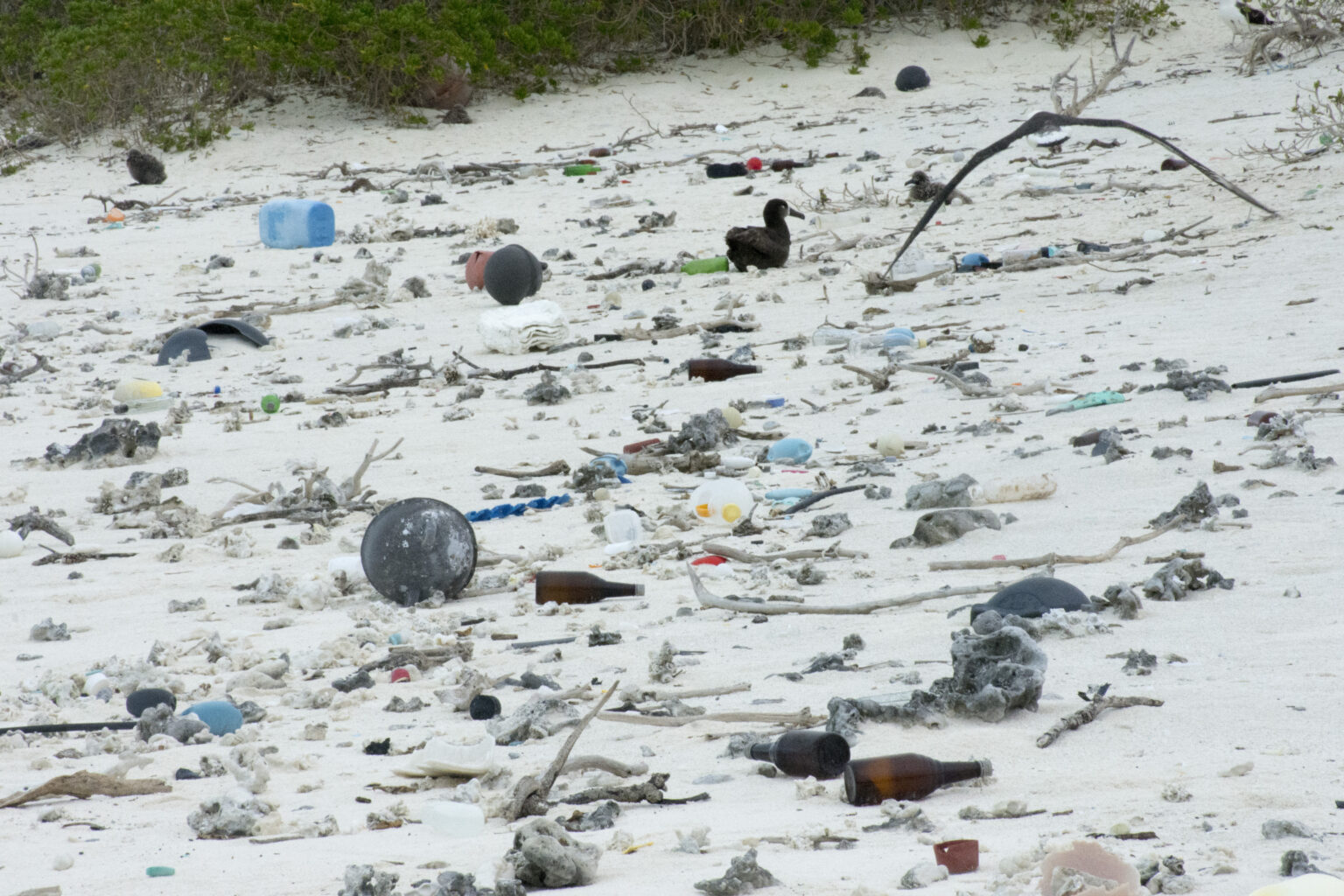
These currents ultimately reach the northwestern Hawaiian Islands. To native Hawaiians, Papahānaumokuākea is a sacred seascape from which all life is believed to originate and where spirits return after death. That meaning sits in stark contrast to what now washes ashore there: debris from around the globe carried across the Pacific, arriving through the same currents that shape this deep significance of the place. What began as an effort to save individual seals 40 years ago for Baker was a precursor to a much more intensive conservation action he would participate in later in Hawaii.
The Northwestern Hawaiian Islands are covered with beautiful white sand and surrounded by clear blue water. As many as 12 million seabirds and green sea turtles (Chelonia mydas) make it their home.
“The islands are only a few meters high at most and covered in wildlife,” Baker said.
The islands are an ecological hot spot, home to 3.5 million acres of coral reefs, 23 different endangered species and 75% of the endangered Hawaiian monk seal (Neomonachus schauinslandi) population.
But the northwestern Hawaiian Islands sit within the North Pacific Subtropical Convergence Zone, a shifting boundary of the Great Pacific Garbage Patch.
12
M
seabirds and green sea turtles call the islands home
3.5
M
acres of coral reefs surround the archipelago
75
%
of Hawaiian monk seals live within this seascape
And it doesn’t end there—Baker describes finding “the craziest stuff you can imagine,” including TV sets, shampoo bottles, shoes and, at one point, 100,000 lighters.
These encounters are part of a much longer, deadly record of wildlife like Hawaiian monk seals, where every individual counts. Using 40 years of NOAA monitoring, Baker and his team analyzed patterns of monk seal entanglement across the northwestern Hawaiian Islands to understand which seals were most at risk for entanglement.
The research published in Marine Mammal Science showed that weaned pups made up the largest share of entanglements, confirming that young seals were at the highest risk. Most notably, adult females were entangled far more often than adult males.
This can have serious consequences for an endangered population because female mortality significantly impacts population growth.
 Photo Credit: Jason Baker
Most of the entanglements were with abandoned fishing gear, which was unsurprising, as Baker had seen it enough in his career, whether on beaches in the Bering Sea or extracting a young female fur seal out of a large drift gill net in the middle of the ocean.
Paid Ads


Living in the Plastic Age
While there is a lot of focus on visible waste, plastic pollution occurs throughout the life cycle, from the moment the fossil fuel feedstocks are extracted from the ground to while plastic is in use and afterward.
Recycling will not solve the plastic problem for a multitude of reasons. Much of the plastic we use is a mix of different kinds of plastics—mixes that are not recyclable.
Recycling also doesn’t contend with the many serious human and environmental health issues that plastics contribute to.
It fragments, circulates and accumulates as an ever-growing stream of new chemicals that enter the environment and interact with wildlife faster than can be understood. New compounds enter systems already under strain.

Credit: Kaylyn Zipp
A major attempt to contend with the problems caused by plastics and their ingredients is the United Nations Global Plastics Treaty. The UN environmental program launched negotiations in 2022, but so far, negotiations continue to fail largely because fossil fuel and petrochemical producing countries want to focus on waste management, while other countries want to curb production as well.
Plastic production increases reliance on fossil fuels as parts of the world try to transition away from them, and wildlife conservationists across the globe are dealing with the ramifications of their use. One critical emerging issue is the impacts plastics have on climate. Plastics not only emit greenhouse gases during their production, but during all stages of their life cycle, including manufacture, use, transport, waste management and from unmanaged waste, such as open burning and dumping.
“Vinyl windows, foam insulation, grocery bags—they are all emitting greenhouse gases,” Kaufman said, emphasizing that many of the plastic products in our homes are constantly releasing heat-trapping gases. In addition, it appears that as certain plastics break apart once they’ve been exposed to sunlight and more surface area is exposed, more greenhouse gases are emitted, like methane and ethylene from polyethylene grocery bags.
Plastics also increase global heating due to uptake by the plants and animals that sequester carbon in the ocean. For example, key wildlife from zooplankton to whales ingest plastics that interferes with the biological carbon pump—the process that store carbons in the ocean. Plastic dust on plants is even inhibiting photosynthesis. “We don’t know the extent. We don’t know the rate, for any of these impacts,” Kaufman said, remarking on how many of the greenhouse gas contributions have also not been measured.
Even less is known about how and how much plastics particles affect Earth’s radiation budget—changing how the planet reflects, absorbs, traps and moves energy in the atmosphere and on the surface of the Earth. However, according to the Plastics and Climate Project, we do know that the climate impacts of plastics are undercounted, significant and growing. “We need to keep wildlife healthy, which means free from plastics and all the diseases and harm that plastics and climate change can cause,” Kaufman said.
A glimmer of hope
Baker remembers his first NOAA research cruise early in his career out in the middle of the North Pacific in autumn, halfway between Oregon and Japan.
“We were in what feels like nowhere when we spotted a fur seal from Alaska floating in a large mass of gill net. The ship’s crew were able to grapple-hook the net and pull it on board along with the seal. It was a young female, and we got her out and sent her on her way—but the net had taken another life. There was a massive ocean sunfish, already dead and rotting,” Baker said.
That’s the problem: fishing gear is designed to kill. When it’s lost or dumped at sea, it keeps doing its job. The in-depth, long-term monitoring of the seals makes analyses of some net entanglement possible, but really, they are only getting part of the picture. Other seals may die at sea and never be recorded, while records of other species do not exist.
“We really think of the seals as a proxy for all the things that get caught up in the nets,” Baker said.
But wildlifers haven’t given up hope.
For almost as long as the seals have been monitored and disentangled, there have been efforts to clean up the plastic debris in the northwestern Hawaiian Islands.

Credit: NOAA Coral Reef Ecosystem Program
In 1999, NOAA, along with numerous partners, began systematic surveys and industrial-scale removal of in-water marine debris began.
The work is dangerous. Removing the debris involves one or more large seagoing vessels, a fleet of small open boats and teams of divers who go down to cut up and remove nets. Divers go down without diving gear to mitigate the risk of becoming ensnared in the nets and becoming victims themselves. These efforts have grown into the world’s largest in-water marine debris mitigation effort. From 1996 to 2022, researchers removed 945 metric tons of marine debris, roughly the weight of hundreds of pickup trucks.
Baker and his colleagues wanted to know if all this work was making any difference or if it was merely a drop in the ocean. The team analyzed debris removal and entanglement rate information and found that entanglements were decreasing, especially where the greatest amount of debris had been removed.
“To be able to show after 20 plus years that this huge effort by so many collaborators, has actually reduced the entanglement rate, you’re moving the needle,” Baker said.
LISTEN: Hawaii’s plastic predicament
Researchers must hold their breath to free wildlife from the web of plastic ensnaring the environment
Read Article