



It was somewhere around Daggett, just east of Barstow on the edge of the desert, when the dogs began to take hold.
Kristin Berry, a principal investigator and research wildlife biologist with the U.S. Geological Survey, had been studying the threats imperiled Agassiz’s desert tortoises face when a tracking device led her to a house with free-ranging dogs in eastern California. The tortoise was somewhere nearby, and thanks to the help of a U.S. Bureau of Land Management agent, Berry recovered a “terribly chewed up” reptile from the house that had recently been healthy and trauma-free. It was too late for the young male, which later died from its injuries.
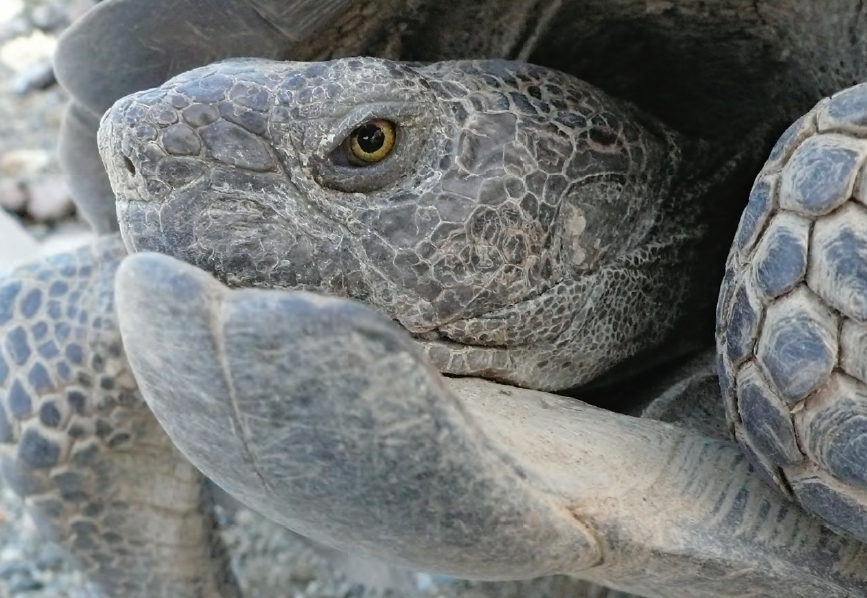
Unfortunately, this attack was one of several dog attacks on desert tortoises Berry had personally witnessed. In fact, the team recently published a study in Wildlife Monographs finding that free-ranging dogs contributed to hundreds of attacks on Agassiz’s desert tortoises (Gopherus agassizii) in a three-decade period in the Colorado and Mojave deserts.
The discovery adds to a litany of threats to the reptiles, listed as threatened by the U.S. Fish and Wildlife Service, including habitat loss and degradation as well as predation from species like coyotes (Canis latrans) and ravens (Corvus corax).
“Many [Agassiz’s desert tortoise] populations in California are no longer viable,” Berry said.
Slow-moving giants
Agassiz’s desert tortoises, also known as Mojave desert tortoises, are found only in arid regions of southeastern California and neighboring states. Factors like urbanization, off-road vehicle use and livestock grazing have degraded their desert habitats. But urbanization brings another kind of threat—free-ranging dogs.
Berry has noticed this growing problem for years. “We had seen a number of attacks and a number where the tourists removed tortoises from the dog,” she said.
Some of these dogs have owners but are left to roam. Even though these dogs are pets, they can still form packs. Berry said that contractors she’s worked with in the past have even been attacked. A man more than six feet tall was conducting work on tortoises at an air force base when a pack of nearly three dozen dogs chased him into his car at one point.
It’s also possible some of these dogs are entirely feral. Berry recalls another situation where a contractor processing a tortoise was attacked by a pack about eight miles from any house or town.
In other cases, dogs are let off leash by owners on hikes, and people have reported the pets attacking tortoises.
Identifying dog attacks on tortoises
It’s not always easy to catch dogs in the act of attacking tortoises. Berry and her team, as a result, had to conduct some forensic work. They turned to a database they’d compiled of photos of 6,727 wild Agassiz’s tortoises from 50 sites in the western Sonoran Desert of California from 1977 to 2006.
They searched for signs of severe trauma to shells, limbs and gular horns—the neck guard that extends from the bottom part of a tortoise’s shell. Males use these in combat over mating rights. “Males will try to lift each other with it or gauge each other around the head,” Berry said.
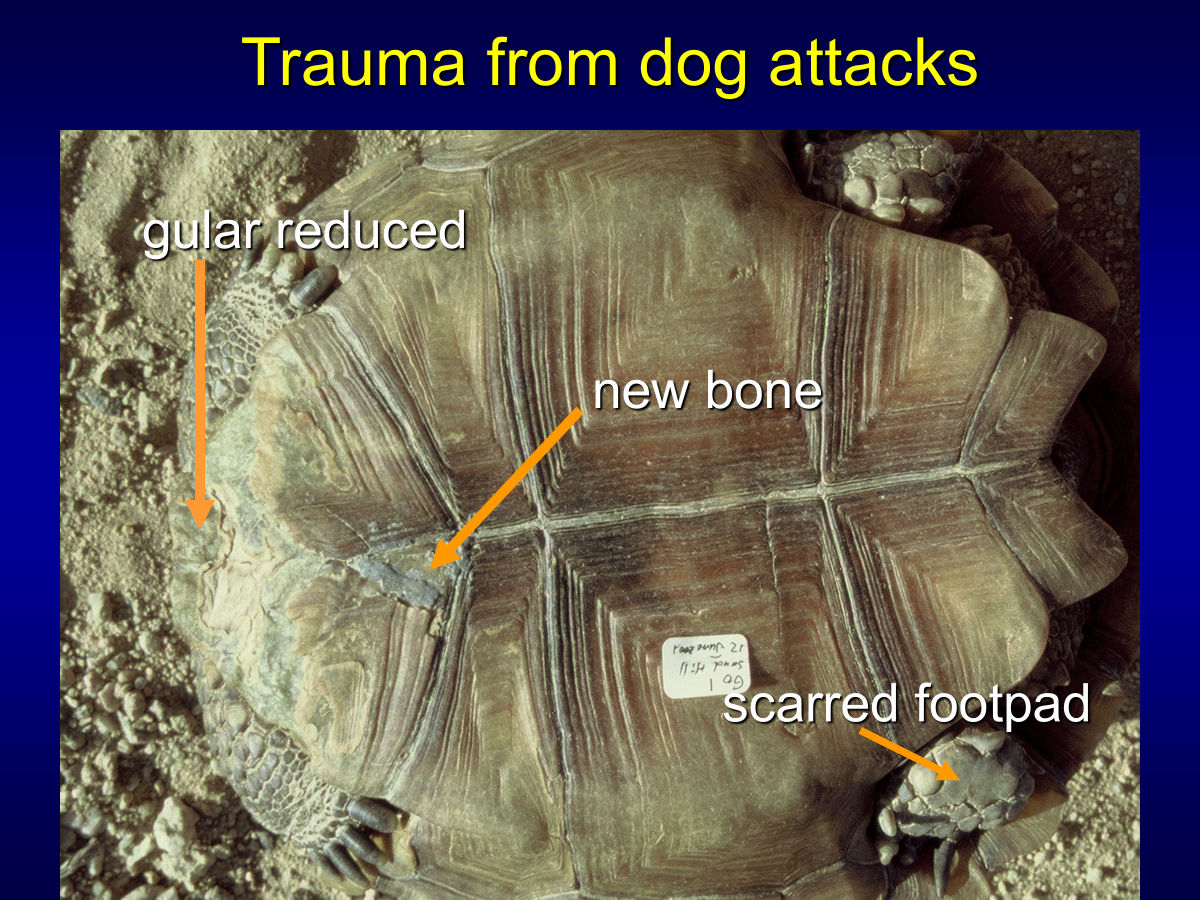
The team found 1,017 of the tortoises had signs of severe trauma to their shells and limbs—more than 15%. “There is a pretty high percentage of the animals that don’t live. It all depends on their size,” Berry said.
Nearly 4.5% had damaged gular horns—dogs will often chew the edges of these features as the tortoise hides in its shell. In some cases, dogs chewed them right off. Nearly 6.5% of tortoises attacked once were then attacked a second time.
Dogs come from towns
Most of the tortoises that had signs of severe trauma from dogs were in areas less than 12 kilometers from a human settlement. “The closer to the settlement, the more risk and more severe attacks,” Berry said. As these settlements grew, with more houses stretching into desert tortoise habitat, the situation worsened. “And as decades progress, the situation became worse, with higher proportions of the tortoise population affected,” Berry added.
The team also found that female tortoises were more vulnerable than males to dog attacks, and older tortoises were more vulnerable than young tortoises.
Berry mentions that feral dogs attacking tortoises and turtles is a worldwide problem, whether it’s giant Galapagos tortoises, sea turtles or other chelonians.
With the Agassiz’s desert tortoise, some of the pressure could be relieved by building higher fences between settlements and nearby critical habitats so pets can’t range widely. “In some cases, it wouldn’t take much of a fence to have an effect,” Berry said.
The Red Cliffs Desert Reserve in Utah, for example, already has ordinances requiring that home builders include fences or walls around new houses. Red Cliffs also has a leash law, though Berry has found that scofflaws will often ignore these regulations, and they are hard to police. One woman in Red Cliffs, she said, has repeatedly let her dogs run freely.
In California, it’s important to act soon to protect these reptiles, Berry said. She said that many of the state’s populations are no longer viable—adult females have declined more than males, complicating recovery. As a result, last year, the California Fish and Game Commission listed the tortoise as endangered.
This article features research that was published in a TWS peer-reviewed journal. Individual online access to all TWS journal articles is a benefit of membership. Join TWS now to read the latest in wildlife research.
Article by Joshua Rapp Learn