


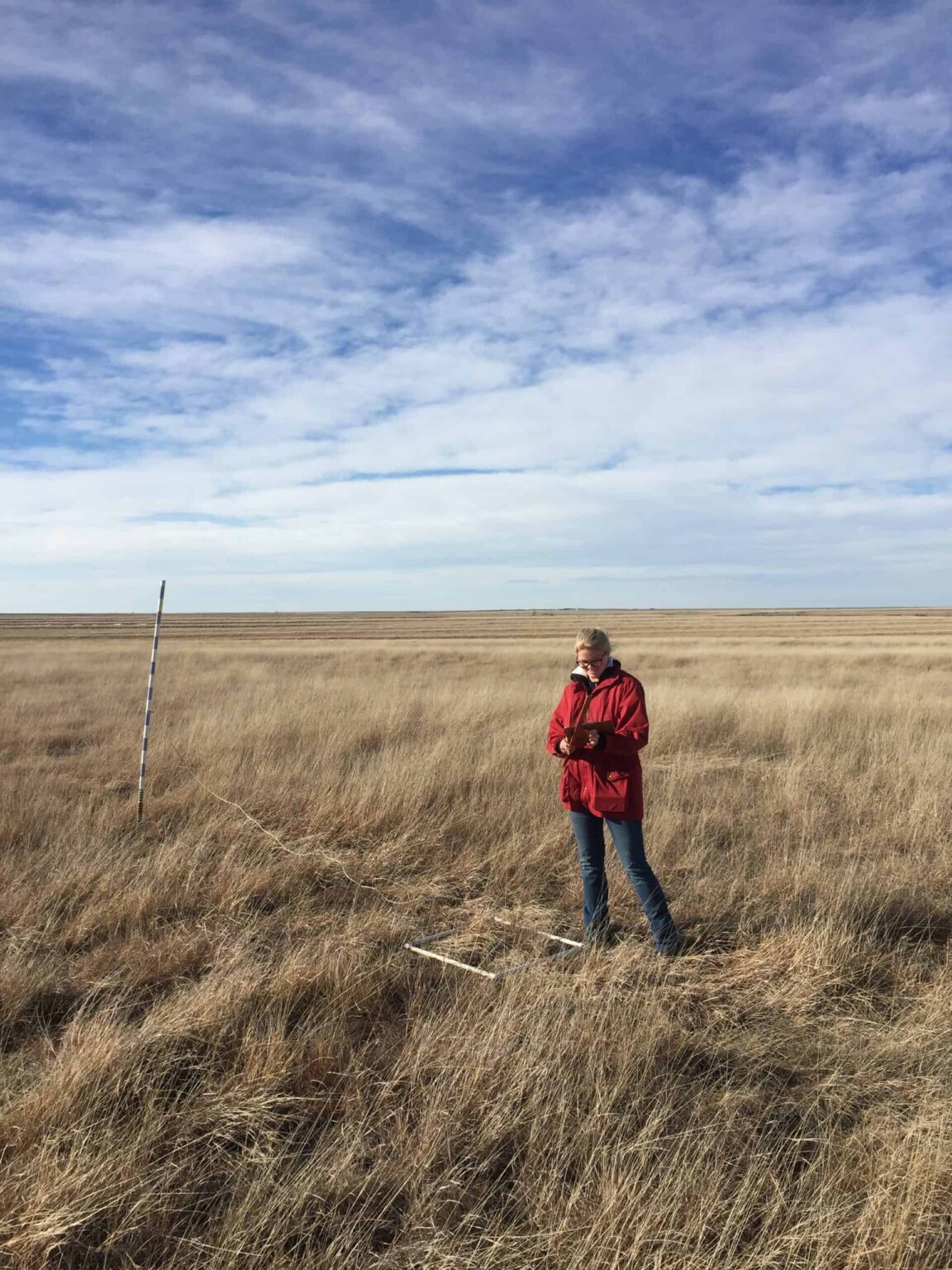
The Wildlife Society has awarded Elisabeth “Elli” Teige the Donald H. Rusch Memorial Game Bird Scholarship, which honors the memory and furthers the legacy of Donald H. Rusch by supporting graduate students researching the biology and management of upland game birds or waterfowl.
“It feels really wonderful to be recognized,” Teige said. “I like to use the term ‘grouse-greats’ to describe researchers who have moved the needle for sage- and prairie-grouse conservation. There are a lot of ‘grouse greats’ who have won this award, and I’m excited to join their ranks.”
Teige is a doctoral candidate at Kansas State University, where she researches lesser prairie-chicken (Tympanuchus pallidicinctus) use of Conservation Reserve Program grasslands in Kansas—a U.S. Department of Agriculture program that helps farmers and landowners restore native grasslands. She studies with David Haukos, unit leader of the Kansas Cooperative Fish and Wildlife Research Unit (CRU).
Teige’s research focuses on how lesser prairie-chickens use Conservation Reserve Program (CRP) plantings and lands, including evaluating how the land affects lek attendance and breeding habitat quality. She said that the CRP has been one of the most successfully implemented conservation efforts in the U.S. “We have some information about how these birds are using CRP plantings, but we need to know more about them across their entire range in Kansas,” she said. Her research focuses on the quality of CRP as reproductive habitat and how it affects lesser prairie-chicken lekking behavior, demographics and survival.
“Elli already has contributed much to the conservation of wildlife, and I strongly believe that she will be an outstanding leader in our profession for decades,” said TWS member David Haukos, Teige’s PhD advisor who has known her for nearly nine years, in his nomination letter. “Her work has considerable influence in recent actions related to lesser prairie-chickens, a species recently listed as threatened in Kansas under the Endangered Species Act.”
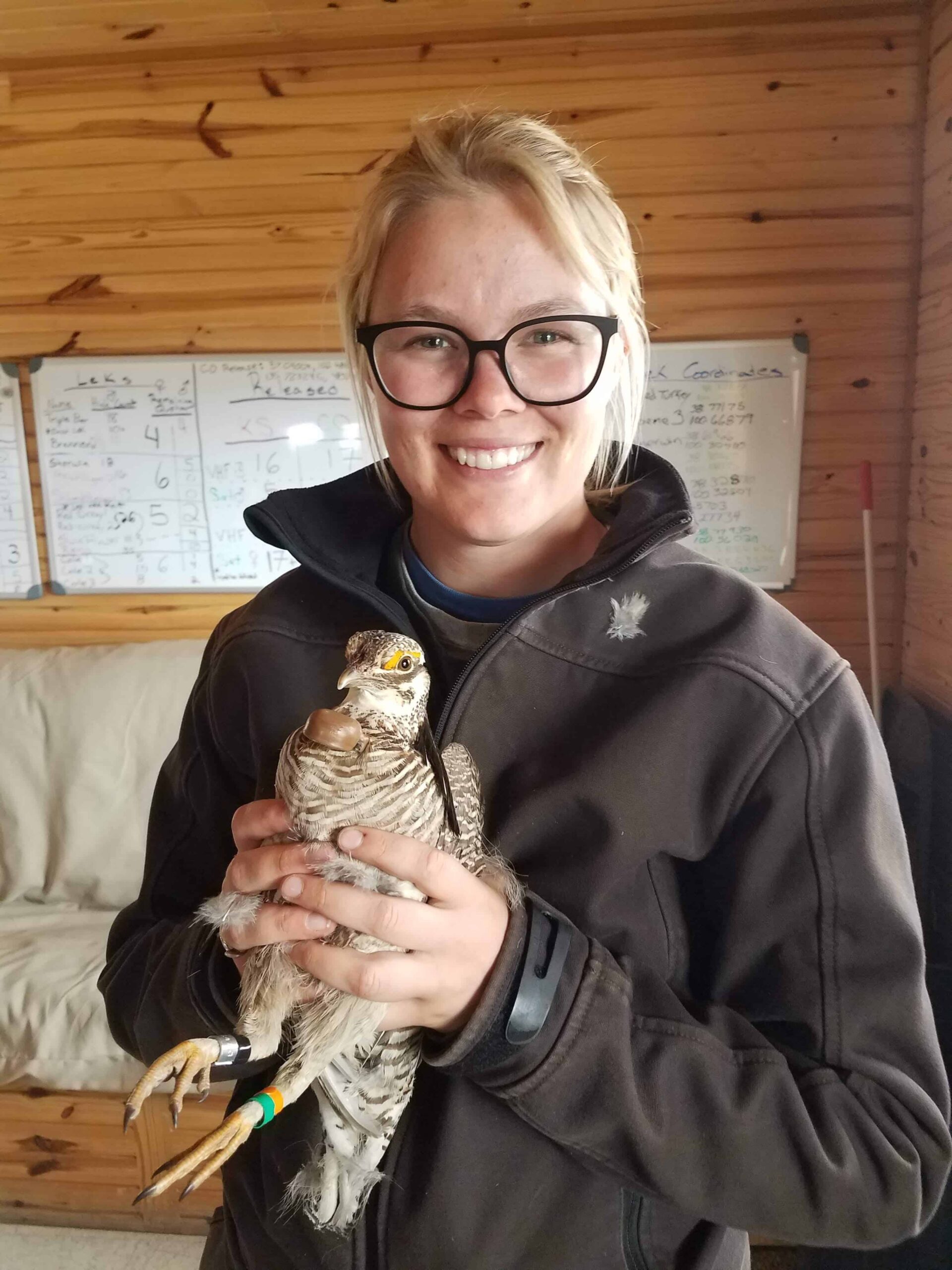
She was brought to this work by a desire to bridge wildlife research and management, rooted in an understanding of the importance of hunting in wildlife conservation. Growing up in rural northwestern Wisconsin, she loved watching ruffed grouse (Bonasa umbellus)—what she called “tree chickens” growing up—ambling through her yard.
But it wasn’t always birds that sparked her interest. She was working with mammals as an undergraduate and then got a technician position doing lesser prairie-chicken translocation work that turned into her master’s project. She was immediately captivated. “It was so amazing, and I realized that not a lot of people had the chance to see what I saw,” she said. What kept her in the field, Teige said, was her colleagues. “There’s a passion for conservation and wanting to work hard across agencies to make conservation projects happen,” she said. “The people I work with are really cool, and I feel so supported.”
Teige holds a Master of Science from Kansas State University and a Bachelor of Arts in biology from Minnesota State University Moorhead (MSUM). She has been involved with TWS since her undergraduate years and is an Associate Wildlife Biologist®. She has also engaged with TWS leadership, including as vice president of the MSUM student chapter, board member-at-large for the Central Mountains and Plains Section, graduate student liaison for the KSU student chapter, and secretary and treasurer of the Kansas Chapter.
Teige said she’d like to continue working with game birds, specifically at the intersections of research, policy and conservation. “I really want to help move conservation actions forward so we can see on-the-ground benefits, especially on private lands.”
Article by Olivia Milloway