


Perched on the end of a 20-foot pole, Michael Ocasio’s camera swayed back and forth among the palm trees. He was trying to catch a glimpse of the inside of a basket-like nest hung from the underside of a palm frond to look for oriole eggs.
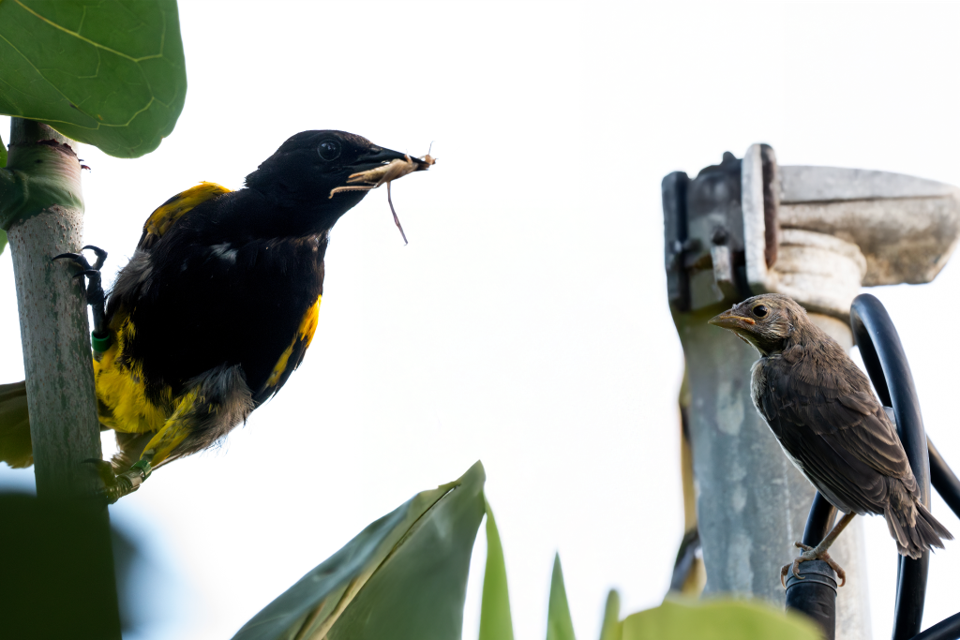
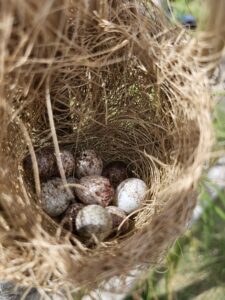
But Ocasio wasn’t the first one to come looking—a shiny cowbird (Molothrus bonariensis) had beaten him there. The nest was full of speckled, round eggs.
Ocasio is a doctoral candidate at the University of Maryland, Baltimore County, studying the biology, behavior, demographics and status of the Puerto Rican oriole (Icterus portoricensis). Based on his research so far, things aren’t looking great for the species. Shiny cowbird brood parasitism is causing the vast majority of nesting efforts to fail, and researchers don’t know enough about Puerto Rican orioles to figure out the best way to manage their threats.
“The Puerto Rican oriole is pretty representative of a lot of the endemics in Puerto Rico and the Caribbean,” Ocasio said. “There have been almost no studies on them—oftentimes, there’s been absolutely zero—which means we’re making assumptions based on other orioles.” Deforestation and habitat fragmentation, which was covered in part one of this three-part series on reforestation and wildlife management in Puerto Rico, are also linked to one of the oriole’s main threats—the shiny cowbird. As the parasite continues to flood oriole nests with its eggs, these under-researched assumptions about what orioles need to survive could cost the species time it doesn’t have.
Follow the oriole
The Puerto Rican oriole became its own species in 2010—not because scientists hadn’t documented the animal before, but because scientists formerly grouped it together with three other orioles as one single species: the Greater Antillean oriole. Because Puerto Rican orioles have only recently been recognized as a distinct species, scientists don’t know much at all about the bird.
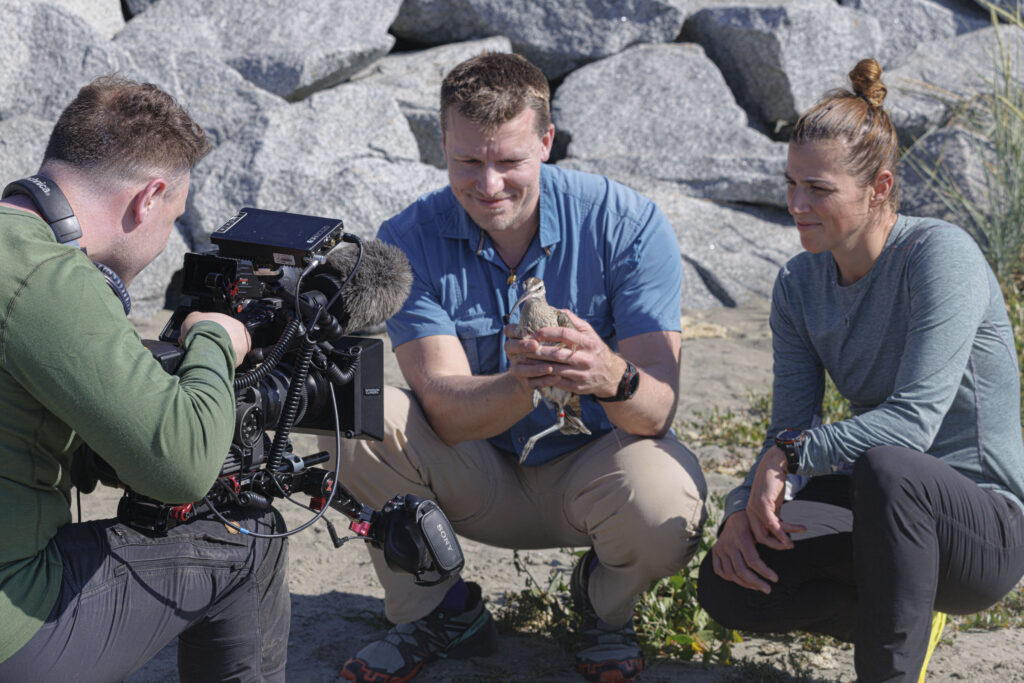
Since 2023, Ocasio has been banding and radio-tracking birds at Hacienda la Esperanza, a nature reserve on Puerto Rico’s northern coast made up of a patchwork of farmland and young forests. He’s also tracking the species in Cañón de San Cristobal, a rugged, patchy forested area between the towns of Barranquitas and Aibonito, about an hour and a half’s drive south of Hacienda la Esperanza.
At Hacienda la Esperanza, he’s found around 2.6 orioles per square kilometer, whereas Cañón de San Cristóbal has around 27 orioles per square kilometer. In both sites, Ocasio has found a slight decrease over the years, though his study is still in progress.
Hacienda la Esperanza has what the birds need—mature Puerto Rican royal palm (Roystonea boriquena) that’s not connected to the canopy for their nests and karst and mangrove forests to forage—but their density is still low compared to Cañón de San Cristobal. “In the highlands, there are very steep, forested cliffs, and they like to forage down in the canyons,” Ocasio said. That’s a main benefit of the radio-tracking, which he does both by hand and with the Motus Wildlife Tracking System—Ocasio can track the birds down into the canyons without having to go there himself.
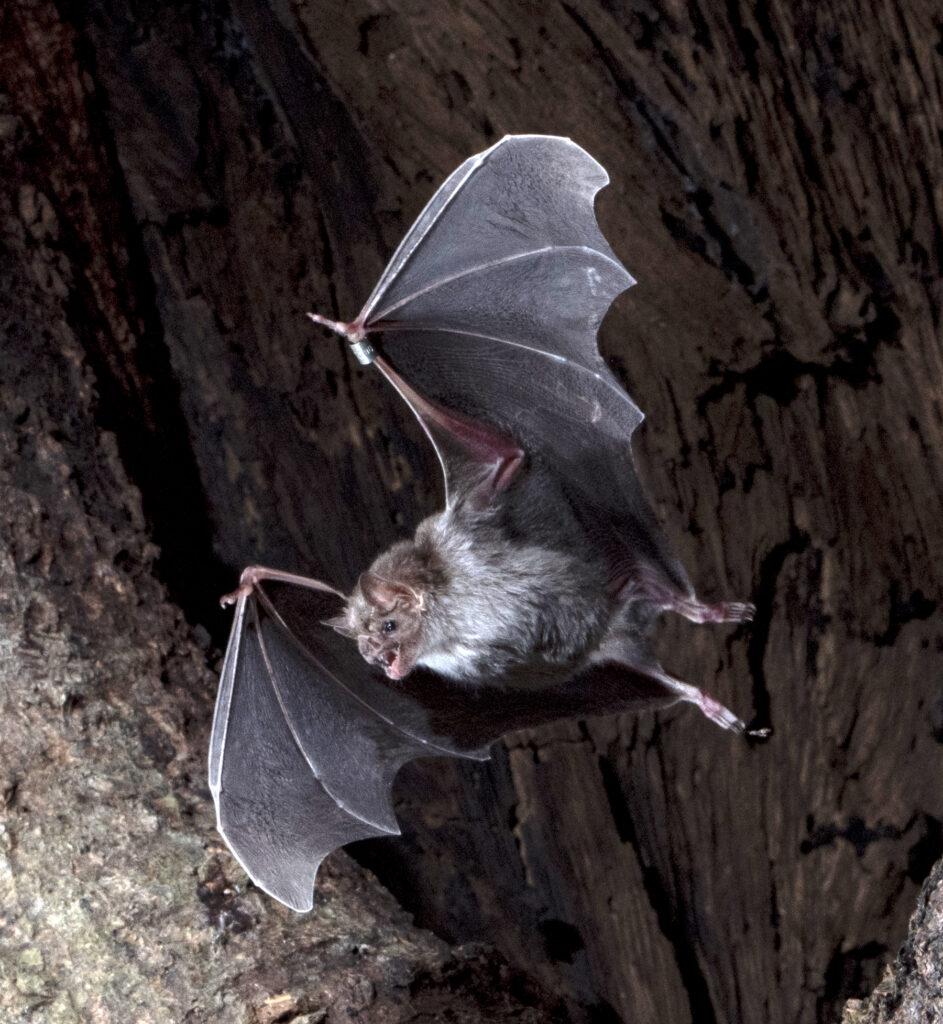
The Motus Wildlife Tracking System is a collection of thousands of stations around the globe that together track nearly 500 species of flying animals, like birds, bats and even some insects. Each animal is tagged with a tiny radio transmitter that pings any Motus stations within range.
Maya Wilson, who is the manager for the landbird monitoring program with international nonprofit BirdsCaribbean, has seen the Motus network in the region boom in recent years. Wilson, who calls the Motus network “banding on steroids,” said BirdsCaribbean began installing Motus stations in the region in 2022, including the one at Hacienda la Esperanza.
Thanks to the many organizations involved in the Caribbean Motus Collaboration, there are now 24 stations across the region in places like Cuba and Tte Bahamas. All Motus data can be viewed on a central database.“All of the monitoring that’s going on is really essential to fill all the information gaps that we have about Puerto Rican endemics, regional endemics and migratory species,” Wilson said. Ocasio, for example, used the Motus trackers to learn more about the seasonal movements of the Puerto Rican oriole, which he’s found stay in the same area pretty much year-round. “Sometimes, they make small dispersals through Hacienda la Esperanza or nearby, but they are rarely in a surprising location,” Ocasio said.
While it may seem like the orioles aren’t faring well at Hacienda La Esperanza, Ocasio said it was a surprise they were even there. He has driven all around the island, through habitats he would consider to be perfect for Puerto Rican orioles, but he rarely sees them. In fact, he and his colleagues almost ditched the study entirely because they couldn’t find enough birds to track. Ultimately, they met the manager of the reserve, Alcides L. Morales-Pérez, who told them about the population there.

Ocasio has also conducted interviews in the suburban areas around Hacienda la Esperanza and Cañón de Cristobal, speaking with several community members and elders. “They pretty much ubiquitously say that they used to have the orioles all over the place,” he said. “And they often think the birds are not even there anymore, because their densities are so low.”
Cowbird, cowbird, oriole
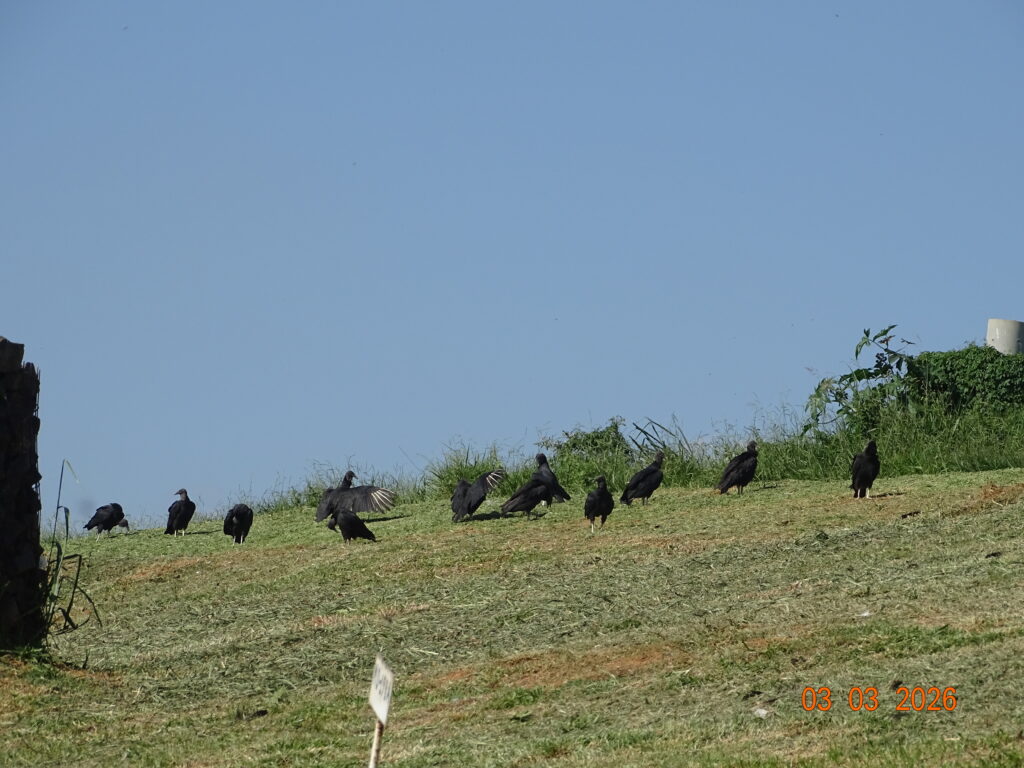
Ocasio said the main cause of the oriole’s decline is likely the shiny cowbird, an invasive brood parasite from South America that lays its eggs in other birds’ nests. The shiny cowbird takes advantage of the carefully built nests and attentive parenting of other species to incubate and raise their young. To keep the host’s eggs from incubating and competing for resources, the cowbird will puncture the other eggs with its beak.
Shiny cowbirds were first documented in Puerto Rico in 1955, having island-hopped from South America via the Lesser Antilles. While hurricanes had likely been bringing stray birds to the Caribbean Islands for millions of years, something was different in the 20th century. By the 1940s, 94% of the island had been deforested. Cowbirds are known to have a distaste for forests. One study documented a negative relationship between brood parasitism and forest cover in Argentina. As obligate insectivores, cowbirds need grassy areas to forage. “If you have enough continuous forests, they don’t infiltrate,” he said.
Ocasio’s advisor, Kevin Omland, has hypothesized that as humans cleared the Caribbean of its forests, the cowbirds, which are native to South America, have finally been able to establish themselves. “They never were able to survive and persist until the habitat was correct for them, which we created through deforestation,” Ocasio said.
Each Puerto Rican oriole nest that Ocasio has found has contained at least one cowbird egg, and he didn’t even find an oriole nestling at Hacienda la Esperanza until 2025. Out of the 93 nests he’s found, 95% of them have failed. “I don’t think we expected the extent of parasitism that we have,” he said—and orioles are likely not the only avian victims on the island. “It’s an important indication that other endemic species are almost certainly also getting parasitized to a pretty high extent.”
Fighting back
The orioles aren’t totally defenseless against cowbirds. If they see one in their nest, they’ll abandon it and build a new one. Other species of orioles use soft materials to build their nests, which can cover up and kill the parasite’s eggs if they’re laid too soon. This behavior hasn’t been observed in the Puerto Rican oriole, though.
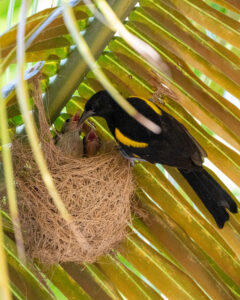
The Puerto Rican oriole’s year-round breeding schedule puts them at an advantage. The sliver of nests that have succeeded were built in January and February, which is off-peak breeding season for shiny cowbirds. Although fewer orioles are also breeding during this window, this temporal escape from the terror of cowbird eggs might be enough to keep the species going. The timing of this breeding could be hereditary, although Ocasio said it’s too soon to tell.
Wildlife managers have been successful managing cowbirds around other endangered species, like the yellow-shouldered blackbird (Agelaius xanthomus), by trapping and removing cowbirds. These birds live in more densely packed communities, and a nest with one or two cowbird eggs is considered a high level of parasitism. For the Puerto Rican oriole, Ocasio finds nests that have 10 to 12 cowbird eggs each.
Ocasio is interested in removing cowbirds around oriole nests in future experiments. The Puerto Rican orioles lay their eggs in the same area every year, often even the same tree, even if their nests were parasitized.
Another, more proactive solution to the cowbird problem, Ocasio said, is more robust reforestation. “If you’re excluding cowbirds from certain areas, they can act as refuge habitats,” he said. Development is a constant threat in Puerto Rico, which is why reserves like Hacienda la Esperanza are prioritizing reforestation within their protected lands.
Buying the species much-needed time
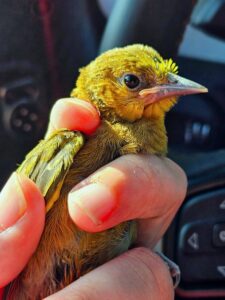
Studies have shown that some birds can deal with novel brood parasites with time. The question is whether the Puerto Rican orioles can hold on for long enough. “In theory, if you can just keep the populations going for that long, they may develop strategies,” Ocasio said, although he’s a little skeptical that these findings are applicable to all species.
In the 2025 State Wildlife Action Plan for Puerto Rico, Ocasio recommended the species’ status be changed from “data deficient” to “vulnerable.” This would mean its inclusion on the U.S. Geological Survey’s list of Species of Greatest Conservation Need, which informs funding and research priorities.
“I’m trying to be a little conservative,” he said. “With limited funds, we want to be realistic about what species we can focus on.” Species’ statuses don’t always reflect the reality on-the-ground. Ocasio questions the Puerto Rican oriole’s listing as “least concern” by the International Union for the Conservation of Nature. “That doesn’t seem accurate, as far as we’re seeing,” he said. He thinks people aren’t noticing the declines because the birds live relatively long lifespans and have a high survival rate as adults—his research has shown about 55% survive annually. “The question is, do they have enough time to replace themselves? Maybe they do,” he said. “But things like hurricanes or droughts, which are becoming increasingly intense, could really lower their survival rates—and then all of a sudden, you’d see a crash.”
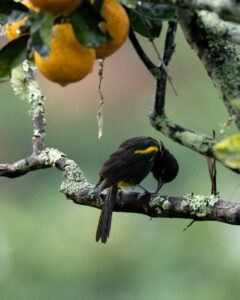
For the time being, Ocasio said he’s not putting energy toward listing the species on the Endangered Species Act. “I’ve been advised that that’s not something worth trying, mainly due to the politicization of it,” he said. He hopes that its inclusion as a species of greatest conservation need will push for more attention and funding for the bird, including research into potential means of cowbird management.
In the meantime, he’s learning all that he can about just one of the island’s many endemic bird species. “Hopefully, my work may inspire some people to look at other species more closely.”
This is part two of a three-part series on habitat restoration and wildlife management in Puerto Rico. The first part is “Rebuilding Puerto Rico’s forests.”
Article by Olivia Milloway