

Roads and survey lines that oil and gas exploration companies built throughout the boreal forest provide coyotes with a fast-track route to colonize northern Alberta wilderness once covered in more contiguous forest.
These features of the province’s oil sands could be helping the ecological balance tip in favor of expanding, generalist species at the potential expense of other species.
“It seems like all this disturbance could be positive for [coyotes],” said Jamie Clarke, a master’s student in environmental studies at the University of Victoria in Canada.
Researchers have described the effect that seismic lines, logging and access roads, pipelines and other linear features have on the ecological balance of the boreal forest of northern Alberta. One study published in 2001 estimated that even then, Alberta had 1.5-1.8 million kilometers of seismic lines that cut through the wilderness. These lines provide “super highways” for predators like gray wolves (Canis lupus), making it much easier for them to exploit ungulate prey like moose (Alces alces) and caribou (Rangifer tarandus). At the same time, white-tailed deer (Odocoileus virginianus) numbers expand in the area due to several factors. A recent feature story in The Wildlife Professional explored this issue at length.
But less work has examined the role that coyotes (Canis latrans) play in this changing landscape. As part of the ongoing Oil Sands Monitoring Program funded by the Government of Alberta and a conglomerate of oil companies, Clarke and her colleagues conducted a study published recently in Ecology and Evolution looking at how energy infrastructure influences coyotes’ associations with the landscape and other species in the northern part of the province.
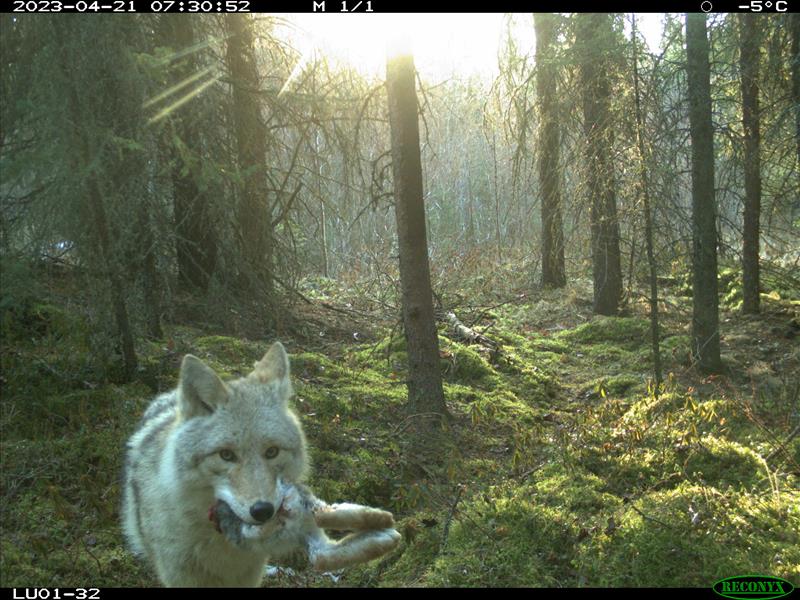
Clarke’s colleagues set out 78 trail cameras in 2021-2022 in landscapes across the oil sands region, with differing types and degrees of industrial disturbance. Then, in 2022-2023, the team set out an additional 155 cameras at different sites. They examined the images for coyotes and modeled coyotes’ relationships with linear and natural features and other wildlife.
Do coyotes use seismic lines?
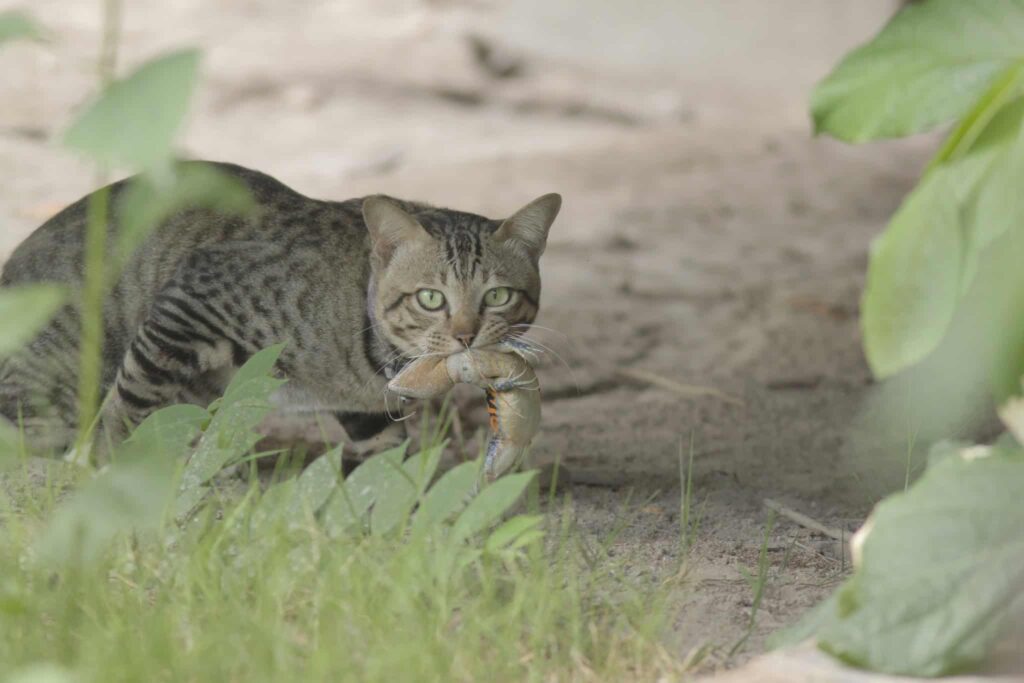
It’s no secret that coyotes tend to do well in human-altered ecosystems, whether that means suburban golf courses or even downtown Chicago. Clarke and her team’s work showed that coyotes were also drawn to oil infrastructure and cutlines. “Coyotes seem to like wide linear features like roads and conventional seismic lines,” she said, adding that they are like highways. “It provides an excellent line of sight to spot whatever they’re trying to eat,” Clarke said. In fact, coyotes preferred these features to natural land cover.
The trail camera photos didn’t reveal much of a relationship between coyotes and ungulates, Clarke said, even though she knows coyotes eat calves. Most of the links they found were between coyotes and smaller mammals—particularly snowshoe hares (Lepus americanus).
Hare populations often go through an ebb-and-flow cycle that lasts about a decade. Part of the reason coyotes were so associated with hares at the time of the study was that the latter were likely at a population peak. As a result, the data didn’t reveal too much competition between coyotes and other carnivores like lynx (Lynx canadensis). “Nobody is really fighting,” Clarke said. “Everybody is just eating a lot of bunnies.”
While wolves are typically dominant, pushing coyotes out of some areas, Clarke didn’t see the same pattern in the oil sands data. This is possibly because the coyotes are scavenging wolf kills, though the trail camera photos didn’t reveal direct evidence of this. It’s also possible that periodic wolf culls to reduce caribou predation help coyotes, which are also known to outcompete small wolf packs for resources on some occasions.
Overall, Clarke said her research on coyotes adds to the evidence that the oil sands and related exploration impacts and infrastructure continue to change the ecology of the Albertan boreal forest. “The speed and the magnitude” of landscape changes really seem to affect what kinds of species are on the landscape and where, she said.
Article by Joshua Rapp Learn