

When Hurricane Helene hit the Asheville area in September 2024, JJ Apodaca was stuck without power for several weeks and had no water for nearly three months. But heavy on his mind was the fate of a salamander species he and his colleagues had just described a few years before that lived in the nearby Hickory Nut Gorge. Surveys had only revealed a couple dozen populations of the Hickory Nut Gorge green salamander, which is sensitive to minute changes in temperature driven by the loss of tree cover—a common occurrence during tropical storms.
Landslides and tree falls had destroyed or blocked the roads to Hickory Nut Gorge, but a GIS expert ran models on the hurricane’s path of devastation, and things looked grim for the area that represented the salamander’s entire distribution.
About a month after the storm, Apodaco and his team finally got a drone into the air, and the images, like the one above, confirmed their worst fears. “Immediately we realized that it was a total loss,” said Apodaca, a TWS member and the executive director of the Amphibian and Reptile Conservancy (ARC). They would have to rescue the population—as much of it as they could find, at least.
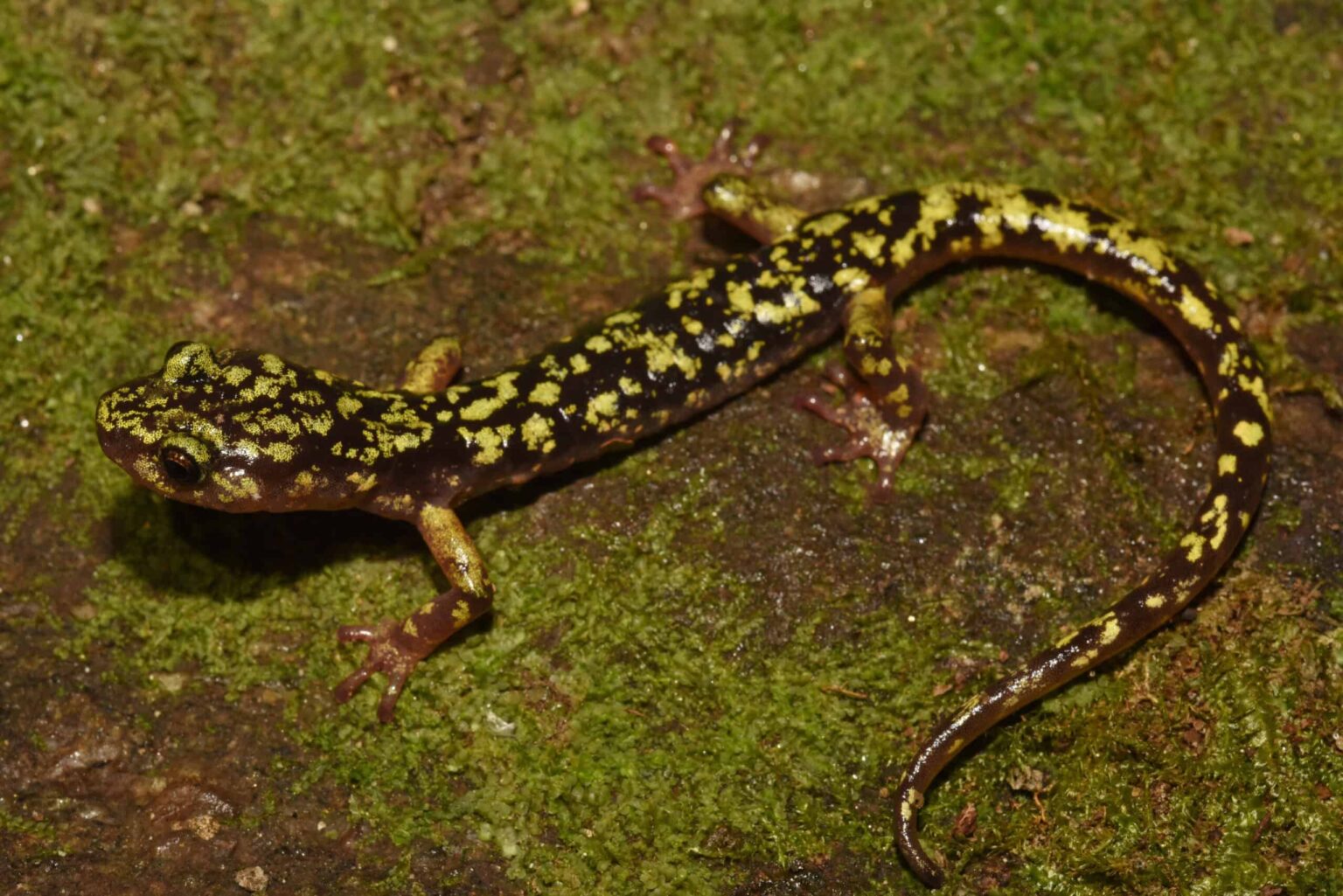
Apodaca led the team that first described the Hickory Nut Gorge green salamander (Aneides caryaensis) scientifically in 2019. These salamanders, formerly considered to be the same species as other green salamanders (A. aeneus), are only found in their namesake gorge. There are only about 20 to 25 populations, and some of these are so small they only consist of a few individuals. The ARC estimates only 300 to 500 exist in the wild, based on years of sampling and population modeling. “Their total range size is a tenth the size of Disney World,” Apodaca said.
The species is currently under review for listing under the U.S. Endangered Species Act due to a shortage of habitat. They typically live in steep, rocky, cliff-like areas with good tree cover. “When they are in their crevices, they look just like moss on rocks—they are a completely beautiful salamander,” Apodaca said. Any loss of tree cover or damage to the cliffside can alter the local temperature, making it unsuitable for the amphibians.
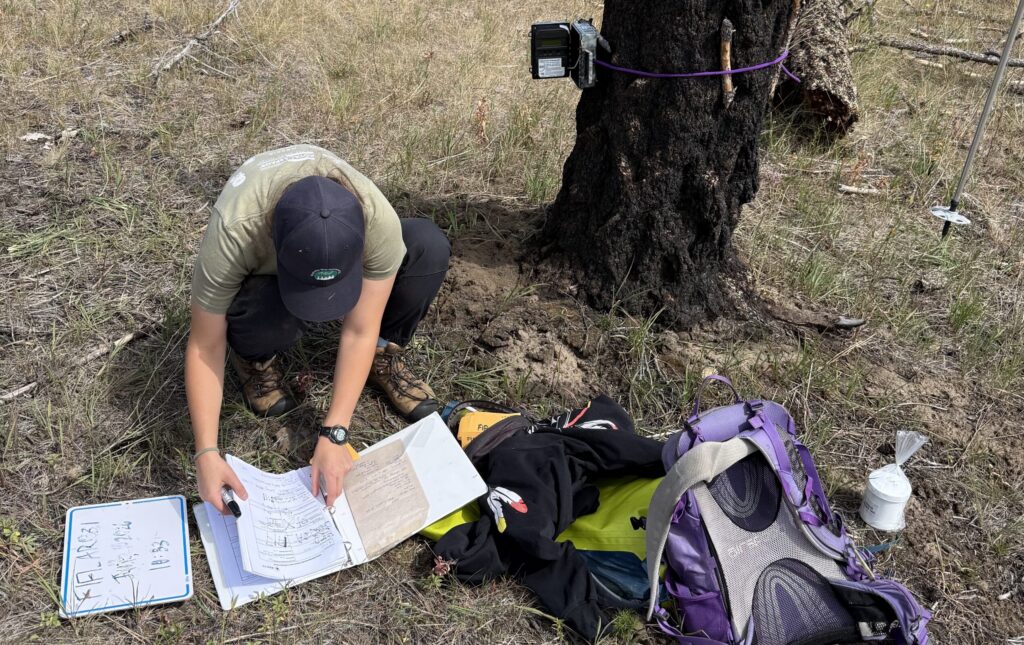
So when Hurricane Helene hit the area, Apodaca and his colleagues feared the worst. It was late spring 2025 by the time a team from the ARC and its partners finally got into the area with a team of safety and rescue staff. “We had to basically go straight up this mountain that was a complete tangle of trees,” Apodaca said.
They began collecting individual salamanders—on the first trip they found just a pair. Over eight trips they collected 15 individuals, including four females with eggs, which they have brought to the North Carolina Zoo in Asheboro—but it wasn’t easy. The U.S. Department of Transportation had to rebuild part of the road, and the team had to cross a newly formed river channel and pick its way through poison ivy, boulders and other debris. The hurricane had uprooted trees and caused landslides throughout the area.
It’s difficult to say what happened to this population, which before the storm was the second largest, with about 10% of the estimated total number for the species. The area is a permanently protected site run by the Nature Conservancy, but the destruction means it’s unlikely to be suitable for many salamanders again in the near future. “We have no way of knowing how many we lost,” Apodaca said, adding that two other smaller populations also disappeared.
In the zoo, the new captive population is doing well. “They are all gaining weight and getting healthy,” Apodaca said.
For now, the partners are going to work on establishing a breeding colony at the zoo as an insurance population. While Hurricane Helene was a rare occurrence, Apodaca said that rainstorms in general have been getting more severe, causing landslides in the steep areas that Hickory Nut Gorge green salamanders prefer. “In some ways, it is a freak accident, but it’s becoming more the norm,” Apodaca said. “We’re seeing huge rainfall events that never occurred before.”
In the future, the researchers hope to find viable habitat to reintroduce the salamander. “We’re going to try to establish a breeding colony, and within the next year or two or three years, we are going to start searching for viable habitat and plan for long-term reintroductions,” Apodaca said. “We can no longer feel good about a couple of sites under state protection or land trust.”
This photo essay is part of an occasional series from The Wildlife Society featuring photos and video images of wildlife taken with camera traps and other equipment. Check out other entries in the series here. If you’re working on an interesting camera trap research project or one that has a series of good photos you’d like to share, email Joshua Rapp Learn at jl****@******fe.org.
Article by Joshua Rapp Learn