


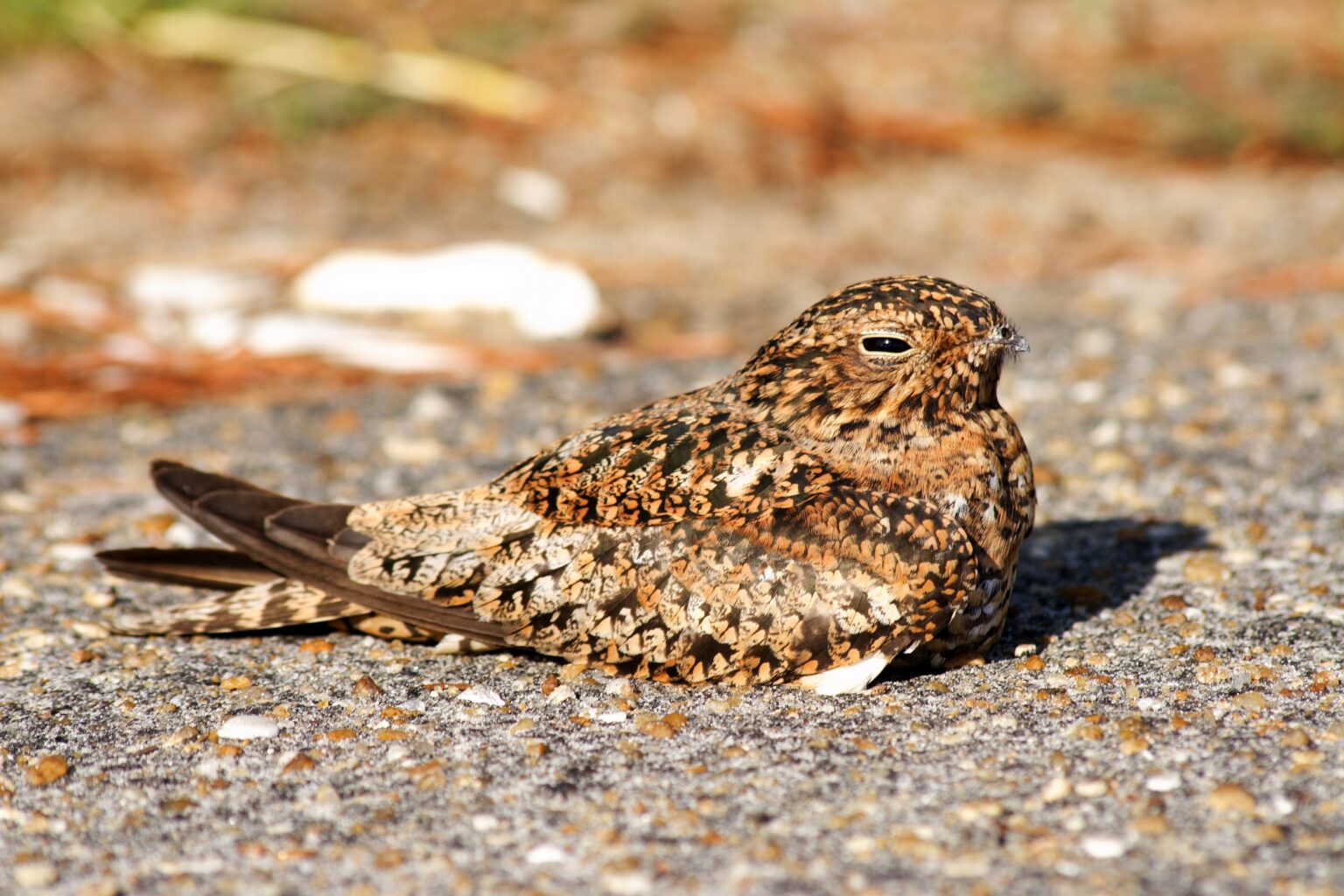
Nighthawks may stay up past the bedtime of most early-rising birds, but they don’t do it to hunt in the neon lights—they prefer the dark.
Contrary to what scientists previously thought, anecdotes about nocturnal nightjars feasting on insects around streetlamps may not tell the full story. The additional brightness may even make things more dangerous for their nestlings.
“It’s generally having a negative impact, especially for nesting areas,” said Carrie Ann Adams, a postdoctoral research fellow at Carleton University in Ontario who wrote a recent paper on these findings in Ibis.
Here comes the boom
The complexity of this question—whether or not insectivorous birds could use artificial light to their advantage—fascinated Adams during her Ph.D. work at the University of Alberta. “I figured I could spend a whole career studying different aspects of it,” she said.
Adams focused on nightjars, a family of birds that includes almost 100 species across six continents. They eat insects and are active outside daylight hours, either fully at night or around dawn and dusk.
There are two different types of artificial light that can affect animal behavior: light emitted directly from sources on the ground as well as skyglow, which is when artificial light is scattered back down toward Earth. “[Skyglow] can make the sky as bright as when there’s a full moon,” Adams said.
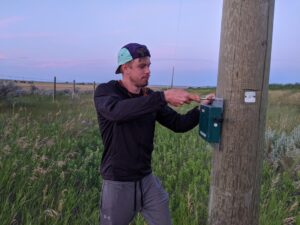
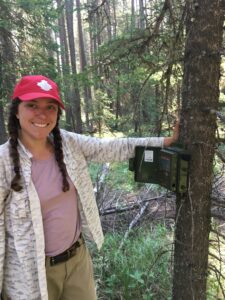
For this study, she focused on the common nighthawk (Chordeiles minor) in two biomes in Alberta: the boreal forests to the north and the grasslands farther south. She collected the majority of her data in the summer months of 2020 and 2021, placing audio recorders set to capture three minutes of sound every 20 minutes.
Adams was interested in studying their behavior, so she needed to figure out where the birds were foraging and nesting. For many species, this would be impossible to tell from a recording alone—you’d need visuals to get a more accurate behavior evaluation.
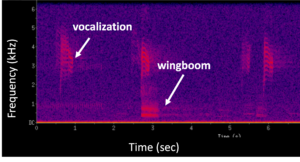
Nighthawks, however, have a unique behavior called wing booming, which they only do in close proximity to their nests. The birds swoop down and pull up quickly, making a booming sound with their wings that can be picked up on the recording. The spectrograms of the recordings made it easy for Adams to pick out the booms. “The nighthawk vocalizations and wing booms are very distinctive,” she said.
The birds tend to wing boom, which scientists think helps establish nesting territories, right after sunset. “If it’s been six minutes and they haven’t done it, they’re probably not near their nest site,” Adams said. From there, she can deduce that they’re foraging.
Shying away from the light
In her past research located in British Columbia, she found there were fewer nighthawks in areas with artificial light, both while foraging and nesting. If they’re in an area with more artificial light, Adams reasoned, predators would more easily locate their nests, as nighthawks are ground-nesting birds that rely on camouflage to hide.
This more recent study added to her past findings. Adams found a strong pattern in Alberta’s grasslands of nighthawks avoiding areas with artificial light. But there was no relationship between nighthawk presence and light in the boreal region, maybe due to how far north and therefore how short the nights are.
There was a slight effect of skyglow on nighthawk behavior, but only on cloudy nights when the effect is amplified. She saw a very slight shift in nighthawk activity to earlier in the morning, although evening foraging times were unaffected. “The skyglow could be signaling them that sunrise is coming, and it’s time to get up,” she said, in a sense “fooling” their biological clock into waking up earlier. But the sample size was low, so there’s still some uncertainty around those results.
While artificial light didn’t affect their daily behavior, she said it did affect where they carried out this behavior.
How to protect nighthawks
Canada’s Committee on the Status of Endangered Wildlife in Canada (COSEWIC) lists the bird as a species of special concern, in part affected by insect declines—declines that themselves have been linked to light pollution.
She said that, at least for Western Canada, this study answers the question of how light pollution is affecting nighthawks. Reducing light pollution by turning lights off when they’re not in use, limiting the brightness of bulbs or lampshades that direct light downward, and other measures can all be helpful.
“The amount of light we can detect from space is growing at around 20% per decade,” Adams said. And in her view, it’s not just about how the environment is responding. In many cities, seeing the stars is already an impossibility, especially during a cloudy night. “There’s also a human right that we have to be able to see the stars,” she said.
Article by Olivia Milloway