

The Wildlife Society will publish more than two dozen papers from the now-defunct Journal of Fish and Wildlife Management.
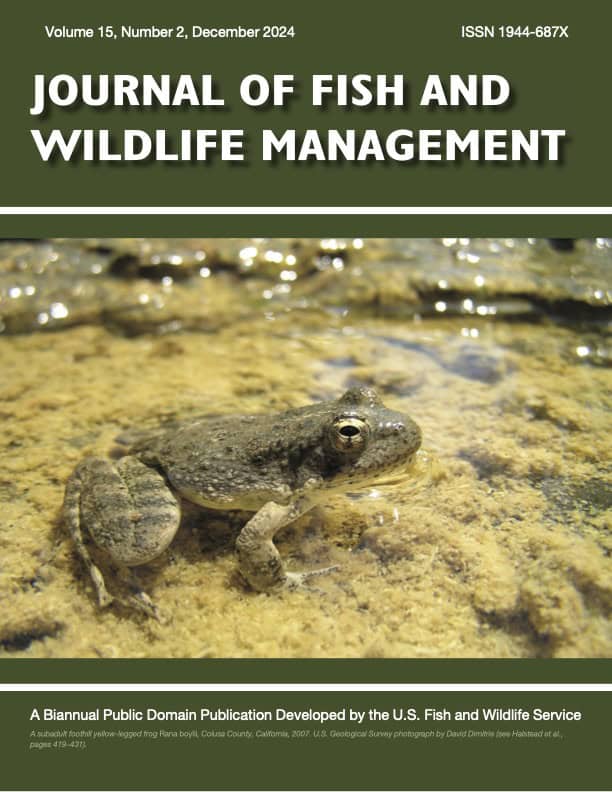
In May 2025, the Journal of Fish and Wildlife Management (JFWM)—a no-fee open-access journal published by the U.S. Fish and Wildlife Service (USFWS)—ceased production due to Department of Interior budget cuts and restructuring, leaving 31 pending manuscripts “orphaned.” These papers, which had already been accepted for publication or were in later stages of revision but not yet published, will now be published in The Wildlife Society’s The Journal of Wildlife Management (JWM) as a special section in the November 2025 issue.
“Peer-reviewed journals are an essential part of scientific communication and crucial to informing policy and management decisions,” said Cameron Kovach, the chief program officer at TWS. “Losing a publication like JFWM is regrettable, as it erodes the foundation our profession has for publishing research through a rigorous process supported by expert scrutiny. I’m grateful that TWS is in a position to step up and support the professionals affected by the sudden loss of JFWM and to provide a platform for their work to contribute to our field’s overall body of knowledge.”
For Allison Cox, the content editor at JWM, this has been an opportunity to support wildlifers affected by this federal funding decision while gaining a deeper knowledge of a diversity of fish and wildlife research. While much of the content is similar to what is normally published in JWM, Cox said that around 40% of the papers focus on fish species, which are not normally covered by TWS journals.
TWS’ publisher, Wiley, agreed to forego its production fees for some of the manuscripts. TWS will cover any additional costs associated with publishing the remaining manuscripts.
John Wenburg, the editor-in-chief and founding editor of JFWM, first reached out to Wildlife Society Bulletin editor-in-chief Bret Collier, who helped find the manuscripts a home at JWM. “There was no deliberation on the idea to step up and give those orphaned articles a home, and we owe Wiley our gratitude in their waiving page charges due to the extenuating circumstances,” said Jacqueline Frair, editor-in-chief of JWM.
Although Frair is grateful JWM can be a home for these more than two dozen papers, she is worried by the loss of the journal. “Going forward, the loss of JFWM leaves an important hole for members of the wildlife community, who now have fewer options for publishing applied wildlife work fully open access at no cost,” Frair said. Another concern is the archive of 15 years of publication in JFWM and more than 130 years of monographs published in North American Fauna, another journal formerly published by the U.S. Fish and Wildlife Service and other governmental organizations during its long lifespan. The archives of both journals will remain on the USFWS’s current website through the end of 2025, although the future of those resources is uncertain.
Wenburg, who is still the director of the Conservation Genetics Laboratory for the Alaska Region at the U.S. Fish and Wildlife Service, wrote an editorial in JWM on the last two decades of working to create and maintain JFWM. “We cannot thank [TWS] enough for finding a way to publish these 31 papers,” Wenburg wrote.
Though he noted a feeling of melancholy to see the end of JFWM, he is proud of what the journal was able to accomplish for the field. “The process mattered, the effort mattered and the products mattered,” he wrote. “There will be other peaks to climb; we will strive on.”
All manuscripts in the special section will be included in a virtual issue, which will be open to the public for three months after publication, titled “Journal of Fish and Wildlife Management Legacy Collection.”
As many federal employees are unable to travel to this year’s annual conference due to new budget and travel restrictions, TWS is extending free access to its 2025 conference mobile app for federal employees. App users can track emerging research topics, view prerecorded content from educational sessions uploaded within the app, message presenters, express support for colleagues, participate in forum discussions and receive real-time updates through the conference social feed.
Article by Olivia Milloway