




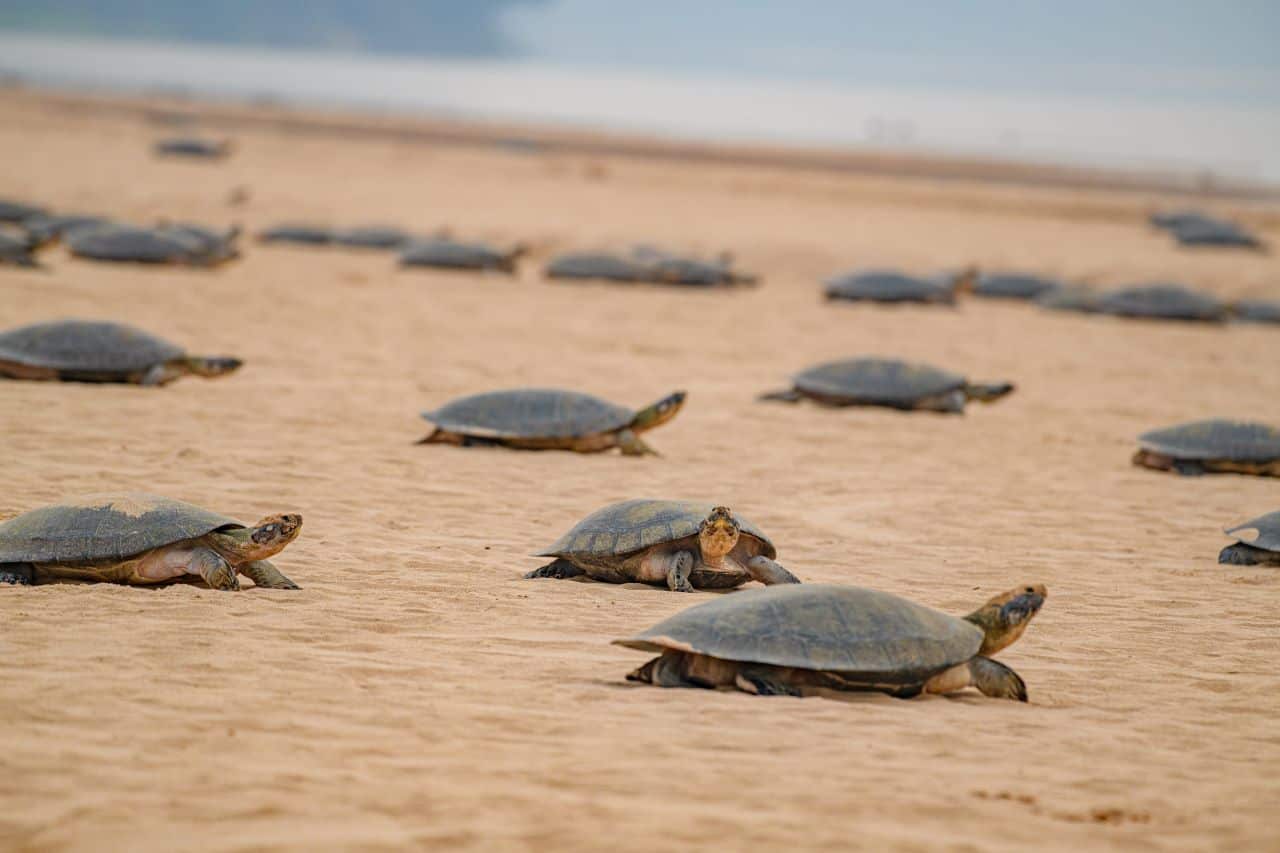
Thanks to developments in drone technology, researchers documented the world’s largest breeding colony of the giant South American river turtle. Their methods, outlined in a new study, combine aerial imaging with statistical modeling and offer a road map for scientists studying other vulnerable species. Female giant South American river turtles (Podocnemis expansa) congregate each year to nest on the banks of the Guaporé River on the border of Brazil and Bolivia. To count these animals without missing or double-counting individuals, researchers from the University of Florida and the Wildlife Conservation Society first marked the shells of over 1,000 turtles with white paint. Then, over the course of 12 days, the team piloted drones over the breeding colony and counted how many marked turtles were present. Based on their calculations, 35% of the turtles present during the breeding event were captured on camera by the drones and 20% of the detected turtles appeared multiple times. Researchers on the ground counted 16,000 turtles, but with the drones and their new models, they found about 41,000 turtles. Researchers said that when population counts vary so drastically, it can be challenging to set conservation goals or assess the status of species. “By combining information from multiple surveys, we can detect population trends, and the Wildlife Conservation Society will know where to invest in conservation actions,” said Ismael Brack, a postdoctoral researcher at the University of Florida’s Institute of Food and Agricultural Science, in a press release.
Read more at UF News.
Article by The Wildlife Society