



Deer eager to mate don’t leave much to interpretation as long as you know what to look for—they leave traces that literally glow.
While scientists have long known the basics of cervid courtship behavior, they never quite captured the full story. By using special flashlights, they discovered that deer scrapes and rubs glow under ultraviolet (UV) light. While scientists haven’t yet confirmed exactly how the deer are seeing these messages, they may be another way for bucks and does to find their perfect match.
“We’re talking about how deer see the world,” said Daniel DeRose-Broeckert, a doctoral student at the University of Georgia (UGA) and lead author of a recent study investigating deer and UV light. “And how anything sees the world has impacts on the decisions they make—what they eat, where they go and how they perceive danger.”
The ‘Kroger bulletin board’ of the forest
DeRose-Broeckert’s findings, which he described in a recent paper published in Ecology and Evolution, are just the most recent installment in a long list of studies from UGA’s Deer Lab that have uncovered some of the secrets of how deer see the world. From the lab’s past work, DeRose-Broeckert knew that white-tailed deer (Odocoileus virginianus) are sensitive to shorter wavelength light—the kind of light responsible for blues, purples and UV light. Humans can’t see UV light because we have lenses that filter out those wavelengths. But deer eyes have different structures. “It’s not confirmed, but common sense would tell you that UV light helps deer see,” DeRose-Broeckert said.
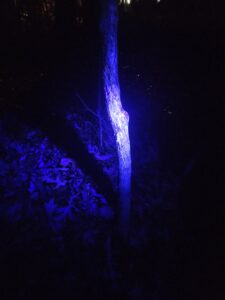
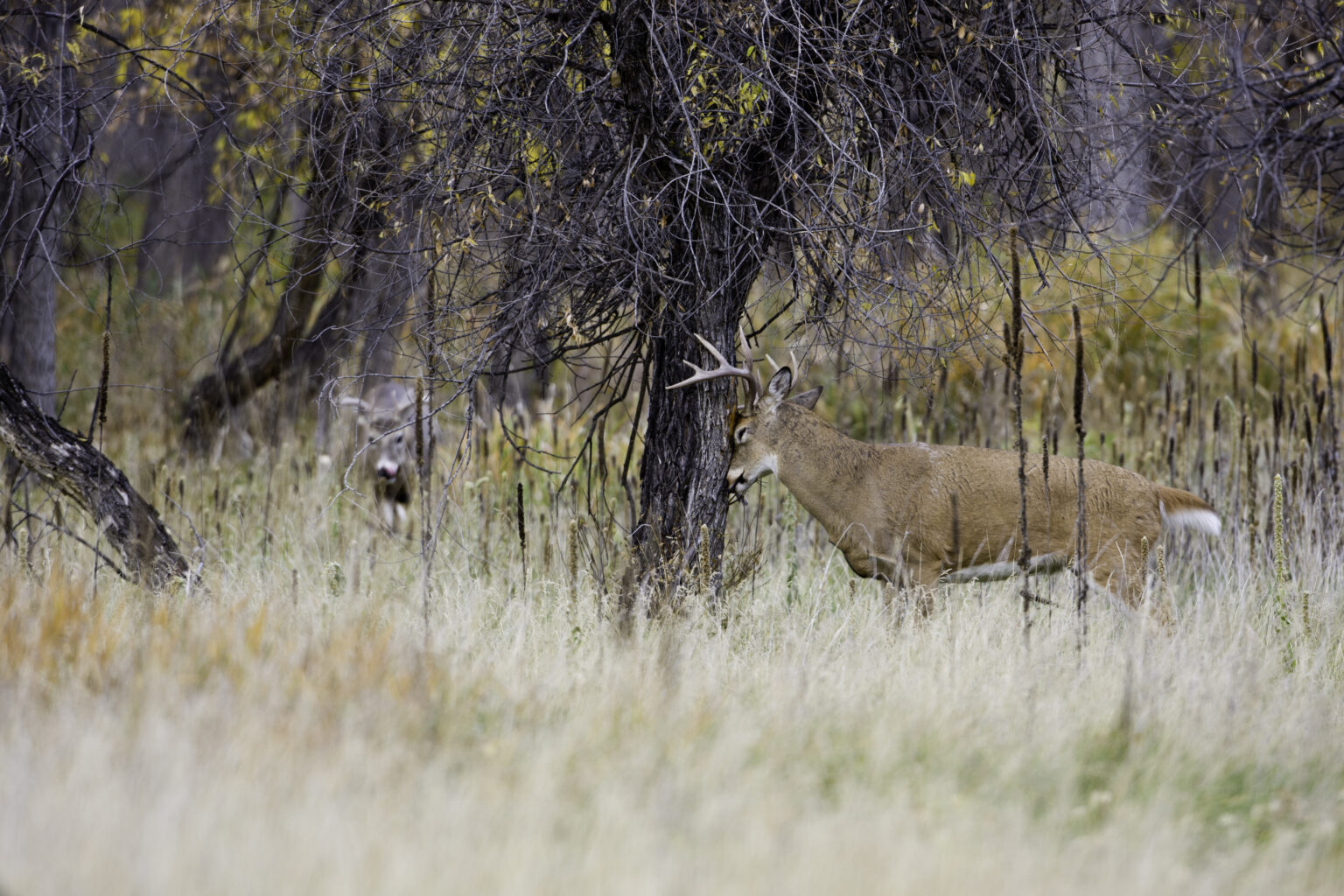
DeRose-Broeckert wondered if deer, like other animals, use UV light to communicate with one another. It’s been long known that bucks rub their antlers on trees during the rut season. Both bucks and does scrape their hooves in the ground and urinate into the scrapes to communicate with other deer in the area. While the bucks are marking their territory and letting their presence be known to other males, females are signaling that they’re ready to mate. “Everyone’s sniffing and checking who might be in [heat],” he said. “And everyone’s sniffing to see who’s the big man in the woods. It’s like the Kroger bulletin board of the forest,” he said, which is a grocery store chain common in the U.S. South and Midwest.
But marks that engage more of the senses, those that “look good and smell good,” would likely be more enticing than smell alone. DeRose-Broeckert took to the woods to search for evidence to back up his hunch.
Follow the glow
During the day, he and his team searched for deer scrapes and rubs in Whitehall Forest, a plot of land near UGA’s campus in Athens, Georgia. He returned to the signposts at night to measure their photoluminescence, or glow, under UV light. He used a spectrometer, an instrument that measures the amount and wavelength of light that a surface emits.
In total, he looked at 109 antler rubs and 37 scrapes and found that both of these markings produced a significant glow under UV light. He also found that the fresher a rub, the more intensely it glowed. Through processes like photobleaching, photoluminescent qualities can get weaker when exposed to the elements.
DeRose-Broeckert also found that the scrapes made before the rut season were less bright than ones made during the rut season. That could be caused by a few different things, he said. “None of the scrapes prior to the rut had urine in them, at least that I could detect,” he said. He detected the urine first by seeing it under the UV flashlight, then confirmed it was urine by giving the scrapes a good sniff, the way a deer would. Urine is also photoluminescent under UV light. DeRose-Broeckert said the urine looked like spilled white paint under his UV flashlight.
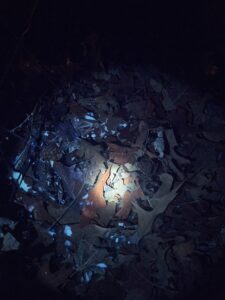
But when bucks make rubs and scrapes, they also deposit smelly secretions from glands on their head and hooves. Some of the compounds known to exist in these secretions glow under UV light in laboratory settings, although DeRose-Broeckert is investigating this more in the wild.
When bucks rub their antlers on trees, the wood itself may add to the glow. Each species of tree looked slightly different under the UV light, reflecting UV light in different ways. However, the case isn’t closed on whether the glow comes from the tree itself or the deer secretions.
Comparing scrapes on the ground and rubs on trees, he said that rubs are like “highway reflectors” because they’re much more visible than scrapes and are often found along a deer path. “It’s not uncommon for you to find them in a line going one direction,” he said. With scrapes, a deer would have to be more or less on top of them to see the urine.
Seeing like a deer
DeRose-Broeckert said his first thought was to apply his findings to deer fencing. Sometimes, deer can get stuck trying to jump over fences. But if the deer can see UV photoluminescence under natural lighting conditions, people might be able to make the top of these fences more visible to deer in a way that isn’t aesthetically unpleasing for a property owner. He also thinks these findings can be used in designing camouflage that won’t be enhanced by UV light.
But he’s still not sure if deer are seeing the UV light the way we do and if the UV light markings degrade over time. “Shining a flashlight at something isn’t the same as what’s out there in the real world,” he said.
But similar to deer, DeRose-Broeckert sees the world differently than most other humans—he’s “very colorblind.” With his own unique view of the world and his new research, DeRose-Broeckert might be one of the people to most fully understand a deer’s point of view.
Article by Olivia Milloway