

Guidelines for Professional Behavior
TWS’ Annual Conference provides an important opportunity for education, exchange of ideas, mentoring young conservationists, networking with fellow wildlifers and engagement with colleagues in a variety of ways. Our hope is that each attendee will benefit from their participation during the conference. Even as we recognize the importance of and strive for diversity in our natural world, we acknowledge the contribution of individual diversity to our profession. As stated in our long-standing Position Statement on Workforce Diversity in the Wildlife Profession, “The Wildlife Society recognizes the value of including the richness of human diversity in our efforts to discover, educate, inform policy and involve the public in wildlife science and management.”
In this light and with the goal of ensuring that the annual conference is welcoming and inclusive for all, we put forward the following guidelines for professional behavior during the annual conference:
- All participants should be treated with respect and consideration, valuing the diversity of views and opinions that may be different than those you hold;
- Communicate with respect for others — critique ideas rather than individuals;
- Avoid personal attacks directed towards conference participants;
- Be mindful of your colleagues and your surroundings;
- Professionalism should be exercised at all times.
The following are examples of behavior that will not be tolerated at the annual conference, including oral and poster sessions and other organized meetings whether at the conference center or off-site:
- Harassment, threats, intimidation or discrimination of any kind or in any form;
- Physical or verbal abuse;
- Verbal comments related to gender, sexual orientation, disability, physical appearance, race, religion, national origin which may reasonably be interpreted as offensive, insulting, or obscene or engaging in any conduct of a stalking or threatening nature directed to any conference participant or attendee.
- Behavior deemed to be excessively loud and/or disruptive of a meeting or any other event taking place during the annual conference.
- Unlawful conduct or activity of any kind.
Reporting of Inappropriate Behavior:
- If you are the subject of or witness conduct in violation of these guidelines at the annual conference please notify a TWS staff member.
- TWS will use reasonable efforts to respond and attempt to resolve the matter in a timely manner respectful of the parties and necessary to ensure the continued integrity and quality of the conference.
- Anyone experiencing or witnessing behavior that constitutes an immediate or serious threat to public safety at our annual conference in the convention center or hotel is advised to locate a house phone and ask for security or dial 911.
TWS at all times reserves the right, in its sole and reasonable discretion, to have individuals acting in an unprofessional manner or contrary to these guidelines removed from the conference or any meeting or event taking place at the conference and the right to prohibit attendance at any future meeting. Attendance at the TWS Annual Conference is a privilege, not a right.
We appreciate your attention to these guidelines and wish you a productive and meaningful annual conference.
Approved by TWS Council – May 31, 2017
Presentation Guidelines
Review your presentation requirements and deadlines to ensure your work is ready to shine at TWS2026.
Oral presenters are expected to give in-person talks in Des Moines, Iowa. Speakers will need to submit two files via the link above (available Sept. 2) or via the link that was emailed to you. Individuals giving oral presentations will prepare a slide deck as well as a recorded version of their presentation. Video presentations will be available on-demand to all TWS2026 registrants via the conference app. Please review the following instructions for preparing your talk. As a reminder, most talks should be 12 minutes.
Your final slide deck (PPTx files only) must be uploaded using this link (or the one received by email) from any computer with adequate internet connectivity a minimum of 12 hours before your talk. You can upload new versions of your talk as desired until that time. Presentations should be 12-minute talk with 3-minute Q&A.
Video files should be submitted by Monday, Sept. 29. You will need to upload an MP4 video file of your talk via the speaker portal, which arrived in your inbox (check your spam folder, too) in late March. There are multiple options for preparing video recordings of your talk, here are a few:
- Zoom – Recording with Zoom Meeting App
- PowerPoint – you can record your talk in PowerPoint and export it as a MP4
- XCD Recording tool – this is an online tool in the speaker portal that allows you to directly record and save your talk. Here is a video tutorial describing that process.
A couple of other tips:
- Always do a short test recording to make sure that your sound and screen are as you wish, then do a final recording and save your recording in case you run into any uploading issues, then you don’t have to re-record.
- If you encounter a “spinning wheel” when you upload your talk, it is very likely that your internet connection speed or computer is too slow, try another network or computer.
- If you run into issues, try another internet browser. We suggest using Chrome.
- We encourage you to further consider the accessibility of your talk by reviewing suggestions on how to prepare an accessible presentation for diverse audiences, shared with us by our colleagues in the IDEA Working Group.
Review your presentation requirements and deadlines to ensure your work is ready to shine at TWS2026.
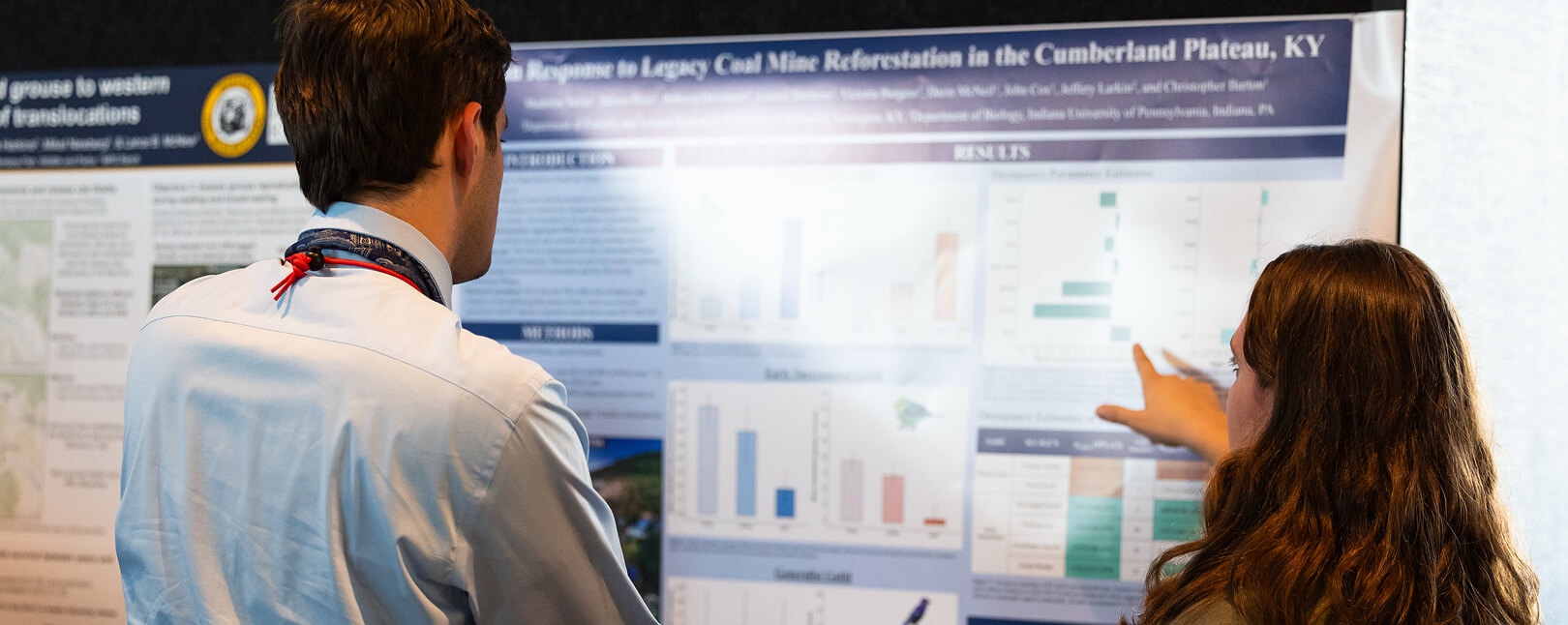
Individuals giving their poster presentation should prepare both a printed poster for display at the conference and a PDF version to upload. Poster presenters may record an optional short video (under 3 minutes) describing their poster that will be available on-demand to all TWS 2026 registrants. Please review the following information related to posting and attending your posters as well as information for uploading a pdf version and optional video for display on the virtual conference platform.
Student Research in Progress Posters should be prepared and printed with final dimensions under 40 inches wide x 48 inches tall.
Contributed Posters should be prepared and printed with final dimensions under 96 inches wide x 48 inches tall.
Tacks will be provided but consider bringing a few extras. Poster numbers will be shared in mid-September.
All posters should be hung on Monday, Oct. 6 between 8:30 – 10:15 am. Poster presenters are expected to attend their poster during the Exhibit and Poster Networking Event on Monday, Oct. 6 from 5:00 – 6:30 pm. Poster presenters are also encouraged to attend their posters during break times on Tuesday and Wednesday morning.
All posters will need to be removed from the poster hall between noon and 3 pm on Wednesday, Oct. 8. Poster tubes left in the poster areas are left at your own risk. TWS is not responsible for missing poster tubes or posters.
PDF and Optional Video files will be due no later than Wednesday, Sept. 24. You will need to upload an MP4 video file of your talk via the speaker portal, which arrived in your inbox (check your spam folder, too) in mid-August. There are multiple options for preparing video recordings of your talk, here are a few:
- Zoom – Recording with Zoom Meeting App
- PowerPoint – you can record your talk in PowerPoint and export it as a MP4
- XCD Recording tool – this is an online tool in the speaker portal that allows you to directly record and save your talk. Here is a video tutorial describing that process
Moderator Tips
Familiarize yourself with the Guidelines for Professional Behavior. As a moderator, you should not only adhere to the Guidelines but also maintain the civility of the discussion for everyone.
Demonstrate respect and consideration for all people. Engage in introductions with session speakers and remember to not make assumptions. Allow individuals to self-identify and seek to clarify pronunciation of names.
Remind participants and attendees about the Guidelines for Professional Behavior and the availability of on-site resources like the Conference Ombuds – Jen Sims.
Be mindful of and listen well to others. Make room for a diversity of voices during sessions. Invite others to engage but be sensitive not to pressure those who have not yet communicated.
Demonstrate that differing perspectives are valued. Be civil and critique ideas—not people—and encourage others to do the same.
Recognize differences of opinion from offense. It is not a violation of the Guidelines to express an opinion, raise research, or describe an experience that is at odds with the opinions of others—if the articulation reflects intellectual rigor and is part of an on-point discussion of the topic at hand. It should not interfere with the reasonable ability of others to participate fully.
Interject as needed to ensure that the Guidelines are being embraced. This includes demonstrating consideration for anyone who appears in distress by promptly stopping the cause, but still pursuing a way to share pertinent information with assistance from TWS if needed.
If you believe that a participant or attendee’s behavior is unacceptable, alert TWS (staff have a red badge ribbon). You may also ask that individual to stop the behavior and comply with the Guidelines. If the behavior continues, you may calmly ask the individual to leave the session and to raise any questions or concerns with TWS. Do not argue with any participant or attendee.
Take time to appreciate the sessions you are moderating. In addition to being a much-appreciated part of TWS’ Annual Conference, moderating a session is an ideal opportunity to expand your network, meet new researchers and benefit your own research program.
Ombuds Resource
The Wildlife Society is pleased to announce the return of Jen G. Sims as the official TWS Conference Ombuds during the 32nd Annual Conference in Des Moines, Iowa, from Nov. 1-5. This action is taken to support the DEI Vision of TWS and the goal of cultivating a safe, welcome, and inclusive conference for our attendees. The Ombuds will serve as an independent, neutral, off-the-record, and confidential resource for conference attendees to discuss any concerns they may have regarding conference-related behaviors and activities. All attendees at TWS2026 are expected to follow TWS’ Guidelines for Professional Behavior.
Meet Jen
Jen (she/her/hers) emphasizes informal methods with which to address situations that aren’t working well for visitors. Jen applies skills of observation, deep listening, inquiry, sense making, and assessment of patterns to uncover possible responses a visitor might consider. She tries to encourage taking multiple perspectives for a better understanding of the situation a visitor is dealing with.
Originally from Chicago, Jen G. Sims now lives in Austin. Jen has her own consulting business focusing on conflict, coaching and ombuds work. Previously she was the Staff Ombuds Office for University of Texas where she founded this office more than six years ago. She is an ombuds because she believes people want to do good work and be respected for the work they do. Though conflicts are inevitable, they also offer opportunities for positive change, learning, and professional development. She has been an ombuds for more than ten years. Prior to becoming an ombuds, she served in a variety of administrative, teaching and research roles for the Hawaii State Judiciary and the University of Hawaii. Jen has experience in mediation and facilitation, counseling and coaching, training and analyzing and interpreting organizational policies and procedures.
Social Media Policy
Welcoming the world to the work of wildlife professionals: How to responsibly share content from TWS2026 and elevate the reach of wildlife science and management.
The Wildlife Society actively encourages the sharing of your conference experience via social media. With over 800 educational opportunities and events planned for Des Moines, social media provides the perfect forum to reflect on sessions, connect with others, brainstorm new ideas, discover new topics, share your expertise and increase public awareness of wildlife science and its applications.
To promote a safe and positive environment for everyone, TWS has established a social media policy for #TWS2026:
- Conference attendees are expected to abide by TWS’ Guidelines for Professional Behavior both online and in-person. All those engaging on social media are asked to maintain respect, courtesy, inclusivity and support in their conduct to ensure a safe, hospitable, and productive environment for all. Let’s make room for many voices. Harassment, intimidation, or discrimination in any form will not be tolerated by The Wildlife Society.
- TWS encourages presenters to include social media handles and/or hashtags in their presentation or poster if they welcome sharing via social media. Please request permission from presenters and/or attendees featured in your post prior to sharing.
- Please give proper credit to any presenters/researchers whose presentation and/or research is featured in your posts.
- Consider including the conference hashtag #TWS2026 in your social media posts so conference attendees may stay up-to-date on the latest educational and networking content for that day.
- Lastly, have fun! In addition to sharing your research, we encourage you to share pictures of your conference adventures with friends and colleagues. Tag us on Facebook, X (formerly known as Twitter) and Instagram and use the hashtag #TWS2026.
Anyone may participate in conversations on TWS’ social media channels, but must abide by the community guidelines for each platform:
- Instagram Community Guidelines
- Facebook Community Standards
- X Rules and Policies, including The X Rules
While we aim to leave comments as posted, TWS reserves the right to remove any posts or comments that we feel violate any of the aforementioned policies at our sole discretion.
Thank you in advance to everyone for following these guidelines and for helping us to maintain a welcoming environment for all. We look forward to seeing your thoughts and discussion online.