




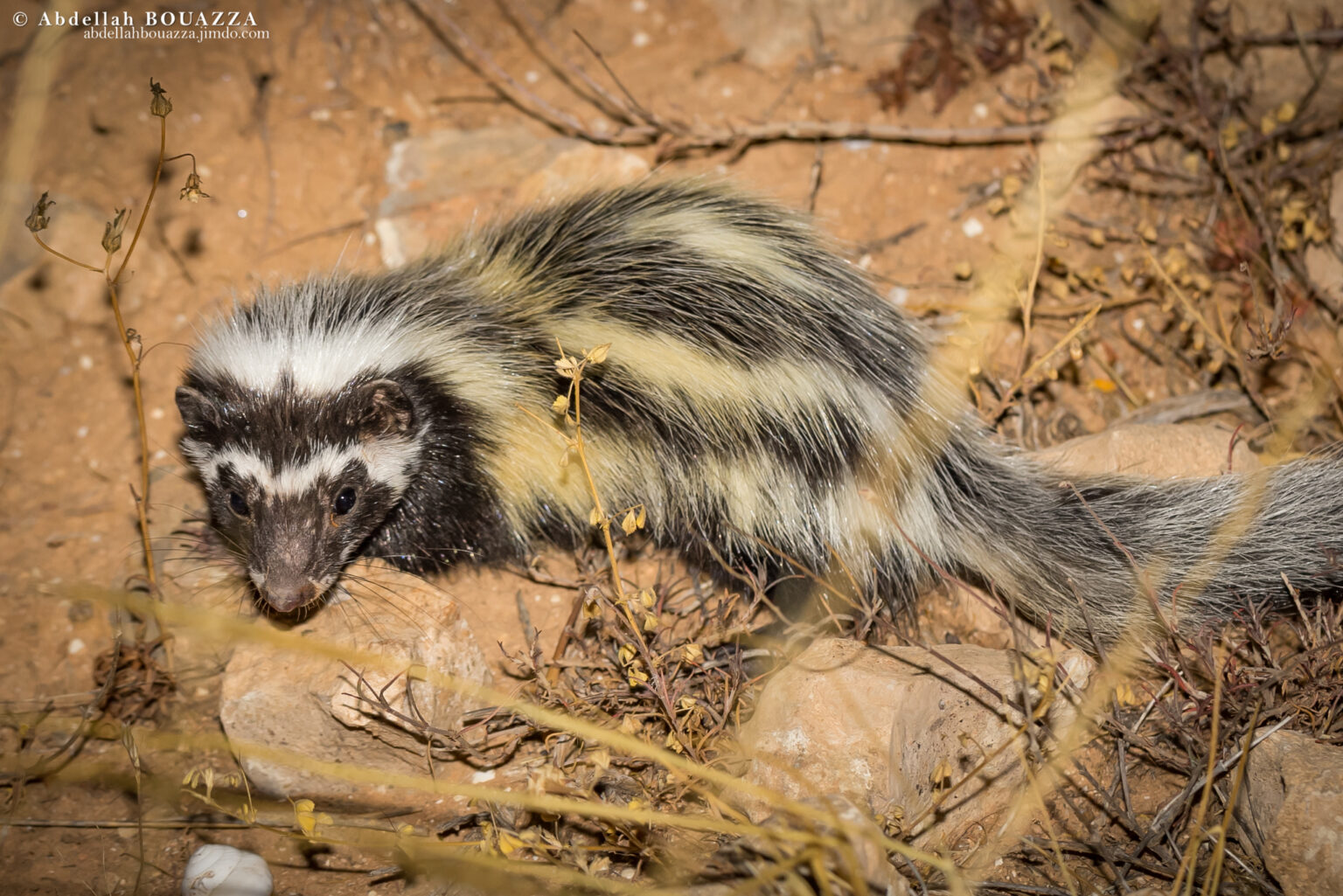
How do you capture a creature so feisty that it eats scorpions and venomous snakes for dinner? New research shows that catching Saharan striped polecats with hand nets, rather than metal traps, is the best—and arguably most fun—way to capture the animal.
“I had to be very fast to trap them,” said Firas Hayder, a postdoctoral researcher at Sol Plaatje University in South Africa.
The animals, which are in the mustelid family that includes weasels and otters, are used for traditional medicine in Tunisia and surrounding countries. Although often hunted and common in the pet trade, there has been very little research on Saharan striped polecats (Poecilictis libyca).

In research recently published in the Wildlife Society Bulletin, among the first studies of carnivores in Tunisia, researchers compared two methods to capture the polecats: cage traps versus spotlights and hand nets at night.
The researchers found that hand nets were far superior to cage traps for capturing the animals. Furthermore, radio collars—which might work well on other species—need to be tweaked for use on the polecat.
Small but mighty
The Saharan striped polecat is a small black and white mammal that grows to about nine to 11 inches long, not including its bushy tail, and weighs about as much as a can of soup. To Americans, it may resemble a skunk, although it’s much more closely related to honey badgers (Mellivora capensis). Like honey badgers, polecats are among a few mustelids that have glands on its rear that spray a foul-smelling fluid when the animals feel threatened.

Originally from Tunisia, Hayder began his PhD work at the University of Fort Hare in South Africa working with Emmanuel Do Linh San, a Swiss biologist who has been working on small carnivores on the continent for about two decades. When he first set out to trap polecats, Hayder’s problem was that no wildlife biologist had systematically studied them before, and he didn’t know the best way to trap them. He turned towards the community that had been living alongside them and hunting them for years.
During his doctoral research on the animal, Hayder spoke with local hunters in Tunisia to learn about their perception of polecats. Based on his interviews, he learned that that hunters and their ancestors have harvested polecats for centuries to use their meat to treat diseases that resemble cancer both in humans and in domestic animals like camels, horses and donkeys. “They’ll say, ‘Camels are really expensive, and polecats do nothing for me, so I’d rather prefer to save the camel,’” Hayder said.
But polecats are important for the native ecosystem, especially when it comes to controlling wildlife that can potentially harm humans like scorpions and venomous snakes. Hayder’s interviews revealed that polecat populations have decreased a lot in recent years, especially in the northern parts of Tunisia where an increase of development has destroyed ecosystems with undisturbed, sandy soils crucial to their survival.
Some community members had subsequently noticed an uptick in venomous creatures as the polecat populations decreased. Conversely, in another part of Tunisia, local people detected a decrease in snakes and scorpions as the polecat populations increased.
Saharan polecats are listed as “Least Concern” by the International Union for the Conservation of Nature. But that doesn’t account for the differences across its range, which includes 15 countries and territories around the Sahara Desert, Hayder said.
Ninety-six Saharan nights
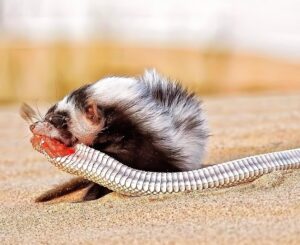
During his interviews, Hayder learned how to track down polecats from the experts. Local hunters look for signs of polecats and then dig up their burrows to capture them. He also learned that because polecats bite snakes in half and then drag them to their burrows to eat them, signs of the carnage often trace right to their homes. “[Hunters] told me that in the desert, they can usually find the burrow from snake tracks,” he said.
Hayder couldn’t just dig up a burrow as he didn’t want to destroy the polecats’ homes. Instead, he tried out two different methods to capture the animals. One of his methods was using baited drop-door cage traps. His efforts were futile—he didn’t catch a single polecat during 96 nights of trapping. They seemed to know they were walking into a trap. “Cage traps weren’t good enough, because we saw [polecat] footprints in front of the cages,” Hayder said.
Instead, Hayder and his colleagues tried a different technique using a combination of spotlights and hand nets. First, Hayder found the animals using a spotlight that reflected their eyeshine. They stopped the truck as close as they could, but sometimes he had to run more than 150 meters because the vehicle couldn’t get close though. With a hand net made from sewing fishing nets onto an aluminum hoop attached to a wooden handle, Hayder then went in for the catch. “Chasing these small, elusive animals at night can be exhausting, but also very exciting,” he said.
The polecats forage near their burrows at night, and if Hayder wasn’t quick enough, they would retreat underground. At that point, it was very challenging to capture the animals. Hayder remembers the feeling he had the first time he caught a Saharan striped polecat. “It was like a dream,” he said.
Chasing the small animals through tall grass was a big challenge, though the team still captured 49 polecats. But the hard part wasn’t over yet. After catching the mustelids, Hayder recorded their weight, size and 22 other physical traits and then fitted radio collars. The first time he brought a polecat into the veterinarian’s office for sedation and data collection, the animal sprayed the doctor. “Later, when a technician arrived, he thought there had been a gas leak,” Hayder said.
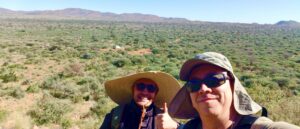
He learned a few important things from this study, including previously unknown information about their home ranges, behavior and movement. The polecat’s home range is quite large for a mammal of its size: on average, 208 hectares for males and 107 hectares for females. He found that it’s rare for two polecats to sleep in the same burrow, unless it’s during mating season. They also move around quite frequently, using an average of 30 to 35 different burrows per season. While they are active mainly at night, they sometimes come out during the day during the cold winters, perhaps to do a little “sunbathing,” Hayder said.
Males and females also maintain strict territories that become even stricter in the winter, perhaps due to less abundant insect and reptile populations in the colder weather.
But he also learned about the limitations of radio collars. Collars need longer antennae in burrows to create a stronger signal, although they must be made out of a durable, flexible material. “Make sure that you work with the company to have material that is appropriate for specific study species and area,” said Do Linh San. Polecats also don’t tend to move their heads up and down, which is how many activity sensors on radio collars work.
Based on what he learned in these early studies, Hayder has a few suggestions for how to protect the Saharan striped polecat. Agriculture is especially disruptive. “When there is plowing in the soil, the animals leave their burrows,” Hayder said. He advised locals not to plow an entire area at once, but give time for the polecats to find a stable burrow someplace else. He also thinks that some areas should remain without agriculture or development as a natural sanctuary.
“In a little over two years of fieldwork, he collected enough data for five or six papers,” Do Linh San said.
Now, Hayder is studying the sister species to the Saharan striped polecat that lives in South Africa, the zorilla (Ictonyx striatus), as well as human-carnivore conflict and conservation in North Africa.
Article by Olivia Milloway