





Trail cameras and acoustic detectors can put eyes and ears in the sky to survey flying squirrels, but those methods still may not be able to help researchers tell the difference between a northerner and southerner.
“Flying squirrels are really easy to pick up on trail cameras and really easy to pick up [using] acoustics,” said Amanda Cheeseman, an assistant professor in wildlife biology at South Dakota State University.
Improving the use of these technologies could help researchers track the northward range shift that southern flying squirrels (Glaucomys volans) and northern flying squirrels (G. sabrinus) are potentially experiencing in New York state, with the former entering from Pennsylvania and New Jersey, displacing the latter into Canada.
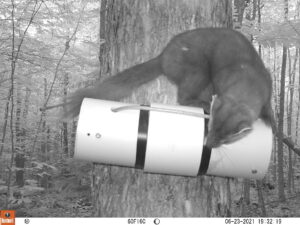
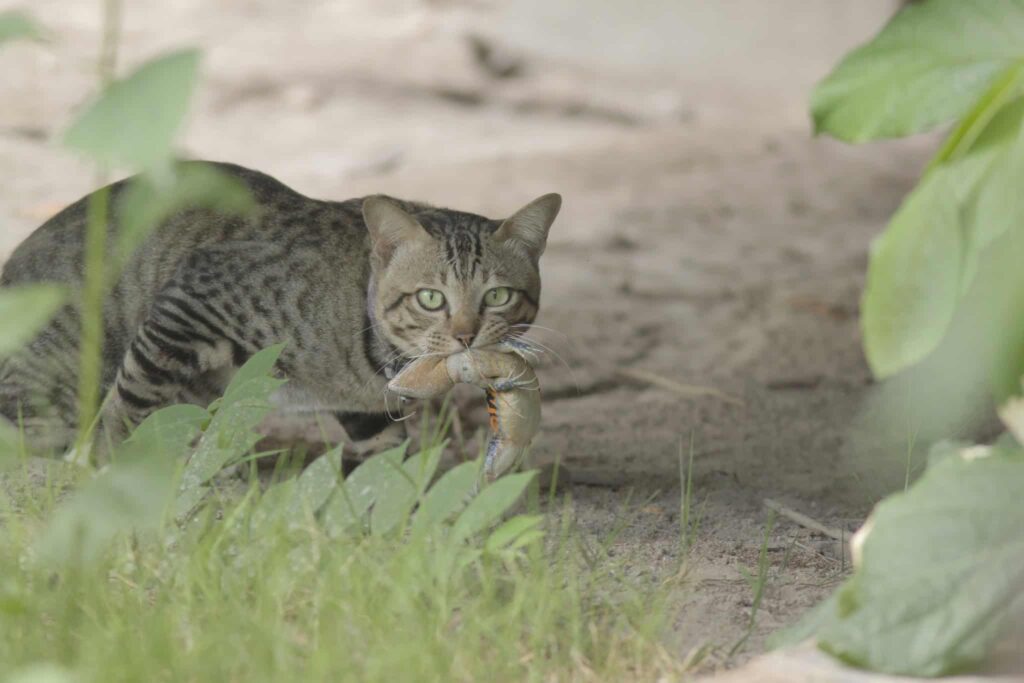
Since 2018, researchers have been mapping the distribution of wildlife, such as martens (Martes americana), like the one pictured above, as part of the New York Mammal Survey, a large joint monitoring effort between the State University of New York’s College of Environmental Science and Forestry and the New York Natural Heritage Program. But flying squirrels present a unique challenge among mammals. “They are nocturnal, they are fast, they are small,” Cheeseman said.
Previous surveys mostly involved using wire mesh live traps, but they didn’t work particularly well. “They are notoriously neophobic—they can be very difficult to trap,” Cheeseman said.
Catching flight
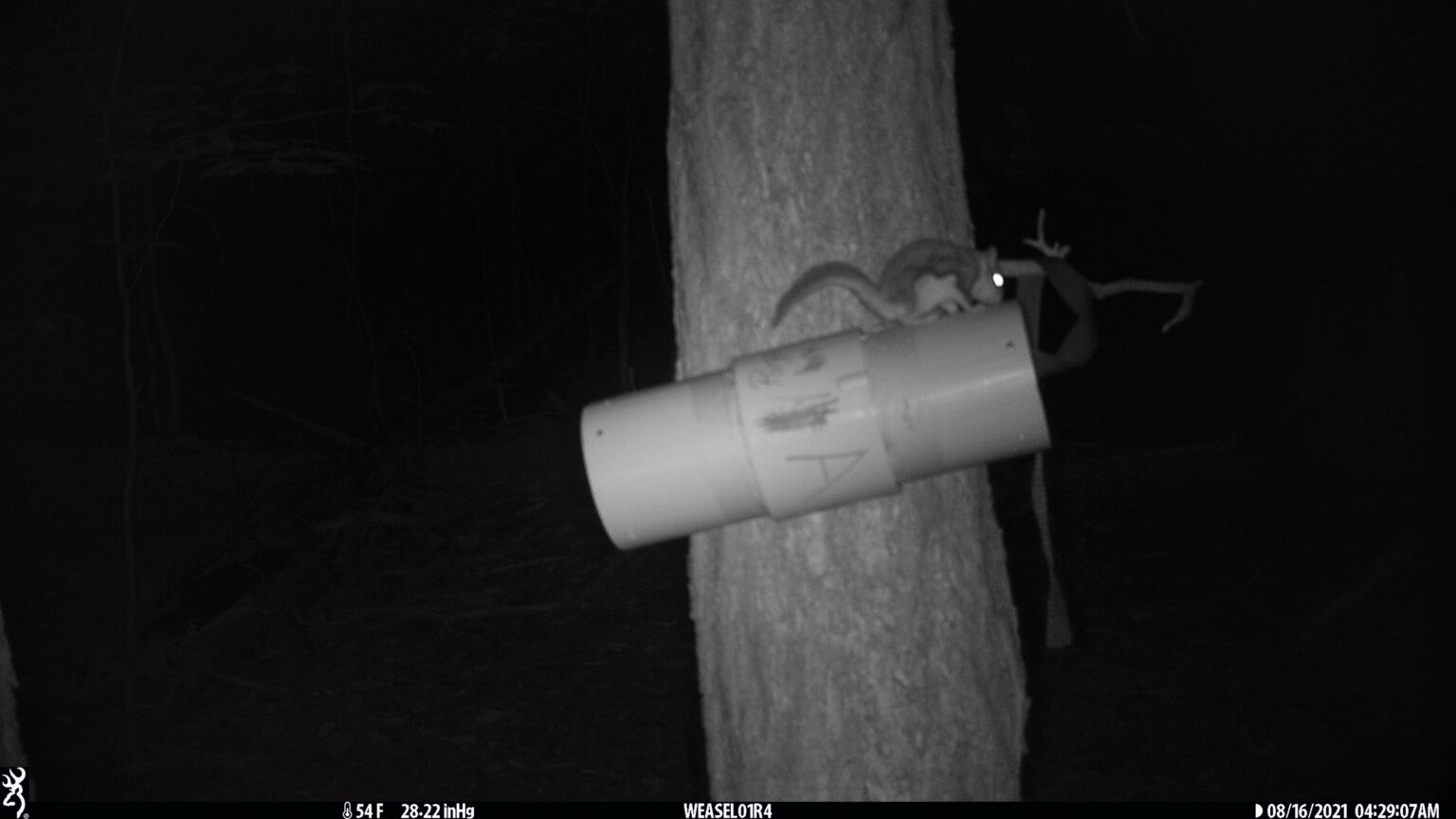
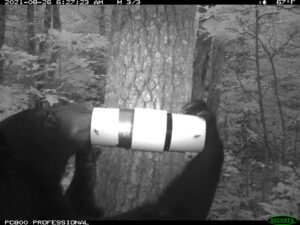
In a study published recently in The Journal of Wildlife Management, the team decided to take a new approach, using a combination of low-cost AudioMoth acoustic recorders and trail cameras fixed to trees about 2 meters above ground. They baited the area surrounding the trail cameras with a peanut butter-based birdseed blend inside PVC piping so that bears couldn’t get to them.
Flying squirrels communicate using chirps unique to the northern and southern species. “They’re very chatty; they make a lot of different noises,” Cheeseman said.
They also have different markings on their bellies—northern flying squirrels are a little bigger in size, with some dark gray at the base of their fur, while southerners usually have uniformly white bellies.

The team deployed the devices across 57 sites in New York state, from the western side to the Adirondacks and throughout the central area. Some of the sites only had trail cameras, while others only had acoustic recorders. About half of the sites had both devices.

“Some of those sites were pretty remote, but a really beautiful area,” Cheeseman said. Her team had a lot of time to appreciate the scenery once when they got trapped for half a day behind a concrete truck that flipped over on the logging road they were on.
The team found that both methods were better at detecting squirrels than the wire mesh traps were. The northern species speaks more quickly than their southern counterpart, but both squirrels make ultrasonic chirps like those of the hoary bat (Lasiurus cinereus). The researchers found that the resolution of the recordings wasn’t always good enough to tell the difference between the two squirrel species or between the squirrels and hoary bats.
They did find that the audio recordings detected the sounds better at the beginning of the spring, when both squirrels make more trill calls, such as the one above. These calls related to the breeding season are easier to differentiate between species. Later in the season, squirrels don’t trill as much, mostly sticking to chirps, which are much harder to distinguish between the species. With AudioMoth detectors, researchers couldn’t fully analyze the chirps—just the trills, Cheeseman said.
“We were somewhat limited in the types of calls we were able to evaluate,” she said.
Squirrels flying through cameras
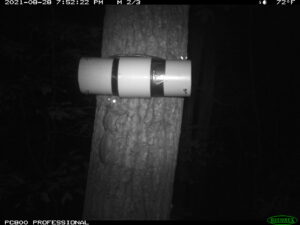
Trail cameras worked well to detect flying squirrels from spring to fall. But one challenge with the cameras is that the squirrels don’t often cooperate by showing their bellies, so it was also hard for researchers to determine the difference between northern and southern squirrels based on photos much of the time.
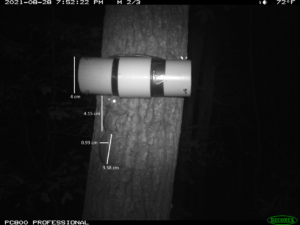
The researchers could only tell the difference between the species 27% of the time based on size or belly patterns—the squirrel in the photo above is a southern flying squirrel.
Unfortunately, the researchers couldn’t yet confirm what they anecdotally suspect—that more common southern flying squirrels are displacing the less common northern flying squirrels in the state.
But Cheeseman said that in future flying squirrel surveys, she would recommend using sound recorders earlier in the year during breeding season. If surveys are conducted later, trail cameras or higher-end acoustic recorders may be more reliable.
The authors said that researchers could optimize future surveys by shortening the trigger delays on the cameras and leaving them out in the season for longer. As for the sound recorders, improvements in detector sensitivity for AudioMoths or using high-end acoustic recorders could help differentiate between the two species of squirrels and hoary bats.

This photo essay is part of an occasional series from The Wildlife Society featuring photos and video images of wildlife taken with camera traps and other equipment. Check out other entries in the series here. If you’re working on an interesting camera trap research project or one that has a series of good photos you’d like to share, email Josh at jl****@******fe.org.
This article features research that was published in a TWS peer-reviewed journal. Individual online access to all TWS journal articles is a benefit of membership. Join TWS now to read the latest in wildlife research.
Article by Joshua Rapp Learn