


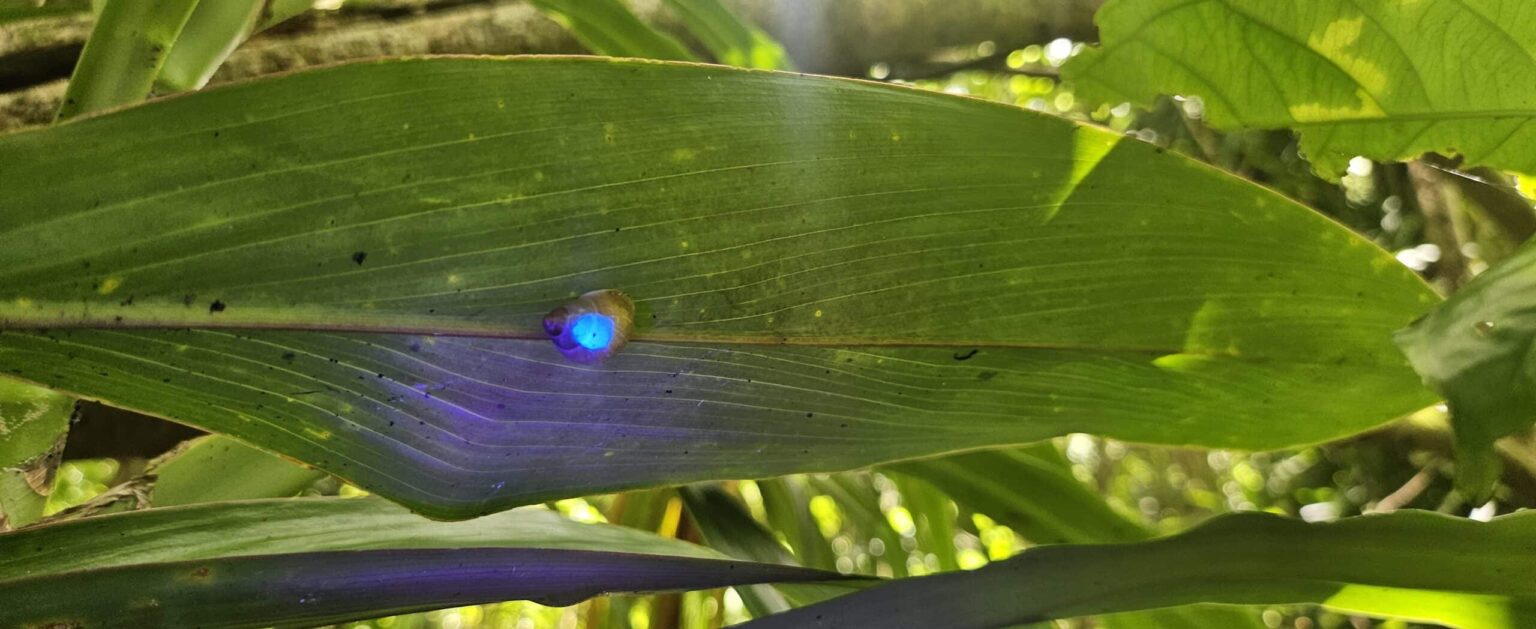
Before their journey back into the wild, each tiny Partula snail received a small streak of reflective paint, glowing electric blue under a ultraviolet light at night in the Pacific islands of French Polynesia. Partula snails are nocturnal, and the paint turns them into a shifting constellation, slowly moving in the leaf litter, allowing the researchers applying the colors to monitor the released snails and track the species’ recovery. These snails were part of a pivotal boost this year for a slow-moving conservation success story—more than 7,000 zoo-bred Partula snails were released into the wild across four islands in French Polynesia. This year’s release marks the largest reintroduction of snails—some formerly listed as “extinct in the wild” by the International Union for Conservation of Nature, since releases began 10 years ago.
Wild Partula populations declined significantly in the 1980s and early 1990s due to the introduction of invasive predatory snails, prompting conservationists to rescue the last individuals of 15 species. They brought them into captivity and initiated an international breeding program.
Efforts like these have resulted in the 2024 downlisting of the Moorean viviparous tree snail (Partula tohiveana) from “extinct in the wild” to “critically endangered.” This year brought two more milestones: the first wild-born Moorean viviparous tree snail found outside the release area and the first Polynesian tree snail (P. varia) born in the wild in over 30 years.
“This exciting news demonstrates the power of conservation breeding programs and carefully planned releases in bringing species back from the edge of extinction,” said Fiona Sach, a conservation manager at the Zoological Society of London involved in one of the captive breeding programs, in a release.
Read more at the Zoological Society of London.