


Super Bowl LX was full of excitement—including what was likely the first-ever amphibian to make an appearance during the halftime show. Concho, an animated Puerto Rican crested toad named after its Spanish name, sapo concho, had a brief moment in the limelight at one of the most-watched television programs in U.S. history.
Bad Bunny features Concho throughout the visuals, music videos and merchandise for his album, Debí Tirar Más Fotos. The now iconic toad has helped raise awareness about the plight of Puerto Rico’s natural patrimony and cultivate a sense of pride among Puerto Ricans around the world.
Until recently, the Puerto Rican crested toad (Peltophryne lemur) was a little-known endangered anuran living only on its eponymous island. Few people on the island—let alone off the island—could identify it in a lineup. But that changed when Puerto Rican artist Bad Bunny released his Grammy-winning album in January of 2025.
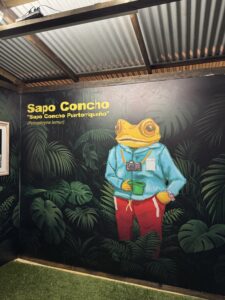
Conservationists across North America have already had the toad in the spotlight, which had at one point nearly disappeared from the island entirely. With only one natural population remaining, wildlife biologists are working hard to save the species from extinction through a captive breeding and reintroduction program. Little by little, their efforts are working.
This slow recovery is giving hope to Puerto Rican conservationists, who are working on a series of projects to make the island’s varied ecosystems more resilient and preserve endemic species into the future.
This is the last installment of a new, three-part series by The Wildlife Society on these efforts. Part one covered forest restoration for endemic birds; part two dealt with the plight of a native species in the face of a new parasite; and part three will tackle the fight for the Puerto Rican crested toad.
Meet the sapo concho
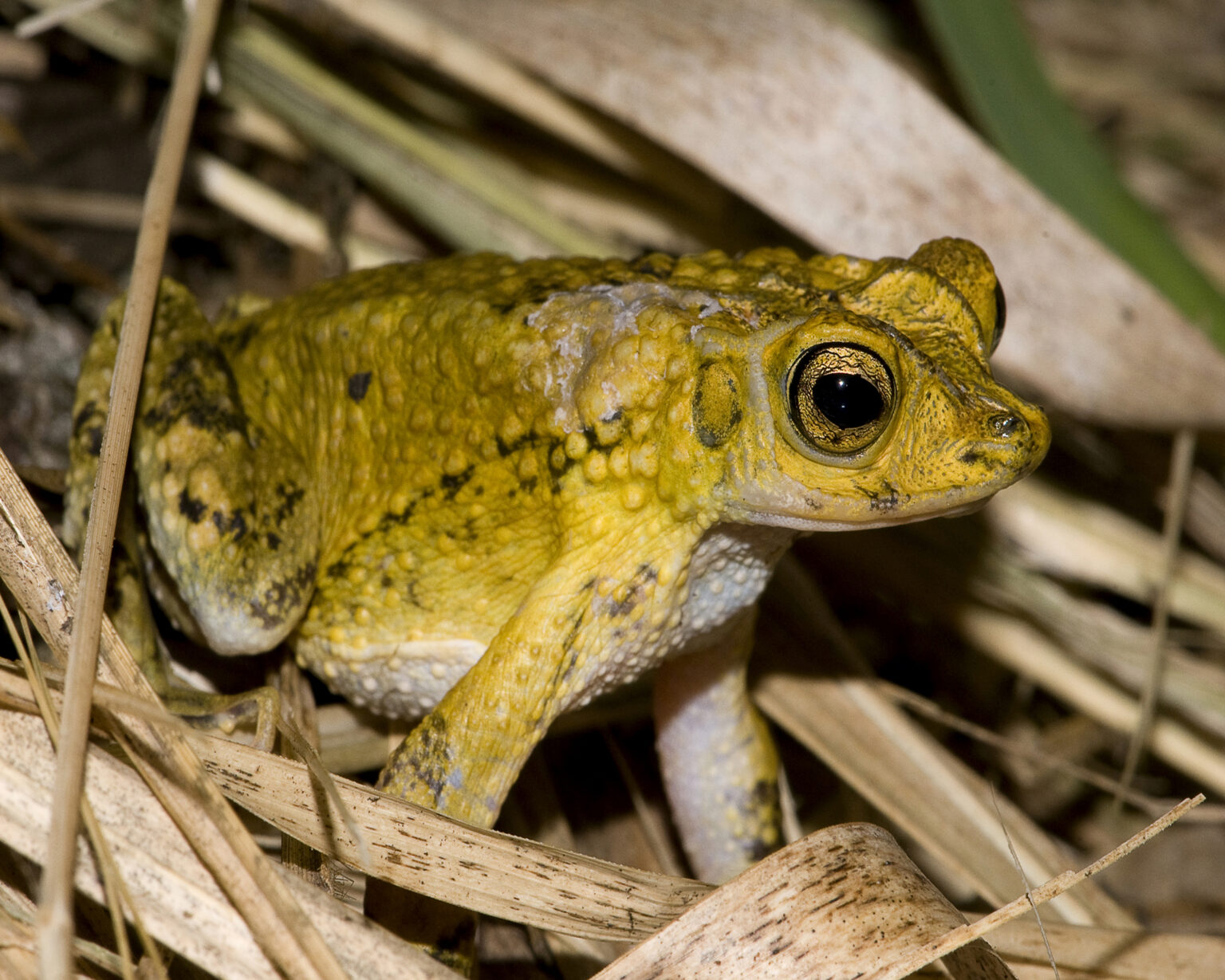
The sapo concho is the island’s only native toad. It has a distinct button nose. The males, which are a bit smaller than the females, turn yellow along their sides during the breeding season. Around the size of a credit card, the crested toad has large, gilded eyes and two rigid crests running across the top of its head. The juveniles are brown with dark chevron markings on their backs, which can last until they’re around two years old.
Locals often confuse them for cane toads (Rhinella marina), an invasive species on the island that can also be yellowish in hue and is one of the reasons for the crested toad’s decline. The cane toad was brought to the island in the 1920s to control a beetle that ravaged sugar cane plantations. The cane toad quickly became invasive, outcompeting native amphibians.
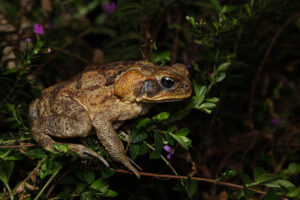
“Toads try to eat everything that moves,” said Ricardo Rodriguez, the management coordinator for the north region of Para la Naturaleza, a Puerto Rican conservation nonprofit that translates to “for nature.” Crested toads are no different, even eating members of their own species. But what makes cane toads so dangerous to native amphibians is their size: they’re twice as large, gobbling up everything in their path. Other invasive species, like bullfrogs (Lithobates catesbeianus), pig frogs (Rana grylio) and Cuban treefrogs (Osteopilus septentrionalis) crowd out the crested toad as well.
Rodriguez is in charge of 27 natural protected areas and has been working on the crested toad reintroduction and recovery effort since it started in 2012.
One of the reintroduction sites he manages is within Hacienda la Esperanza, a nature reserve bridging the karst forests and coastal forests of the island’s northern side. Though mostly decimated due to development and farming, Puerto Rico’s karst forests are bastions of biodiversity. Steep hills and a lack of topsoil have protected the region from deforestation and farming in the colonial era to the present.
The karst forests near the coasts are also critical habitat for the crested toad, which the U.S. Fish and Wildlife Service (USFWS) lists as endangered.
Millions of years ago, the karst—upon which today’s karst forests have grown—was limestone on the seafloor. Tectonic forces pushed the karst upward, creating the island of Puerto Rico. Acidic rainwater carved divots, holes and crevices into the sedimentary rock made from calcium carbonate and coral reefs.
These crevices are now crested toads’ favorite hiding places to shelter from the tropical heat and hide out from predators. But as karst forests are being developed, the crested toad is suffering.
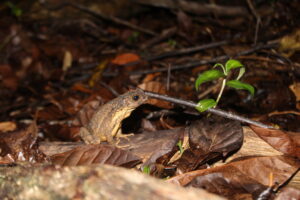
“It’s a species that has always been naturally rare,” said Alcides Morales Pérez, the manager of Hacienda la Esperanza, where one of Para la Naturaleza’s three crested toad ponds are located. “They also live near the coast, which is where development happened first,” he said. The toads also need shallow pools of water, which people filled in because they were seen only as mosquito breeding grounds.
There is only one remaining natural population of the Puerto Rican crested toad that scientists know of. It’s on the island’s south side in Guánica State Forest, a UNESCO World Heritage Site, whose limestone deposits have created sinkholes and jagged cliffs. The toads have not been seen in the wild since 1992, when they were on the northern side of the island, but not before scientists collected a few individuals to add genetic diversity to captive breeding efforts.
When frogs fly
Since the organization joined the effort in 2012, Para la Naturaleza has welcomed more than 300,000 crested toad tadpoles to the island. Like other visitors to the island, they come by plane.
Zoos that are members of the American Association of Zoos and Aquariums, which partner with Para la Naturaleza, the USFWS and Puerto Rico’s Department of Natural and Environmental Resources, breed the tadpoles and send them down to the island. As the toads are an endangered species, the USFWS assesses the needs and priorities of each reintroduction site and sets quotas for release.
“Once they arrive, everything needs to move pretty quickly,” Rodriguez said. Para la Naturaleza staff release the tadpoles in constructed ponds deep in nature reserves, like Hacienda la Esperanza, so the tadpoles can grow into froglets and disperse into the karst forest.
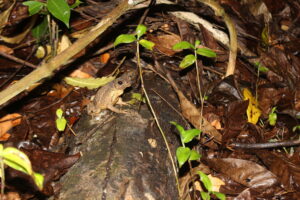
Before they release the tadpoles, though, the team clears the pond of invasive frogs and their eggs, like the cane toad and Cuban treefrog.
The pond at Para la Naturaleza ranges from two to six inches deep—the crested toad tadpoles thrive in about four inches of water. Rodriguez and his colleagues feed the tadpoles green algae pellets from a pet store and return to the ponds often to count tadpoles. The pond is also enclosed with mesh to prevent other species from getting in and laying eggs, including dragonflies and damselflies, whose nymphs are voracious predators big enough to eat tadpoles. While some get through, it excludes most of them, helping to keep the tadpoles safe until they leave the pond. “Then, they’re on their course,” Morales said.
The staff at Hacienda la Esperanza monitor the frogs every two or three days until they metamorphose, then monitor the pond at night after heavy rains to see if adults come back to breed. This was the first site within the reintroduction program that produced a natural breeding event. In other words, when adults—which were once tadpoles flown across the Caribbean—had returned to the ponds they metamorphosed in, and they made their own babies. “There are still so many questions,” Rodriguez said, “like how far they go into the forest or if they stay near the ponds.”
The last shipment of tadpoles they received was around 500, which Rodriguez said was pretty low. From this, they found 70 toadlets on the paths around the pond, which he called a good number, considering the low survival rate of the species throughout metamorphosis. They’re releasing genetic hybrids of the now extirpated northern population and the relic southern population to bring more genetic diversity to the species to protect it from falling into an extinction vortex, where a population collapses into ruin when the individuals become too related.
A cultural reawakening
Morales said he sees the plight of the toad as an analogy for what’s happening to Boriquas, or Puerto Ricans, today. “There’s a lot going on in the island, with people moving in and displacing Islanders,” Morales said. Similarly, the crested toad has suffered from losing its home in the karst forests and from the cane toad, which colonizers brought to the island for sugar cane plantations.
For Morales, the crested toad is an important symbol that represents national pride, which has been elevated in the last year. Outside of Bad Bunny’s “No me quiero ir de aquí” (I don’t want to leave here) residency in San Juan last year, the plaza featured celebrations of Puerto Rican music, dance, art and nature, including a booth about the Puerto Rican crested toad and its conservation efforts.
The crested toad has now become an umbrella species—a species whose conservation has ecosystem-wide benefits. Action focused on the crested toad, like purchasing more land around where the reintroductions are occurring or expanding protected areas on the north side of the island where the historic populations used to be, will help the island’s other endangered species, like the Puerto Rican boa (Epicrates inornatus).
“I see it romantically, also,” Rodriguez said. “Everything will reemerge, reinvent itself or become extinct—it’s inevitable.” Thanks to the work of Puerto Rican artists and conservationists, the story of the crested toad has escaped extinction and has become one of reemergence and reinvention.
This is the final installment of a three-part series on habitat restoration and wildlife management in Puerto Rico. Read the first part on deforestation and habitat fragmentation here, and the second part on Puerto Rican oriole conservation.
Article by Olivia Milloway