

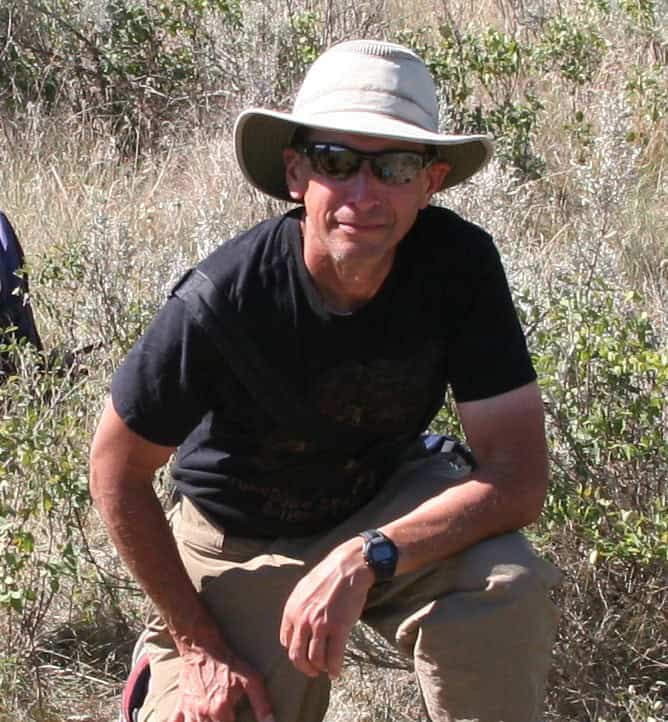
I am a professor and director of graduate studies at the University of North Dakota. I have a B.S. in Zoology from Duke (1981) and Ph.D. in Ecology/Evolutionary Biology from the University of Pennsylvania (1987). I did my PhD work on desert amphibians in Big Bend National Park, Texas and accumulated 10 field seasons there learning how amphibians make a living in a hot desert. I taught at Virginia Tech for a few years, followed by a couple at Kellogg Biological Station at Michigan State University. I joined the faculty at UND in 1995 and have been there since. The bulk of my research still involves ecology and population genetics of amphibians, now in the Prairie Pothole Region of North Dakota, on how amphibians make a living in a human-dominated, highly-altered (by agriculture) world. I have expanded my research to other beings who interact with the landscape on larger spatial scales, including elk in North Dakota, wolves in northwestern Minnesota, and bison in Theodore Roosevelt National Park, North Dakota. The wolf research was the MS project of one of my grad students, who worked as a seasonal technician for the Red Lake Band of Chippewa DNR. Our work quantified what we already suspected – wolves move readily across “borders” and if Tribal Nations have different values and management goals than the surrounding state, how is it possible to achieve them? I also spend a lot of my time thinking about climate change and climate adaptation, and how state or federal management should also adapt to the new and uncertain conditions we are facing. One critical aspect of this is how non-Tribal agencies/organizations can best support Tribal interests and objectives in land and water stewardship. That is a goal, too, of my work in the TEK section of the Ecological Society of America, where we promote appreciation for Indigenous Knowledges, values, and peoples.