




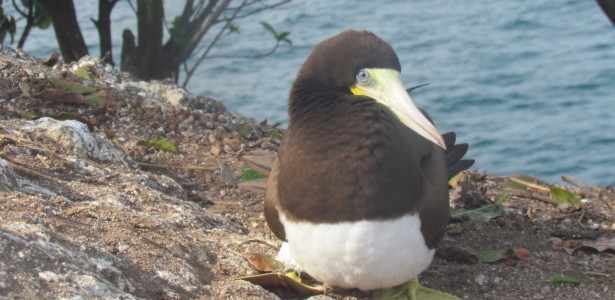
Decades after Brazil banned DDT and other chemicals, the pollutants are still showing up in seabirds off the country’s coast. People widely used the pesticide DDT in the 20th century, but Brazil banned it in 1985 for most uses—people still used it to control mosquitoes that transmit viruses like dengue fever until 2009. But in new research published in Environmental Monitoring and Assessment, scientists found traces of DDT and PCBs, the latter of which were formerly used for industrial purposes, in brown boobies (Sula leucogaster) in an archipelago 1,000 kilometers off the coast of Rio Grande do Norte, a state in the northeast of Brazil. “Even if they haven’t been used in a particular area, organic pollutants suffer from the grasshopper effect,” said Janeide de Assis Guilherme Padilha, a researcher at the University of Minho in Portugal and the lead author of the study. “In this phenomenon, they evaporate in the heat and condense again in the cold. As a result, they migrate through the air from the low latitudes of the tropics toward the polar regions.” The team is currently looking at the effect of other chemicals in birds in Brazilian waters as well, such as plastic pollution.
Read more at The São Paulo State Research Support Foundation.