



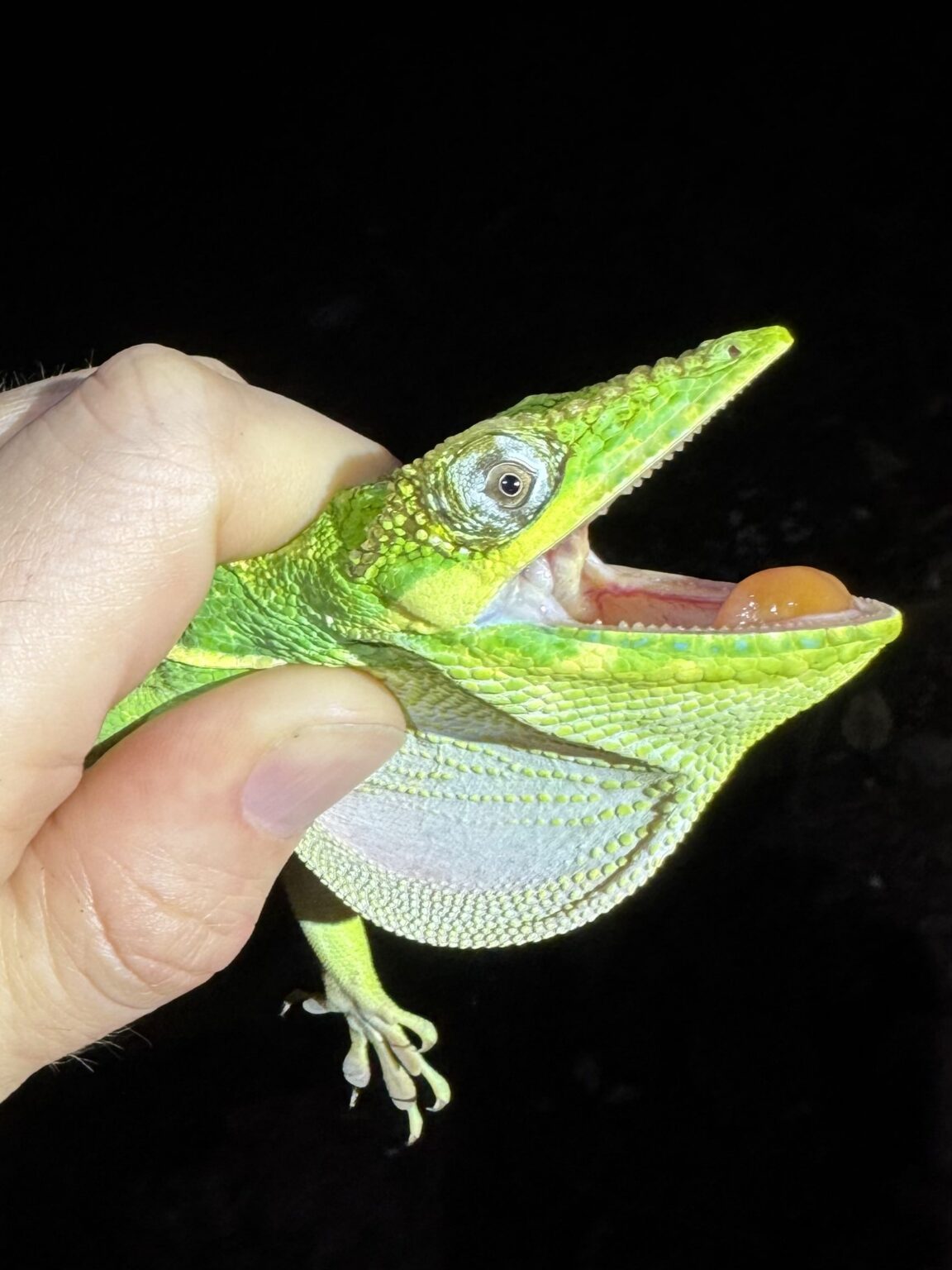
Giant Cuban anoles have found footholds in habitats across Florida thanks to expanding human development over the past decades.
But it’s unclear whether the reptiles can push into Georgia or if the introduced reptiles may be near the edge of their potential range.
“Jacksonville might be suitable, even though one might be surprised that they can get so far north,” said Alexander Romer, a quantitative ecologist at the University of Florida’s Fort Lauderdale Research and Education Center who works with the interagency Everglades Invasive Reptile and Amphibian Monitoring Program (EIRAMP).
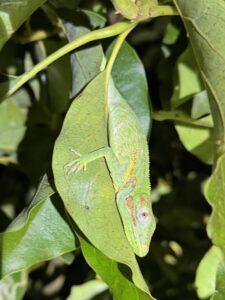
A biology student was the culprit behind the first introduction of Cuban knight anoles in 1952 to the campus of the University of Miami’s north campus in Coral Gables. They have since spread throughout much of the state—especially in urban areas. These lizards are much larger than most anoles, stretching up to 20 inches long, including their tails. They are striking, with vibrant green bodies, yellow stripes with black speckles and baby-blue mascara-like eye shadowing.
Their ecological impact isn’t completely certain yet, but scientists have observed them eating some imperiled invertebrates, such as Florida tree snails (Liguus fasciatus). They also likely eat federally endangered Florida tiger beetles (Cicindelidia floridana) and Schaus’ swallowtail butterflies (Papilio aristodemus). “We know that they do eat butterflies,” Romer said. “They do eat beetles.”
In a study published recently in Ecology and Evolution, Romer and his colleagues examined the factors that characterized suitable habitat for knight anoles in Florida and compared them to the factors that predicted occupancy in their home range of Cuba.
Citizen scientists track anoles
To conduct the study, the team relied on citizen science reports gathered from the Global Biodiversity Information Facility, a database that corrals information from platforms like iNaturalist together with museum specimen data.
They also used data that EIRAMP collected during reptile surveys in southern Florida in the Everglades Cooperative Invasive Species Management Area.
The models that they developed predicted knight anoles gravitated toward different ecological factors in Florida as opposed to Cuba. In Florida, for example, urbanization was the strongest predictor of knight anole presence, which wasn’t the case in Cuba.
While their study didn’t examine why Florida knight anoles gravitate more toward human settlement, Romer said it might have to do with the novelty of the environments and the level of disturbance there compared to Cuba. “Disturbed habitats likely have more open niches,” he said. “There are [fewer] predators, less competition.” In Cuba, meanwhile, the ecosystems might function better, with more predators that control the expansion of knight anoles.
So far, knight anoles have been seen in most eastern coastal cities in Florida and some western coastal cities. They are found all the way north to St. Augustine, but the models predicted the heat island impact in Jacksonville has likely made that city warm enough for the lizards, though they haven’t yet spread there, according to records.
Romer still hesitates to call knight anoles invasive rather than just introduced at this point, despite their potentially negative impact on several imperiled invertebrates. But this research shows that developing or disturbing habitat only helps them spread.
“Conserved habitat is precious,” he said. “When you disturb habitat, you’re facilitating invasive species. When you protect it, you’re protecting native species.”
Article by Joshua Rapp Learn