From the winter issue of The Wildlife Professional.
An open-access article, written in collaboration with the U.S. Forest Service — a premier partner with The Wildlife Society.
How Wildlife Professionals are Battling Amphibian Declines
A parasitic fungus, similar to the one that caused the extinction of numerous tropical frog and toad species, is killing salamanders in Europe. Scientists first identified the fungus, Batrachochytrium salamandrivorans, in 2013 as the culprit behind the death of fire salamanders (Salamandra salamandra) in the Netherlands (Martel et al. 2013) and are now exploring its potential impact to other species. Although the fungus, which kills the amphibians by infecting their skin, has not yet spread to the United States, researchers believe it’s only a matter of time before it does and, when that happens, the impact on salamander populations could be devastating (Martel et al. 2014).
Reports of worldwide declines of amphibians began a quarter of a century ago (Blaustein & Wake 1990). Globally, some amphibian population declines occurred in the late 1950s and early 1960s, and declining trends continued in North America (Houlahan et al. 2000). In the earlier years, population declines were attributed primarily to overharvest due to unregulated supply of species such as the northern leopard frog (Lithobates pipiens) for educational use (Dodd 2013). In later years, however, causes of declines were less evident. In 1989, herpetologists at the First World Congress of Herpetology traded alarming stories of losses across continents and in seemingly protected landscapes, making it clear that amphibian population declines were a “global phenomenon.” In response to these reports, in 1991, the International Union for Conservation of Nature (IUCN) established the Declining Amphibian Populations Task Force to better understand the scale and scope of global amphibian declines. Unfortunately, the absence of long-term monitoring data and targeted studies made it difficult for the task force to compile information.
Today, according to AmphibiaWeb.org, there are 7,342 amphibian species in the world — double the number since the first alerts of declines — making the situation appear deceptively less dire. In fact, our understanding of genetic diversity significantly raises the stakes, and we are at risk of losing far more species than we believed only a few years ago. According to the IUCN, amphibians now lead the list of vertebrate taxa affected by the larger “biodiversity crisis” and sixth major mass- extinction event on Earth (Keith et al. 2014, Wake and Vredenburg 2008).
Decline and Mitigation
Across the world, numerous factors are responsible for the ongoing decline in amphibian populations such as habitat loss, invasive species, chemical contaminants, diseases, climate change, and synergisms among several of these factors.
The Oregon spotted frog (Rana pretiosa) — recently listed as threatened under the Endangered Species Act (Federal Register 2014) — is an example of a species facing combined threats. Once common in large, relatively warm wetlands with permanent water across the Pacific Northwest, Oregon spotted frog populations are believed lost from at least 78 percent of their former range. Factors — several of which are driven by human-caused changes to the landscape — such as loss of wetlands, hydrological changes, disease, and depredation by non-native predators, including introduced trout and bullfrogs, have contributed to declining populations.
Yet, for each of these threat factors alone or in concert, science, management, and the public are playing key roles in the form of research, management, and monitoring. The following is a sampling of ongoing efforts to address and mitigate threats facing amphibians in the U.S.
Research. One stressor that has been gaining attention — with significant research contributions over recent years — is the amphibian chytrid fungus, Batrachochytrium dendrobatidis, which causes the disease chytridiomycosis. This pathogen, described 15 years ago (Longcore et al. 1999), can be lethal under some circumstances, which has been the case for the federally endangered mountain yellow- legged frog (Rana muscosa). The species appears to be more susceptible to chytridiomycosis than other frogs in the region, and exposure to pesticides may weaken its immune response.
In response, researchers are working to understand geographic and biologic occurrence of the fungus along with pathogenicity patterns. The U.S. Forest Service — with the help of world scientists, professional ecologists, resource managers, and volunteer citizen scientists — has developed occurrence maps reflecting the 1,377 species that have been inventoried for the fungus. It’s widespread — found about half the time overall — yet at most sites with the fungus, amphibians do not show symptoms of chytridiomycosis. Now, emerging science suggests that some strains of the fungus may be located exclusively in North America (Schloegel et al. 2012). Consequently, it’s likely that some North American amphibians co-evolved with some of these strains, which would explain why we see amphibian populations that test positive for chytrid infection, but without disease-related die-offs. Given the ubiquity and antiquity of the global pandemic lineages of the amphibian chytrid, the question of whether some subtle environmental or strain change has occurred to trigger symptoms becomes extremely relevant.
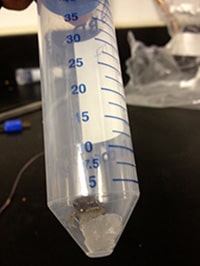
A wood frog sits frozen in a test tube as part of a study on the effect of cold temperatures on the amphibian chytrid fungus. Wood frogs (see inset) are found at higher latitudes and have a unique ability to freeze in winter months—a characteristic that offers some protection from the fungus. However, warming temperatures caused by climate change could make the species more vulnerable to disease.
Image Credit:Tara Chestnut
New research aimed at studying the ecology of the fungus has also helped us to understand patterns of occurrence. This aquatic fungus appears to be sensitive to temperature conditions, and is not as prevalent in areas that get extremely hot and cold. In at least one strain of the fungus, researchers found that differences in frogs’ generation time and fecundity were observed in response to different thermal regimes (Voyles et al. 2012). We pursued the fungus at high latitudes to see if its range might be limited there due to extreme cold temperatures. In Alaska, we found the fungus throughout the range of the wood frog (Lithobates sylvaticus), the only amphibian species that inhabits the Alaska interior and a unique frog species in that they “freeze” in winter. Our research showed that frogs can largely clear the pathogen during this process, although upon warming, lingering fungal zoospores appeared to be able to quickly re-establish infection.
In another recent advance in research, the occurrence of the amphibian chytrid fungus can now be detected as a free-living form by filtering water, in addition to swabbing animals to detect it on their skin. As part of our research, we described water sampling across the U.S. where we reported this fungus persists year- round, with variable densities in the environment (Chestnut et al. 2014). Water is moved between watersheds for a number of management and conservation needs such as fire fighting, fish hatchery production, and reintroduction programs. Well-meaning nature enthusiasts and teachers have relocated animals and released pets and classroom animals that may be infected with or carry the amphibian chytrid fungus.
In addition, amphibians are part of an enormous world trade for food and pets, with hundreds of millions of animals, and the water they live in, moving across borders every year. Hence, infected waters may be a concern for amphibian health as well as infected individual amphibians. In fact, the stakes for salamander conservation have been raised this year, given the deadly consequences of the newly described chytrid fungus, B. salamandrivorans, for many of the world’s salamanders. Researchers note that movement of animals or the water in which they’re kept could prove lethal to native U.S. species such as forest-dwelling newts. As a result, they are exploring the possibility of modifying existing methods used to sample wetlands for amphibian chytrid fungus in an effort to provide early detection for this and other aquatic diseases.
Monitoring and Modeling Tools. Using occupancy modeling — statistical methods that account for imperfect detection — in 2013, researchers with the U.S. Geological Survey (USGS) Amphibian Research and Monitoring Initiative provided the first estimate of the rate of amphibian declines in the U.S. (Adams et al. 2013). They studied amphibian occupancy of sites on federal lands and reported that those populations from across the nation were declining at a rate of 3.7 percent per year, noting that salamanders were declining at a faster rate than frogs. Further, their research showed that amphibian occupancy of sites declined in all parts of the U.S., with the south experiencing greatest declines.
Today, researchers can better quantify species decline metrics with monitoring conducted by a diversity of professional ecologists, citizen scientists, and land managers. Standardized survey protocols have been established based on habitats and life history attributes of species in various regions and compiled into a manual developed by Partners in Amphibian and Reptile Conservation (Graeter et al. 2013). In 2000, Congress established the USGS Amphibian Research and Monitoring Initiative to investigate the status and trends of amphibians, identify causes of amphibian declines, and provide critical information to natural resource managers to support effective management actions that address declines. However, with our current knowledge of a variety of threat factors and their potential interactions, wildlife professionals might consider increasing the scope and scale of routine amphibian monitoring.
On-the-Ground Management. With ongoing management measures, wildlife professionals are already seeing signs of success. For example, research shows that habitat restoration can result in increases in spotted frog populations, and scientists noted that between 1991 and 2011, Columbia spotted frog populations (Rana luteiventris) in the northwestern U.S. grew rapidly in response to wetland restoration in areas with historical population declines (Hossack et al. 2013). Still, long-term benefits of management efforts for many species are currently unknown; however, experts agree that no single action is enough to recover most species. Further, some threats are challenging to control such as the effects of non-native fish and bullfrogs. For example, the Oregon spotted frog requires permanent year-round water and, as a result, management actions such as altering hydrologic regimes that would reduce or eradicate harmful predators could also hurt the frogs and other aquatic organisms.
In terms of threats from disease, federal and state wildlife agencies, in collaboration with the Woodland Park Zoo in Washington State, have implemented reintroduction programs that screen Oregon spotted frogs for the amphibian chytrid fungus before release to new locations. In the wild, Oregon spotted frogs have tested positive for several diseases of concern including the amphibian chytrid fungus, the fungus-like pathogen Saprolegnia, and trematode parasite Ribeiroia ondatrae, which causes limb malformations. However, it isn’t clear if these diseases are a threat to populations because the strains that occur throughout the range along with the effect of co-infections are not known. Strain differences warrant identification and study for differential pathogenicity. Screening animals prior to reintroduction is a sound precaution that will prevent the introduction of virulent strains that may be present in the area where animals were collected but may be novel to areas where they are released.
Collaborative Efforts. Ultimately, partnerships and joint efforts are critical in managing amphibian populations. For a host of considerations such as ethical, aesthetic, biomedical, ecological, or “One-Health” ─ a worldwide strategy for expanding interdisciplinary collaborations and communications for the health of humans and the environment ─ we are no longer free to consider species as we once have. Our role has shifted from exploiting species for various uses toward becoming their stewards. The bridging of science, management, and the public to address amphibian declines is creating a new platform for conservation biology, where partnerships and open communication pathways expedite the pace of science and its application to field settings. It’s a bottom-up approach where local human communities are making great strides to affect their local wildlife communities, and a top-down approach where programs that span regions and continents can have strong ripple effects. This is especially evident in the U.S., where a variety of state, federal, tribal, and private lands are being managed for eco- system services inclusive of amphibian diversity.
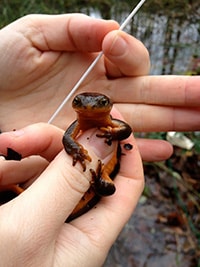
A researcher swabs a rough-skinned newt for traces of the chytrid fungus Batrachochytrium dendrobatidis. Authors Olson and Chestnut recently completed a study in the Willamette Valley, Oregon, investigating the relationship between B. dendrobatidis in the environment and the occurrence of disease in amphibian populations.
Image Credit:Tara Chestnut
Public and private coalitions are growing as neighboring landowners determine where to establish protected areas, and how each group can address amphibian declines and identify solutions, which may span a larger spatial context. As landowners and managers coordinate efforts, each entity contributes resources that allow species inventories across a much broader area than could be achieved by one landowner alone. This cooperative process facilitates greater understanding of amphibian species ecology, recognition of new species, understanding of known or suspected threats, and implementation of multi-agency protections. In some cases, these cooperative efforts and conservation strategies have made formal protections such as listing under the Endangered Species Act (ESA) less necessary.
A prime example of this process has been the development of multi-agency conservation strategies among federal agencies that have helped preclude formal decisions to list species under the ESA. The tri-agency conservation strategy for the forest-dependent Siskiyou Mountains salamander (Plethodon stormi) is one example of this approach. In fact, targeted surveys for animals and habitats resulted in discovery of a new species — the Scott Bar salamander (Plethodon asupak) — and the designation of high-priority sites for long-term management of the Siskiyou Mountains salamander across a swath of Forest Service and Bureau of Land Management Lands, in cooperation with the U.S. Fish and Wildlife Service.
What Lies Ahead
We are entering a new age of information transfer about wildlife threats and population status, which enables an improved response of both research and management to a variety of stressors. E-communications and real-time web portals for information are being developed for a variety of purposes, and this will change how we aggregate and assess data, conduct risk assessments, and respond to critical issues. The fate of amphibians and other imperiled species are not random. There is a human link to most known amphibian threats and, as a result, we have a role in both their imperilment and stewardship. We expect to continue to test new tools for amphibian conservation that may have application for broader wildlife consideration. Amphibians also serve as ideal tools to teach future generations how wildlife are integrated with their environment and how our actions affect their futures and ours. In this way, amphibians are helping to bind science, management, and the public into a new alliance for conservation.
This article has been reviewed by subject-matter experts.



 With a donation of at least $100, you can participate in a pivotal effort that is having a significant impact on the future of The Wildlife Society by becoming a member of The 1,000 today.