Wildfire!
Toward Understanding Its Effects on Wildlife — from The Wildlife Professional

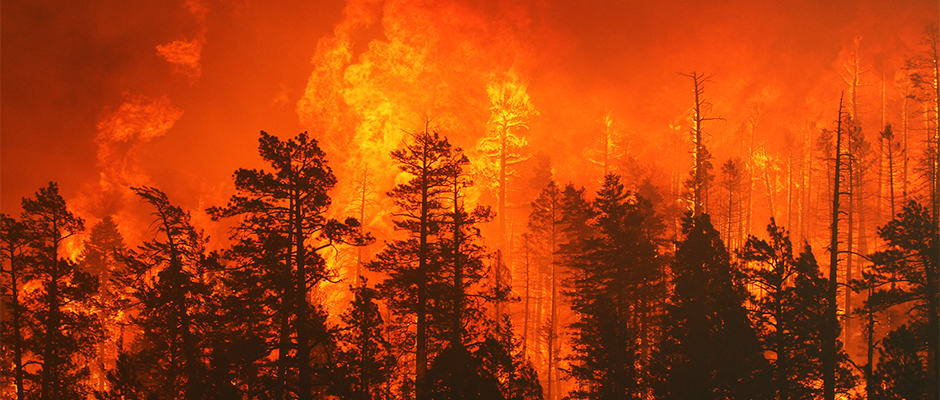
There are few places in western North America, and increasingly in the northern regions of Canada and Alaska, where wildfire and its effects are unfamiliar sights. Last year, wildfires burned more than 800,000 hectares of National Forest lands; the same year, a record 4.1 million hectares burned across all land ownerships in the United States. National Forest lands have been particularly hard-hit in the five-year span from 2011 to 2015, with over 3.6 million ha scorched. Not surprisingly, given the horrific images that emerge from these fires, the public’s view of wildfires is strongly negative, and most people generally support efforts to reduce the risks of large, severe fires. At the same time, the public is less familiar with the positive aspects of wildfire, such as the creation of wildlife habitat or the maintenance of ecological processes upon which many desirable ecosystem services depend.

However, wildlife professionals know, many North American ecosystems are fire-adapted and require fire to shape their structures, functions and processes, which in turn shape wildlife habitats and populations in important ways. Over the past century, however, synergistic effects of fire exclusion, livestock grazing, timber harvest and land development have led to conditions where many wildfires are larger and burn with greater intensity and severity than they did in the past.

No doubt, the emerging influences of climate change are now resulting in longer burning seasons and a greater land base that is susceptible to wildfire.

Drought and hotter temperatures also lead to increases in insect outbreaks that add to fuel loads across the landscape.

The U.S. Forest Service is working to better understand effects on wildlife habitats and populations and also to understand effects of fuel reduction treatments aimed at reducing risk of uncharacteristic fire. These management practices aim to reduce the probability of uncharacteristic, high-intensity, stand-replacing events and allow fire to provide a diversity of landscape conditions as it has done for millennia.

Changes in Fire Management Practices

Today, the structure and composition of many fire-adapted, low- to mid-elevation forests across western North America deviate substantially from historical conditions as the result of fire suppression and other management actions. For example, tree densities and fuel loads are generally greater, and the array of vegetative conditions differs from those existing prior to fire suppression. This structural simplification promotes more uniform, large-scale disturbances, which in turn result in larger patches of uniform habitat.

Land managers use both forest thinning and prescribed fire — individually and in combination — to break the cycle of large-scale fires by reducing fuel loads and fire risk as well as to restore the structure, function and processes of forested ecosystems. Some species may be negatively impacted in the short term while others may benefit over time as a more resilient community is restored.
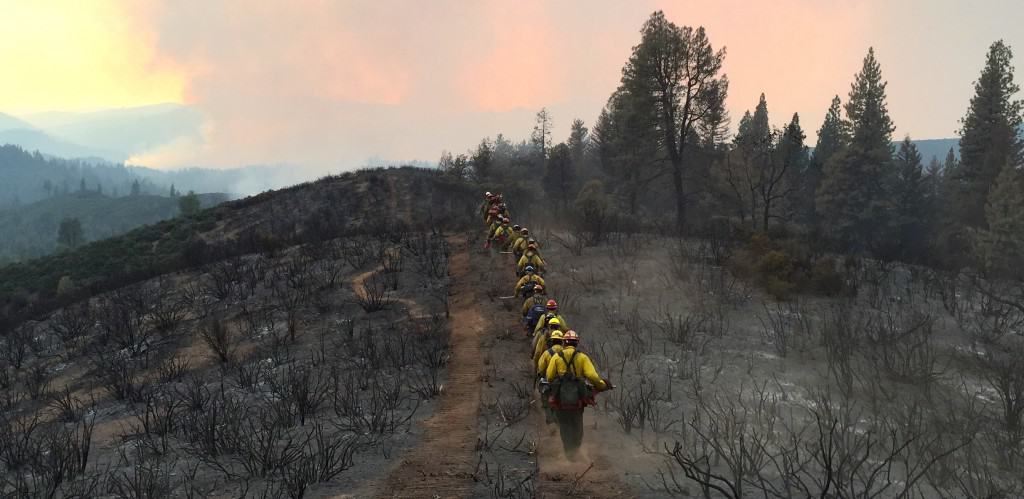
At 894,552 hectares, Shasta-Trinity National Forest in Northern California is the largest in the state. Here a multi-agency hand crew from Alabama and Georgia National Forests head out to build firebreaks in the Fork Complex during a wildfire in August 2015. ©Micah Thorning, USFS

At 894,552 hectares, Shasta-Trinity National
Forest in Northern California is the largest in the state. Here a multi-agency hand crew from Alabama and Georgia National Forests head out to build firebreaks in the Fork Complex during a wildfire in August 2015. ©Micah Thorning, USFS

Effects on Small Mammals and Birds 

To better understand the impacts on wildlife, the national Fire and Fire Surrogates Study conducted an integrated network of experiments at 13 sites across the United States (Schwilk et al. 2009), many of which took place on National Forest lands.

The results suggest that more species increased in number than decreased. For example, researchers reported that populations of western bluebirds (Sialia mexicana) increased following prescribed fire; whereas mountain chickadees (Poecile gambeli) decreased in response to thinning treatments (Hurteau et al. 2008). The positive and negative responses of deer mice (Peromyscus maniculatus), gray-collared chipmunks (Tamias cinereicollis) and least chipmunks (T. minimus) varied among the sites; but the overall biomass of small mammals increased in response to the fire treatments (Converse et al. 2006). Researchers also found that small mammals’ responses were related to fire uniformity: the more heterogeneous the post-fire landscape, the greater the proportion of positive responses.

Another regional effort, The Birds and Burns Network, evaluated the effects of different fire conditions — including unburned and prescribed and wildland fires — on populations and habitats of birds throughout the West (Saab et al. 2007). This study was replicated at 10 locations dominated by ponderosa pine, extending from the middle Rockies to the Southwest. In the northern sites, prescribed fire treatments resulted in increased occupancy rates for many bark-insectivore, cavity-nesting, aerial-insectivore and ground-insectivore species; whereas some foliage insectivores and seed specialists declined following treatments. In the Southwest, the impacts of prescribed fire treatment on breeding birds were minor. Collectively, the results of these studies suggest that two to three years after a prescribed fire, more species benefitted than not.

Studies from the Birds and Burns Network also analyzed relationships of bird occupancy with the severity of wildfires in dry pine forests in Idaho and Arizona — states that have historically different fire regimes. Proportionately more positive species occupancy relationships were observed for mixed-severity fire regimes. In Idaho, researchers observed a positive species richness relationship with burn severity, while they observed the opposite pattern in Arizona, which fits with the low-severity fire regime characterizing the state.

Overall, cavity nesters and aerial insectivores occupied more severely burned sites following wildfire, corresponding with predicted increases in nesting substrate and foraging opportunities for these species. In contrast, canopy-nesting foliage gleaners and pine-seed consumers exhibited negative relationships with burn severity. Results like these are useful for creating optimal regional management strategies for maintaining avian diversity. Specifically, intensive fuels management may be ecologically less appropriate for promoting biodiversity in areas where mixed-severity wildfires and dense forest stands were historically more common.

The Special Case of Woodpeckers
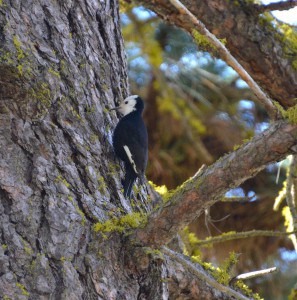
A white-headed woodpecker forages in open ponderosa pine forest in Washington’s Okanogan-Wenatchee National Forest. As cavity nesters, populations of this woodpecker species and others are strongly influenced by fire and timber management activities. ©Peter Singleton

A white-headed woodpecker forages in open ponderosa pine forest in Washington’s Okanogan-Wenatchee National Forest. As cavity nesters, populations of this woodpecker species and others are strongly influenced by fire and timber management activities. ©Peter Singleton

Wildland fire creates many standing dead trees that provide habitat for disturbance-associated species, notably black-backed (Picoides arcticus), Lewis’ (Melanerpes lewis), and white-headed woodpeckers

(P. albolarvatus). In fact, these and several other species of cavity-nesting birds are considered species of conservation concern by state and federal agencies because the birds’ populations are strongly influenced by fire and timber management activities (Saab et al. 2007).

Wildlife managers worry that certain timber management practices such as removal of snags in post-fire logging operations have the potential to decrease regional woodpecker populations. The Forest Service is assessing locations and prescriptions for post-fire timber harvest such that negative impacts to woodpeckers are minimized.

Saving the Spotted Owl

The northern spotted owl (S. occidentalis caurina), a federally threatened species, was listed in 1990 largely due to concerns about loss of habitat in the Northwest resulting from commercial timber harvest. But balancing forest management objectives focused on reducing the risk of high-severity wildfire with conservation of old forest habitat is a particular challenge for land managers.

Much of the southern and eastern portions of the owls’ range historically supported low- and mixed-severity fire regimes. However, today, wildfire has become the leading cause of habitat loss on federal lands, though the relative effects of fire and timber harvest vary by land ownership, ecoregion, and fire regime (Davis et al. 2011). These areas have experienced significant increases in stand density and loss of large trees during the 20th century, increasing the probability of large fires and insect outbreaks that could further disturb the spotted owls’ habitat.

Research shows that the effects of wildfire interact in complex ways with the creation, maintenance and destruction of northern spotted owl habitat. While large-scale, high-severity wildfires pose substantial risks to owl habitat, fires of low-, moderate- and mixed-severity may also contribute to the spatial and structural complexity characteristic of areas currently occupied by spotted owls in fire-prone landscapes (Clark et al. 2013). Size, severity and pattern of fire impacts all appear to be important factors that can contribute to variable spotted owl site persistence after fires (Clark et al. 2013). Similar patterns have also been reported for the California (S. occidentalis occidentalis) and Mexican spotted owl (S. occidentalis lucida) subspecies (Lee and Bond 2015).

Overall, these studies suggest that spotted owls can persist with some level of natural disturbance in fire-prone landscapes provided that adequate nesting and roosting characteristics are retained and abundant prey resources are available in suitable foraging areas after the disturbance. In a review of the literature on the effects of forest fragmentation on all three subspecies of spotted owls, the authors concluded that at the territory scale, some degree of forest heterogeneity — including early seral patches and ecotones — may contribute to owl habitat (Franklin and Gutierez 2002). However, it is also important to note that the long-term effects of wildfire on northern spotted owl habitat and site occupancy are not well documented. Current forest patterns and fuel loads have created conditions susceptible to large-scale, high-intensity wildfires that can substantially simplify forest structure and landscape patterns across relatively broad areas, eliminating nesting and roosting habitat characteristics required for northern spotted owl post-disturbance site persistence. New silvicultural approaches that integrate fuel reduction and spotted owl habitat conservation objectives are being developed and tested in Forest Restoration Projects on NFS lands across fire-prone portions of the range of the northern spotted owl (Lehmkuhl et al. 2015).

Fires Help Fisher Populations 

Many forest carnivores, including the fisher (Pekania pennanti), are also associated with the complex forest structure found in older or late-successional forest. Structural attributes such as closed canopy, dense understory and multi-layer stands have frequently been identified as important habitat features, providing secure resting and denning sites as well as access to a diverse prey base (Aubrey et al. 2013). However these same characteristics, when prevalent across the landscape, have the potential to promote the spread of the large, severe wildfires. These fires not only destroy the necessary structural elements for foraging and reproduction, they also fragment the available habitat and limit genetic flow between isolated subpopulations.
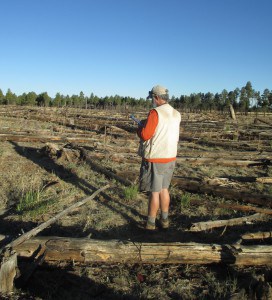
Bill Block, wildlife program leader for the Rocky Mountain Research Station conducts bird point-counts 17 years following the 1996 Horseshoe/Hochderffer fires in Arizona’s Coconino National Forest. The study aims to evaluate long-term effects of wildfire on bird community structure in ponderosa pine forests of northern Arizona. ©Jean Block

Bill Block, wildlife program leader for the Rocky Mountain Research Station conducts bird point-counts 17 years following the 1996 Horseshoe/Hochderffer fires in Arizona’s Coconino National Forest. The study aims to evaluate long-term effects of wildfire on bird community structure in ponderosa pine forests of northern Arizona. ©Jean Block

Recent evidence suggests that fishers are not only capable of using post-, low-to-moderate fire landscapes, but that these fires can also help create a new generation of denning and resting sites as well as protect the integrity of the overall landscape mosaic (Spencer et al. 2011). In contrast, disturbances that simplify stands and landscapes can remove critical habitat elements and have long-term detrimental impacts.

But little information is available on the direct impacts of wildfire on fisher survival, reproduction and occupancy. A growing body of evidence suggests that the species tolerates low-to-moderate levels of habitat disturbance as long as thresholds of scale and intensity are not exceeded. In one study, researchers found that fishers did not avoid disturbances at the home range scale, as long as disturbed patches, characterized by reduced structural complexity, were sufficiently dispersed such that animals could move around them (Zielinski 2013). Surveys of post-fire landscapes using scat-detector dogs also have found evidence of fisher activity one year (C. Thompson unpublished data) and 12 years later (Hanson 2015). These data are currently being used to not only promote the conservation and restoration of forest carnivore habitat in the Sierra Nevada region, but to help guide forest management.

Protecting the Future
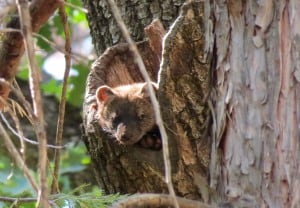
A female fisher peers from a den cavity in a California black oak on the Sierra National Forest, Calif. Recently burned forests are not conducive to fisher reproduction, and males and dispersing juveniles only explore the areas occasionally. ©Craig Thompson

A female fisher peers from a den cavity in a California black oak on the Sierra National Forest, Calif. Recently burned forests are not conducive to fisher reproduction, and males and dispersing juveniles only explore the areas occasionally. ©Craig Thompson

As the trend toward more and larger fires increases, the decisions made now in the early part of the 21st century will set the stage for how these landscapes support wildlife populations for hundreds of years to come. Working with partners, USFS programs restored or enhanced more than 2.6 million hectares of public and private forest lands in 2014, making them more resilient to the effects of wildfire. But approximately 25-34 million hectares are still in need of management to increase resilience.

Many of these ongoing projects are intended to emulate the influence of fire in creating spatial heterogeneity in vegetation and fuel conditions. Increased vegetative heterogeneity — including the retention and development of important habitat conditions such as a mosaic of large, mature trees and open patches of early-seral conditions — promotes a diverse wildlife community while also providing a more fire-resilient landscape for future generations.

spotlight-twp-open-access-headshot-1 Brian Logan, MS, is the national wildlife program leader for the U.S. Forest Service in Washington, D.C. and a past president of the TWS Montana State Chapter.
Peter Singleton, PhD, is a research wildlife biologist at the USFS Pacific Northwest Research Station and a past-president of the TWS Washington State Chapter.
Craig Thompson, PhD, is a research wildlife ecologist at the USFS Pacific Southwest Research Station.
Victoria Saab, PhD, is a research wildlife biologist at the USFS Rocky Mountain Research Station.
William Block, PhD, is a program manager at the USFS Rocky Mountain Research Station, Caesar Kleberg Award recipient, TWS Fellow, and former editor-in-chief of the Journal of Wildlife Management.

Western land, wildlife contaminated with mercury

An extensive analysis led by the U.S. Geological Survey has found widespread mercury contamination in western habitats and wildlife. Mercury levels varied from place to place, fluctuating with factors such as hydrology and climate. Moreover, it turned out that levels of inorganic mercury — the relatively benign form of mercury common in air and soil — was a poor indicator of the threat to people and animals. Areas with low inorganic mercury tended to have high levels of methylmercury, the toxic form of the element that insinuates itself into food webs.

“One of the most surprising and compelling patterns that we found was a very large disconnect between the distribution of inorganic mercury in the environment in comparison to the distribution of methylmercury in biological communities,” said Collin Eagles-Smith, a research ecologist with the USGS and an author of several studies published in a special issue of Science of the Total Environment. “Where you have high inorganic mercury does not necessarily equate to elevated risk to fish, wildlife and humans.”

Most of Earth’s mercury is in inorganic forms. These compounds can be released into the environment through natural processes such as volcanic eruptions, as well as by human actions such as mining, agriculture and coal burning. The released mercury travels through the landscape in air and water, and when it collects in water bodies such as wetlands, bacteria convert some it into methylmercury.

Past studies in eastern North America have assessed landscape-scale patterns of contamination with both types of mercury. To get a similar big-picture look at the West, researchers gathered long-term monitoring data from multiple government and academic databases. The data included mercury levels in soil, water, plants, fish and birds.

Methylmercury contamination was common in wildlife, with eight percent of bird samples showing levels high enough to pose major health risks. Birds tended to be most contaminated in ocean and salt marsh habitats, with the highest mercury levels found in species that eat fish. The most contaminated bird species of all was the Forster’s tern (Sterna forsteri).

While many animal samples had mercury levels known to cause health problems in some species, the actual danger to wildlife populations is hard to pin down, says Eagles-Smith. Different species vary widely in their sensitivity, and more research is needed to understand the impacts of mercury exposure on each species.

“We looked at mercury concentrations in a lot of taxa, and we can get an understanding of their exposure,” said Eagles-Smith. “The really difficult next step is identifying risk.”

In general, fish and birds tended to have high levels of methylmercury in arid habitats, while in wet forest ecosystems, methylmercury was relatively scarce. This pattern was reversed for inorganic mercury. The researchers found that rain deposited large amounts of inorganic mercury on northwestern forests, where it was absorbed by the soil.

Currently, most efforts to curb mercury pollution focus on inorganic mercury, with strategies such as cleaning up mine tailings and developing cleaner-burning fossil fuel technologies. These efforts are valuable, since all methylmercury ultimately comes from inorganic forms of the element, says Eagles-Smith. But the disconnect between organic and methylmercury at the local scale suggests that targeting inorganic mercury may not be the best strategy everywhere. To reduce mercury exposure in living things, says Eagles-Smith, we should also try to prevent methylmercury from forming and spreading.

“Addressing the mercury at the source is important, but it’s not going to completely solve the problem,” he said. “Once the inorganic mercury enters a water body, it can be methylated. And once it’s methylated, then it enters the food web.”

Agencies raise standards for ESA listing petitions

The U.S. Fish and Wildlife Service and the National Marine Fisheries Service (the Services) finalized a rule on Sept. 27 that sets higher standards for petitions to protect species under the Endangered Species Act.

First proposed in May 2015, the changes aim to increase the efficiency and efficacy of the petition process by requiring more thorough and specific petitions for species listings, delistings, and reclassifications. The rule largely achieves this by placing the burden of evidence on the petitioner and asks that they present a fair case for the species in question.

“A petitioner should provide a complete, balanced presentation of facts pertaining to the petitioned species, which would include any information the petitioner is aware of that contradicts claims in the petition,” says the rule. Requiring the petitioner to provide as much information as possible, both supportive and contradictory to their claims, is intended to reduce the need of the Services to spend time and resources finding information to complete the petition themselves.

The new fairness standard also applies to petitions to alter critical habitat designations for listed species.

The Services also sought to increase state agency engagement in the petitioning process through the revisions. Petitioners are now required to notify wildlife agencies in each state where the species is found of their intent to petition at least 30 days before submission. States then have the opportunity to contribute relevant information to be included in the petition and considered in the review.

“State wildlife agencies are critical partners in conserving wildlife in America and often possess the most up-to-date and relevant information on imperiled species, so making better use of their expertise makes good conservation sense,” said USFWS Director Dan Ashe in a press release.

Petitions will also be limited to one “taxonomic species” per petition, which can include subspecies or distinct population segments. This restriction is intended in part to prevent “mega-petitions,” which argue for listings and reclassifications of multiple species in a single petition.

These revisions come at a time when the Services are increasingly overwhelmed by petitions. USFWS was petitioned to list 63 species 2009; that number increased sevenfold in one year, with 451 petitions filed in 2010. Litigation over a service’s failure to review petitions by the 90-day deadline is increasingly common, and can result in hastened listing, delisting, or reclassification decisions that have not been adequately evaluated.

The Services are hopeful that these changes will improve the content and quality of petitions and the petitioning process, thereby allowing them to keep pace with incoming petitions and direct resources towards more effective implementation of ESA.

Some conservation groups, however, are not pleased with the final result, believing the new restrictions and requirements discourage citizen petitions and make the petitioning process unnecessarily difficult.

“These rules make it harder to get imperiled species the Endangered Species Act protections they desperately need, and they do nothing to address the backlog of hundreds of imperiled species that are still waiting to get the protections they deserve,” says Brett Hartl, endangered species policy director at the Center for Biological Diversity (CBD), in a press release. CBD recently filed a notice of intent to sue USFWS for failing to act on petitions to list 417 plant and animal species.

As of July 2015, USFWS determined via court settlements that listing was warranted for 170 species. Improving the petition process is necessary to bolster the Services’ capacity to review petitions on time, minimize the impetus for costly lawsuits, and allow the Services to make properly evaluated and science-based listing decisions.

The updated listing petition process will take effect October 27, 2016.

JWM study: Wind farms in Canada kill tens of thousands of bats

Each wind turbine in Canada kills an average of 15.5 bats per year, adding up to a death toll that could someday threaten populations, according to new research. In Canada’s first comprehensive analysis of wind farm casualties, researchers found that turbines were killing about 47,000 bats per year in 2013. That number will only rise as Canada’s investment in wind energy increases.

“We have about 50 percent more turbines now, so, as of 2016, somewhere around 70,000 bats are being killed in Canada per year,” said Ryan Zimmerling, a wildlife biologist with the Canadian Wildlife Service and first author of a recent study in the Journal of Wildlife Management. “It is possible that those levels of mortality, if they’re not already causing impacts to some species now, could be causing impacts into the future.”

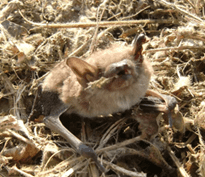
An Eastern red bat lies dead beneath a wind turbine in southern Ontario. ©Mike Anissimoff

A bat lies dead beneath a wind turbine in southern Ontario. ©Mike Anissimoff

Wind energy companies in Canada are required to monitor bat mortality at newly built wind farms, regularly searching the area under turbines for carcasses. The companies report these data as part of post-construction monitoring, but until now, no one had combined them into a single nation-wide analysis. To see the big picture, Zimmerling and his colleagues analyzed carcass counts from 64 wind farms in nine provinces, using statistical corrections to estimate how many carcasses the surveyors missed.

The results varied widely by region. Hardly any bats died in New Brunswick and Manitoba, both because those provinces don’t have many wind farms and because each turbine there killed fewer than one bat per year. In contrast, Ontario’s 1,270 turbines each killed an average of 24.5 bats per year, accounting for two thirds of the whole country’s death count. It’s not clear why turbines are more dangerous in certain places, though the answer could have something to do with bat migration routes, says Zimmerling.

Multiple studies have found that migratory species are especially vulnerable to wind farms, and the new study showed that Canada’s bats are no exception. The species killed most often were the three that migrate long distances: hoary bats (Lasiurus cinereus), silver-haired bats (Lasionycteris noctivagans) and Eastern red bats (Lasiurus borealis). Researchers aren’t sure why migrating species are more at risk, but they have a few guesses, says Zimmerling. Migrating bats fly at higher altitudes, which could put them at the same height as the turbine blades. Additionally, the animals might mistake turbines for the tall trees they like to roost in.

The seven hibernating species in the study were less frequent victims, accounting for fewer than a quarter of carcasses. But even low mortality rates could cause problems for these species, because they are the ones suffering from the disease known as white-nose syndrome. White-nose fungus (Pseudogymnoascus destructans) grows on bats while they hibernate, and it has decimated species such as the little brown bat (Myotis lucifugus). The researchers estimate that up to 1.4 percent of the remaining little brown bats in eastern Canada are killed by turbines each year.

That estimate rests on several assumptions, and researchers need more data on bat population sizes to really understand the impact of wind farms, says Zimmerling. Indeed, little brown bats were one of only two species in the study for which any population estimates existed.

“We feel fairly confident that we have a good handle on how many bats are going to be killed in the future,” he said. “That missing link is: Is it having an impact right now, or is it likely to have an impact into the future? And without population data for bats, we just don’t have a clue.”

Congress holds oversight hearing on wolf management

The House Committee on Natural Resources Subcommittee on Oversight and Investigations held an oversight hearing on Wednesday, Sept. 21, to discuss the status of the federal government’s management of wolves. The hearing took a critical look at multiple aspects of federal and state wolf management across the United States.

The witness panel for the hearing was comprised of seven individuals representing diverse interests, from federal and state wildlife agencies to academia and livestock production. Before a standing-room-only crowd, the panel provided comments about the management of gray wolves (Canis lupus), red wolves (C. rufus), and Mexican wolves (C. lupus baileyi).

Witnesses representing state agencies cited examples in which states effectively managed delisted wolf populations. Virgil Moore, Director of the Idaho Department of Fish and Game, described the situation in Idaho, where there are nearly 800 gray wolves today – well above the federal recovery criteria of at least 150 wolves in the state. Despite this, Moore described the “tortuous path” full of legal roadblocks and post-delisting management restrictions, spurred by public outcry about the delisting decision, that his agency faced before an act of Congress finally granted Idaho’s government the authority to manage wolves in the state. Moore’s testimony argued that states are better able to address stakeholder concerns about wolves, and encouraged the federal government to remove wolves from the endangered species list whenever scientific evidence warrants delisting.

Both witnesses and committee members scrutinized federal management programs, with particular emphasis on USFWS’s red wolf recovery program in North Carolina. Chairman Louie Gohmert (R-TX) questioned Steve Guertin, Deputy Director of Policy for the U.S. Fish and Wildlife Service, about the justification of expanding the red wolf captive breeding program when previous efforts at a smaller scale ultimately proved unsuccessful. Guertin asserted that underlying science called for an increase in genetic diversity, therefore requiring more animals in the breeding program.

Furthermore, Ranking Member Debbie Dingell (D-MI) asked John Vucetich, Associate Professor at Michigan Technological School of Forest Resources and Environmental Science, for clarification as to whether or not the red wolf even qualified as a species eligible for Endangered Species Act listing, considering recent scientific evidence suggesting that red wolves are hybrids of other canids. Vucetich asserted that, despite evolutionary history, red wolves are eligible for ESA listing because “it is possible to have genes from more than one source and not be a hybrid.”

When discussions turned to the Mexican wolf, much of the focus was on a lack of effective collaboration between state and federal wildlife agencies. Alexandra Sandoval, Director of the New Mexico Department of Game and Fish, referenced a “lack of trust” between state agencies and USFWS regarding Mexican wolf recovery, stating that the federal agency did not adequately garner stakeholder support before proceeding with reintroduction efforts. Representative Gohmert mirrored this opinion in his opening statement for the hearing, saying that “USFWS has not worked effectively with stakeholders that use our public lands, nor has it worked effectively with landowners or states in its recovery efforts.”

Tom Paterson, owner of Spur Ranch Cattle Company; and Brian Bean, owner of Lava Lake Lamb, both provided testimony on the impacts of wolves on livestock production. “For every wolf kill you find, there are at least five that you don’t,” said Paterson, citing a USFWS estimate that suggests livestock producers may lose more animals to wolves than they realize. Representative Beyer (D-VA) countered this argument by reminding those in attendance that “we slaughter 5,000 cows for every one that is killed by a gray wolf.” Bean referenced examples of non-lethal control efforts being successful at reducing livestock depredation, but agreed that lethal control needed to remain an option in order to address stakeholder concerns.

USFWS listed the gray wolf, red wolf, and Mexican wolf under the ESA due to threats from unregulated hunting, extermination efforts, and a decrease in habitat and prey availability. While wolf populations have recovered in many areas, the management process is complicated by uncertainties about the recovery of distinct population segments or even the validity of certain species distinctions. Further discussions are necessary to determine the most effective way to manage and recover wolf species in ways that adequately address stakeholder concerns.

Read TWS’ Position Statement on Wolf Restoration and Management in the contiguous United States.

With age comes knowledge for whooping cranes

It’s not only people who can learn from their elders, but also whooping cranes that tend to follow older generations’ overwintering behaviors, according to new research.

As part of a study published in the journal Nature Communications, researchers studied the migratory and overwintering patterns of 175 federally endangered whooping cranes (Grus americana) from the species’ eastern migratory population. Most of the cranes were released as part of efforts led by the Whooping Crane Eastern Partnership (WCEP) — a collaboration between non-profit organizations, government agencies and individuals — to reintroduce a whooping crane population into the wild beginning in 2001.

In this population, some cranes migrate as far south as Florida while others get only as far as southern Indiana, according to Sarah Converse, a research ecologist with the USGS Patuxent Wildlife Research Center and second author of the study. “There are really extraordinary differences in terms of winter distribution between this population and the remnant population that winters on the Gulf Coast of Texas,” said Converse, who is a TWS member.

The researchers examined data collected from radio and satellite transmitters on birds that were released as part of WCEP’s reintroduction effort. Of these, some birds hatched at the Patuxent Wildlife Research Center and made their first southward migration behind an ultralight aircraft led by WCEP partner organization Operation Migration, while some were released in the summer to follow adult cranes south. A small portion of birds hatched in the wild from released parents.

After reviewing the tracking data collected from 2001 to 2015, the team found that the birds appear to follow their elders. “What we found is social transmission of knowledge,” she said. “Whooping cranes demonstrate culture — they learn from each other.” The researchers found that in the case of widespread shortstopping behavior in the population — where birds are progressively shortening their migration routes — older individuals appeared to establish new overwintering sites, which the younger birds then used.

In addition, there are some similarities in these sites: For instance, they tend to have more row crop agriculture and have warmed relatively more over the past 100 years. “The takeaway is that in responding to global climate change and land use change, the population is led by older individuals,” Converse said.

Converse says these findings might mean that since the culture of the reintroduced population is new and still developing, the birds don’t yet have ingrained migration patterns, and there’s more room for innovation and adaptation to global change.

Knowing where these birds tend to overwinter could also help determine where to release them and can help managers predict available habitat for them after their release. Still, the birds face additional challenges even after they’re released such as poor nesting success as well as a risk of getting shot.

“Most of the eastern U.S. hasn’t seen cranes in over a century, until just the last 15 years,” she said. “We need an increase in education and understanding of the importance of these birds and the conservation of the species.”

USFWS proposes bumblebee protection

On Sept. 22, the U.S. Fish and Wildlife Service proposed a rule listing the rusty patched bumblebee (Bombus affinis) as endangered under the Endangered Species Act.This is the first time USFWS has considered federal protection for a bee in the continental United States.

The rusty patched bumblebee, named for a rust-colored patch on its abdomen, was once widespread throughout the Eastern and Midwestern U.S. Today, the pollinator is found in only 8 percent of its historic range, scattered across 12 states and Ontario, Canada. A combination of climate change, pesticides, habitat loss, and disease from commercial colonies threatens the bee’s survival.

In 2013, The Xerces Society for Invertebrate Conservation petitioned the USFWS to list the species as endangered. In 2014, the Xerces Society and the Natural Resources Defense Council filed suit against USFWS for lack of action on the petition. Subsequent USFWS reviews found the petition presented substantial evidence to warrant federal protection and put forth the proposal to list the bee as endangered.

The bee is currently designated as “critically endangered” by the International Union for the Conservation of Nature and as “endangered” under Canada’s Species at Risk Act.

The proposed listing is open for public comments until Nov. 21.

Read more about the rusty patched bumblebee at the Xerces Society.

The good bacteria are in the flowers

Flowers might be a hot spot for transmission of bacteria to bees, but that’s not necessarily a bad thing, according to recent research.

As part of a study published in the journal Microbial Ecology, researchers examined microbiomes—or the microorganisms in a particular environment—of wild bees to determine whether flowers are a source of bacteria for bees and how those bacteria affect the insects’ health.

“The microbiome in general is a really hot research topic,” said Quinn McFrederick, an assistant professor in the entomology department at the University of California-Riverside and lead author of the study. “There was recently a large project on human microbiomes and how microbes could affect obesity and resistance to disease. This is what got me interested in studying microbiomes of bees.”

McFrederick and his team sequenced bacteria on seven species of wild flowers as well as seven species of bees at two meadows near Austin, Texas. They used fine mesh bags to cover the flowers before they bloomed to keep bees from pollinating them. This gave them an accurate picture of the bacteria that were found on pre-pollinated flowers. Once the flowers opened up, the researchers sampled them and examined the bacteria. Then, they looked at the bacteria found on three genera of bees—Megachile, Osmia and Lithurgus—all of which nest in wood. They discovered that the same bacteria were found on both the bees and flowers.

“This suggests the same bacteria shows up whether bees visit the flowers or not,” McFrederick said. According to McFrederick, these bacteria could be airborne or could have possibly moved through very small insects that could have gotten through the small bags. “But it is clear that visitation by a bee is not necessary for the bacteria to show up,” he said, adding that the flowers might be spreading those bacteria to the pollinating bees.

But that’s not necessarily a bad thing, McFrederick says. In fact, research suggests that the lactobacilli species that was especially prevalent on the flowers and bees could actually be good for the wild bee species. Lactobacilli—typically used to protect fermented foods such as sauerkraut, sourdough bread, beer and wine—tend to change their environment, making it more acidic which inhibits the growth of other microbes that spoil foods. For bees, that means that the bacteria might inhibit the growth of other bacteria that might harm them. As a result, McFrederick suggests, “We may be able to increase those good bacteria by using flowers and that could help bee populations.”

While researchers are still working to understand the full impact of bacteria on bee health, McFrederick stresses the need to conserve wild bees; especially since honeybees that were brought in from Europe and are exclusively used to pollinate U.S. crops face many threats and are in decline. “I like to think of [wild bees] as an insurance policy,” he said, calling for additional food and nesting sites to be set aside for the bees. “Wild pollinators are another source of pollination and we want to protect those as well.”

Mahoney, Beck to address essential partnerships in Raleigh

Keeping with President Gary Potts’ theme of expanding partnerships for wildlife conservation, this year’s Annual Conference in Raleigh, North Carolina, will open on Sunday morning with Partnerships Across the Spectrum of Wildlife Governance, a plenary during which Shane Mahoney and John Beck will address the need for partnerships to overcome contemporary challenges in conservation.

tws-news-partnerships-across-mahoney

Shane Mahoney

Shane Patrick Mahoney is the President and CEO of Conservation Visions Inc. Mahoney has over 30 years of experience working primarily as a scientist, wildlife manager, policy innovator and strategic advisor; but also as a filmmaker, writer, narrator, television and radio personality, and lecturer – all within the scope of the greater conservation world, encompassing both the scientific and professional wildlife communities, as well as NGOs and the hunting and non-hunting public.

tws-news-partnerships-across-john-beck

John Beck

John Beck is an Associate Professor in the School of Human Resources & Labor Relations at Michigan State University. He previously served as associate director of the School, primarily in charge of two of the School’s outreach units. John holds degrees from Michigan State University and the University of Michigan, and has taught organizational behavior courses and facilitated myriad partnerships for more than 25 years.

Find the full abstract for the plenary session below, or click here to see the full lineup of plenaries and keynotes and register today!

An ability to sustain effective partnerships will have important implications for the ability of natural resource agencies to meet contemporary challenges in conservation. Although partnerships vary widely in definition and practice, they generally are arrangements where sharing of power, risks, and responsibilities occurs between two or more participating actors, normally to achieve a common goal or mutual interest. Partnerships can arise between public (local, state, and federal government), civil society (e.g., individuals, community groups, and non-governmental organizations), or private (e.g., firms, businesses, and corporations) sectors. Multi-sector partnerships represent the potentially powerful intersection of government, society, and for-profit interests. In an era of declining resources from traditional sources and subsequent declines in agency capacity to achieve the conservation goals, partnerships are an act of good governance to achieve desirable future outcomes. Consistent with principles of good governance, agencies can seize opportunities to foster partnerships that create synergy between statutory or public trust obligations of government and the desire of other organizations/institutions to participate in wildlife conservation. Nonetheless, partnerships have potential to threaten or infringe on state authority over public trust resources and stretch limits of public participation. This session will discuss the need for thoughtful partnerships across the spectrum of interests in conservation and explore organizational changes that may increase the probability of successful arrangements in the future.

Arkansas call for student chapter funding requests

The Arkansas Chapter of The Wildlife Society, in order to promote professional development of student members, created the Student Activities Fund. Each year, student chapters may request funds from the Arkansas Chapter to aid in covering expenses for students to participate in activities or events that enhance student professional development and/or educational opportunities. Approximately $1,200 in funds is available for 2017. The amount given to each request will be determined at the discretion of the executive committee. Requests for funding are due to the Arkansas Chapter by Dec. 15, 2016. Please contact Clint Johnson, Secretary/Treasurer, with any questions. Click here for more information on how to apply.