
Senate committee optimistic about farm bill passage

The Senate Agriculture, Nutrition and Forestry Committee reported the Agriculture

Improvement Act of 2018, also known as the Farm Bill, with a 20-1 roll call vote. The 2014 Farm Bill expires at the end of September, and members of both parties on the committee stressed the importance of passing a new five-year Farm Bill before the old one expires.

Title II of the Farm Bill authorizes the Conservation Reserve Program, Conservation Stewardship Program, Agricultural Conservation Easement Program and Environmental Quality Incentives Program. These voluntary programs provide technical and financial assistance to landowners who follow sound stewardship practices on their lands to improve wildlife habitat, reduce erosion and improve soil and water quality. The programs can help take less productive or ecologically sensitive land out of production to benefit wildlife but still allow landowners to make money.

“This bill has no overall cuts to the conservation title, which helps our farmers be more productive and protects our land and water for outdoor recreation,” said Ranking Member Debbie Stabenow, D-Michigan.

The Senate version of the bill, which was marked up June 13, would raise the cap on the Conservation Reserve Program from 24 million to 25 million acres and sets rental rates at 88.5 percent of market rates. Many farmers have been interested in enrolling their lands in CRP due to falling commodity prices. Raising the acreage caps would allow more farmers to participate in the program.

The House version of the bill (H.R. 2) proved much more contentious in May when it failed by a vote of 198-213. That version would have eliminated the Conservation Stewardship Program and merged some of its features with the Environmental Quality Incentives Program. It would also have raised the Conservation Reserve Program acreage cap to 29 million by 2023, and it would set payment rates at 80 percent of county market value.

The House bill is expected to return to the floor on June 22.

Senators on the committee expressed optimism that their bipartisan bill would pass the chamber before July 4. Most amendments were settled by voice vote, and members pulled several they thought would prove contentious to be discussed more during a floor vote. Discrepancies between the two versions still would need to be settled with a conference committee.
WSB: Drones gauge wild pigs’ damage to crops

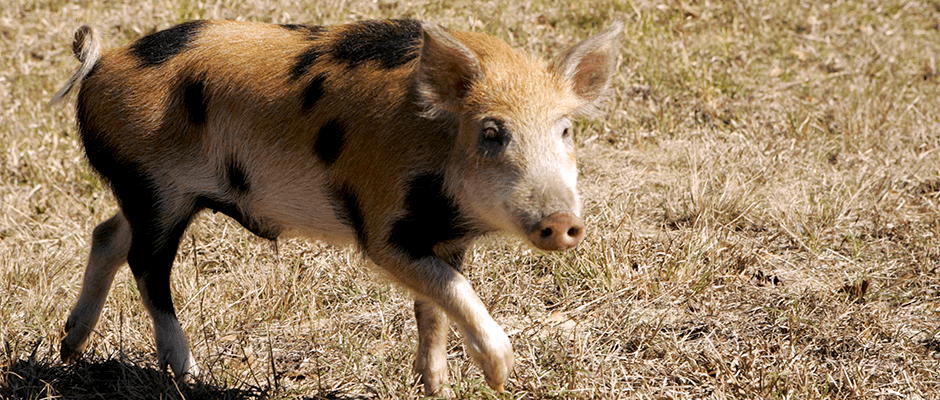
To help manage crop damage caused by feral hogs (Sus scrofa), researchers in Mississippi recently developed a quick, automated system using drone imagery.

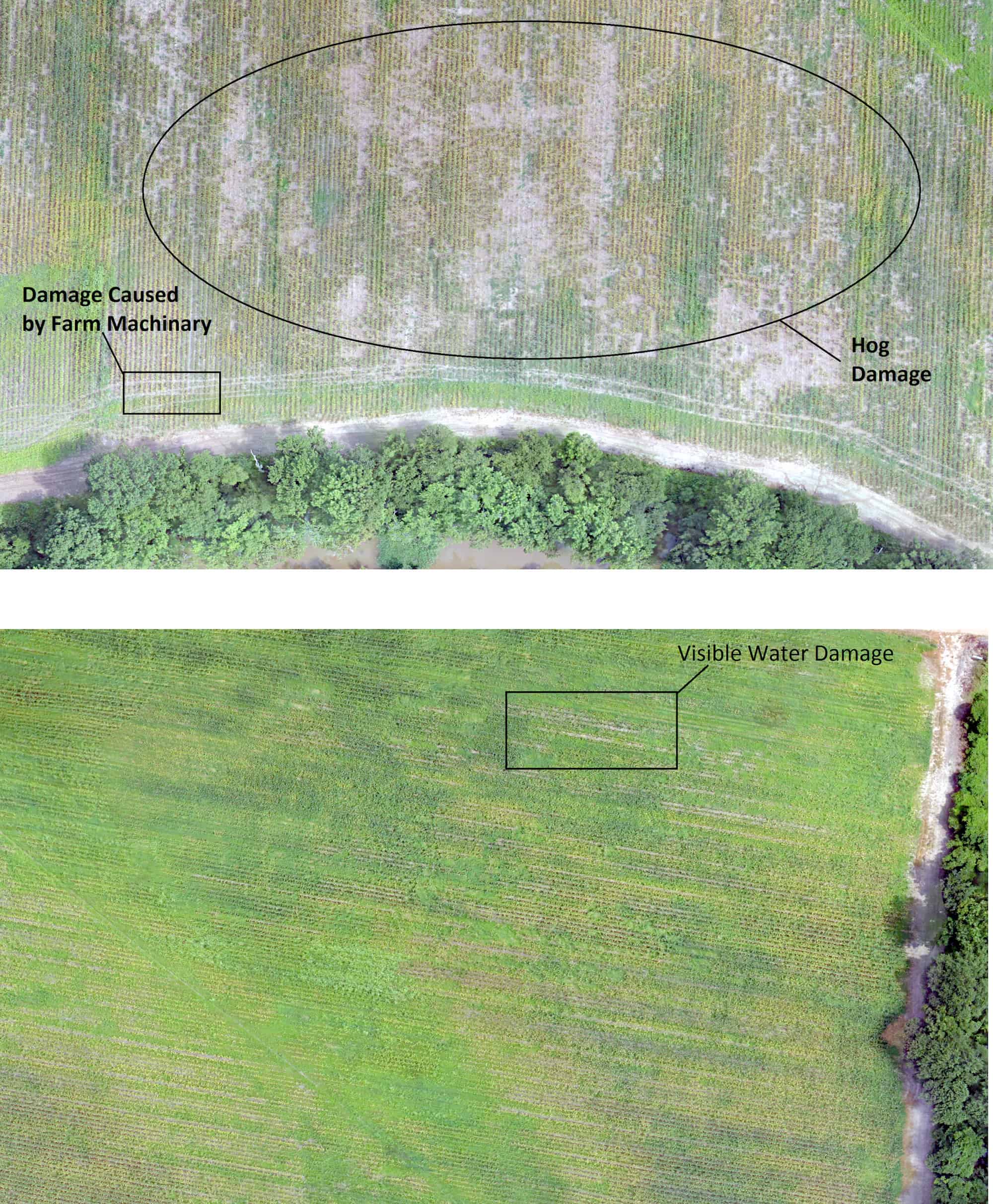
“When you look from a birds-eye view from a drone, you spot all those damages, and with GIS, you measure the amount of damages automatically,” said Sathish Samiappan, lead author on the paper published in the Wildlife Society Bulletin.

Feral hogs, also known as wild pigs, can destroy crops by rooting around and stomping through fields. In 2016, Samiappan, an assistant research professor at Mississippi State University, and his partners flew a drone 120 meters over cornfields visited by these animals. Using a camera similar to those found in cellphones, the drone captured the crop damage. Samiappan’s team created an algorithm to recognize distinct patterns of damage inflicted by the hogs, then compared the assessment to a manual one done on foot using GPS coordinates.

Drone imagery indicates crop damage from feral hogs and other sources in Mississippi. ©Sathish Samiappan

“The correlation was really high,” he said, and the automatic approach was up to 78 percent accurate. Like any technology, though, it isn’t perfect. If the destruction isn’t contiguous, heavy or clear, the technique won’t detect it, Samiappan said. But for obvious damage, the algorithm can identify it far faster than a person on foot possibly could.

To cover a 10-acre field, a person on foot would need a week, he said. A $1,600 drone could photograph it in 30 minutes and the computer could complete the analysis in hours. “You fly in the morning, you have data ready by evening,” he said.

He and his colleagues, who have launched drones to count migratory birds preying on farmed catfish in Mississippi and to map invasive plants on the Gulf Coast, are now applying this new method to quantify how deer affect crops.

“The drone is just a platform,” Samiappan said. “All it can give you is data. It’s up to us and computers to interpret. This has a lot of potential. We just need to do collaborative research and solve problems.”

TWS members can log in to Your Membership to read this paper in the Wildlife Society Bulletin. Go to Publications and then Wildlife Society Bulletin.

House bill would extend federal duck season

Rep. Rob Bishop, R-Utah, and Rep. Jack Bergman, R-Michigan, introduced a bill (H.R. 6013) that would designate Jan. 31 as the end of the federal duck hunting season by modifying the Migratory Bird Treaty Act. The 2018-2019 hunting season framework released by the U.S. Fish and Wildlife Service earlier this month specified the last Sunday in January as the end of the season. The bill in the House of Representatives would add an additional four days to the end of the 2018-2019 federal season. It would also designate special hunting days for youth, veterans and active military personnel on the first weekend in February.

Learn more about the bill at congress.gov.

Senate committee approves Interior spending bill

On Thursday last week, the Senate Committee on Appropriations unanimously approved a $32.6 billion Interior, Environment, and Related Agencies Appropriations Act for fiscal year (FY) 2019 (S. 3073)

Only one amendment was adopted during the markup session, which included a provision that directs the Interior Department and Forest Service to maintain updated five-year deferred maintenance plans. Committee members did not offer any other new amendments to the introduced bill. The legislation also largely rejects many of the spending cuts in the president’s proposed FY2019 budget.

The spending bill will now move out of committee and onto the Senate floor for a vote. The Senate has not voted on a stand-alone Interior, Environment, and Related Agencies spending bill since 2010.

“It is time to return to regular order where we vote appropriations bills out of committee with bipartisan support and take them to the floor,” said Chairman of the Appropriations Subcommittee on Interior, Environment, and Related Agencies Lisa Murkowski (R-AK) in her opening statement. “I look forward to moving the Interior bill through the process in a fashion which allows all members of the Senate to have an opportunity to debate the bill and offer amendments.”

The bill provides the Interior Department with $13 billion in overall spending, equivalent with the proposed spending level in the House appropriations bill. The National Park Service would receive $3.2 billion, an increase of $13.4 million from 2018 spending levels, with the aim of helping the agency address its $11.6 billion maintenance backlog. The Land and Water Conservation Fund would receive $425 million, which is $65 million more than the proposed spending level in the House bill. The U.S. Fish and Wildlife Service would receive $1.6 billion in funding, $19.7 million less than FY2018 spending levels.

The bill would also provide $14 million for the Interior’s proposed reorganization, which Secretary Ryan Zinke says will better align department efforts with ecosystem and watershed boundaries. The Senate Committee’s report provides a stipulation that the funds are not to be obligated until the department provides a report detailing the reorganization plans and expected funding allocations.

The U.S. Forest Service would receive $6.3 billion for overall spending, including $4.3 billion overall to fight wildfires and prevent “fire borrowing,” or instances when the USFS must draw funds from non-fire-related budgets to pay for wildfire expenses.

The House Appropriations Committee recently passed its version of the Interior, EPA, and Related Agencies spending bill, which now moves to the House floor for a vote. The House and Senate will work together to reconcile their versions before passing a final appropriations bill for presidential approval.

Aldo Leopold award recipient will focus on personal reflections

Click here to register now for the upcoming 25th annual TWS conference.

It isn’t Aldo Leopold’s groundbreaking science or policy papers that most people remember when they think about the renowned wildlife biologist, said Aldo Leopold Memorial Award recipient Wini Kessler. It’s his personal reflections.

Kessler plans to share some of these personal moments in not only Leopold’s career but her own during her keynote at the upcoming annual TWS conference in Cleveland, Ohio. She is only the second woman to receive the award, the highest honor in The Wildlife Society.

“I was humbled and delighted with the Aldo Leopold Award, and used it as an opportunity to go back and revisit books by and about Aldo Leopold that would be useful for the keynote address,” said Kessler, a past president of The Wildlife Society. “What really sticks with people are some of the ‘aha moments’ he had that changed his views and that made him think deeply about things.”

One of those moments for Leopold is documented in his 1949 book, A Sand County Almanac: “We reached the old wolf in time to watch a fierce green fire dying in her eyes. I realized then, and have known ever since that there was something new to me in those eyes — something known only to her and to the mountain. I was young then, and full of trigger-itch; I thought that because fewer wolves meant more deer that no wolves would mean hunters’ paradise. But after seeing the green fire die, I sensed that neither the wolf nor the mountain agreed with such a view.”

Kessler will discuss some of her own “dying wolf” moments, including reflections on who belongs in the wildlife profession. Early on, she was challenged by those who didn’t think women belonged in the field. Through her experiences with inspiring mentors and people of all stripes, including colleagues with disabilities, she has seen the profession change for the better through inclusion.

Leopold’s writings and Kessler’s own “aha moments” were key in her service on the team that helped the U.S. Forest Service switch from an agricultural paradigm to a ecosystem-based management.

Kessler, who also spoke at the plenary during the first TWS conference on the subject of education, will revisit insights from Aldo Leopold and others that revolutionized her thinking about the purpose of wildlife curricula.

She hopes some of these messages will resonate with younger people or people going through tough times in their careers. “I’m hoping to pass along some of the inspiration I received from courageous colleagues, that helped put things in a bigger perspective,” she said. Among her favorite words of wisdom for challenging times: “This too shall pass.”

What wildlifers are reading in TWS journals

TWS’ three premier wildlife journals — The Journal of Wildlife Management, Wildlife Monographs and the Wildlife Society Bulletin — support our mission to achieve a positive impact on the sustainability of wildlife populations through the dissemination of science-based wildlife conservation and management.

With online access now included as a membership benefit, TWS members are increasingly engaging with the latest research findings in wildlife science.

In case you missed any of these, here’s a list of the most downloaded papers in 2017.

  1. Free-roaming cat interactions with wildlife admitted to a wildlife hospital
  2. Polar bear attacks on humans: Implications of a changing climate
  3. Determining kill rates of ungulate calves by brown bears using neck-mounted cameras
  4. Effects of control on the dynamics of an adjacent protected wolf population in interior Alaska
  5. Predicting eagle fatalities at wind facilities
  6. How publishing in open access journals threatens science and what we can do about it
  7. Clarifying historical range to aid recovery of the Mexican wolf
  8. Bat mortality due to wind turbines in Canada
  9. Online hunting forums identify achievement as prominent among multiple satisfactions
  10. Inefficiency of evolutionarily relevant selection in ungulate trophy hunting
  11. Investigating impacts of oil and gas development on greater sage-grouse
  12. The role of domestic cats in the admission of injured wildlife at rehabilitation and rescue centers
  13. Consumption of intentional food subsidies by a hunted carnivore
  14. How open access is crucial to the future of science
  15. Predators, predator removal, and sage-grouse: A review
  16. Annual elk calf survival in a multiple carnivore system
  17. Demography of an increasing caribou herd with restricted wolf control
  18. Manipulations of black bear and coyote affect caribou calf survival
  19. Winter diet and hunting success of Canada lynx in Colorado
  20. Overpasses and underpasses: Effectiveness of crossing structures for migratory ungulates

Log into Your Membership to read these papers by going to the “Publications” tab.

We want to thank these authors for choosing to publish with TWS.

Next time you are ready to submit a paper, we hope you will choose a TWS journal as your publication outlet!

Here’s just a few reasons why you should:

  • Universal author guidelines
  • Rapid, rigorous peer review
  • Discounted page charges for members
  • Open access option available

B.C. Chapter supports endangered species legislation

The British Columbia Chapter of The Wildlife Society (BCTWS) has expressed support for the development of endangered species legislation in the province.

The proposed new provincial legislation is intended to establish a clear process to protect species at risk to meet obligations set out by the Canada-British Columbia Agreement on Species at Risk. Canada’s Species at Risk Act provides protection for at-risk species at the federal level. The proposed legislation would facilitate protection at the provincial level. Last month, the government of British Columbia announced that it would hold public consultations on the development process.

In a letter, BCTWS expressed support for the move and offered four elements to be considered for incorporation into the new legislation. The first, science-based decision making should be used during each step of the listing, recovery and delisting processes. Second was the facilitation of partnerships and cooperation between governmental agencies, First Nations, private landowners and other stakeholders in recovering species. Third, BCTWS requested adequate funding to support species recovery and, finally, the use of market-based strategies to encourage endangered species conservation.

“Our hope for this legislation is that it will provide a simplified, unified and effective framework for the protection of species-at-risk in British Columbia and allow British Columbians to thrive economically and socially,” BCTWS said in the letter.

An intentions paper detailing the specifics of the proposed legislation is expected to be made available for public comment in fall 2018.

Quebec biodiversity may increase with climate change

As climate change disrupts wildlife around the world, protected lands in Quebec might actually see higher biodiversity, researchers found, creating challenges for managers as they deal with wildlife leaving warmer climes.

“We wanted to really get a feel for what climate change would mean for our biodiversity,” said Frieda Beauregard, a curator at the McGill University herbarium and a co-author of the study published in Scientific Reports. “We have a long border. It’s a big province containing several biomes. We wanted to try to get some parameters on what we can expect.”

Beauregard and her colleagues created niche models for what projected changes in climate would mean for 529 species that make up about one-third of the protected areas in southern Quebec. They studied birds, amphibians, trees and vascular plants.

The team used government data, including extensive surveys done at the provincial level, and projected future climate change scenarios to make their predictions.

The results showed that climate change could push wildlife from more southern regions of North America into protected areas in the Quebec by 2071 to 2100. Species gain could range from 12 to 530 percent, researchers found, depending on the area, while a few parts of the province may also lose biodiversity. This could raise some challenging questions for managers, Beauregard said.

“What do you do if a new species on conserved land isn’t native to the area?” she said. “Are they invasive species, or a species with a protected status? We’ve got to think through these things at a policy level.”

Wisconsin students collaborate with local organizations

The following student chapter news was included in the Spring 2018 newsletter of the Wisconsin Chapter of The Wildlife Society. Photos of student chapter activities are also included in the newsletter.

University of Wisconsin-Madison Student Chapter of The Wildlife Society

By Valerie Knurr, Student Chapter Past President

The UW Madison Student Chapter of The Wildlife Society had a busy spring semester. They begin the semester with Conservation Warden Jake Donar, a UW Wildlife Ecology alum, speaking about his job with the Wisconsin Department of Natural Resources. The student chapter had several other events, including a tour of the chronic wasting disease testing station in Black Earth, a Snap-a-thon in partnership with Snapshot Wisconsin where teams competed to classify as many trail cam photos as possible, a trip to the UW Arboretum for Madison Reads Leopold and a hike, and an ice skating social with the Forestry Club. The student chapter also had former WDNR herpetologist and current director of Turtles for Tomorrow, Bob Hay, speak about wood turtle conservation. In April, students had a Crafts for Conservation event in partnership with the Henry Vilas Zoo where members created crafts out of snares from South East Asia that were being used to illegally trap saolas. These crafts are sold to make money for saola conservation efforts. The student chapter will also be taking a trip to a maple syrup festival at the Mackenzie Center and participating is Science Expeditions for an outreach event. They plan on attending a naturalist led hike in Owen Conservation Park and cleaning up a highway segment on Earth Day. They’ll also be participating in the DNR citizen science frog and toad survey and the Great Wisconsin Birdathon like they’ve done for many years.

This semester the student chapter has been focusing on getting as many students involved as possible, especially underclassmen. The student chapter did a member survey to see how they can improve. They then followed that up with an officer shadow meeting where members who were thinking about running for an officer position could experience an officer meeting and get a better understanding of the organization’s leadership. The student chapter is also working to increase the number of events offered so more students can participate and members have more options. They hope these efforts will have a lasting impact on the organization and keep members invested for years to come.

University of Wisconsin-Stevens Point Student Chapter of The Wildlife Society

By Katherine Rexroad, Student Chapter Past President

The members of the UWSP Student Chapter of The Wildlife Society started 2018 with a bang! Over 50 Pointers, both faculty and students, attended the Midwest Fish and Wildlife Conference this year in Milwaukee. The student chapter had five poster presentations with multiple student authors and multiple students took home awards. Student chapter member Emily Masterson won best undergraduate presentation and UWSP graduate student Kali Rush won the best graduate presentation. Alumni Rachel Konkle received the Aldo Leopold Award from the Wisconsin Chapter of The Wildlife Society and graduate student Jordan Meyer received the Janice Lee Fenske Award. The student chapter would also like to congratulate TWS members Dr. Scott Hygnstrom and Dr. Shawn Crimmins for being elected to serve on the Wisconsin Chapter executive board.

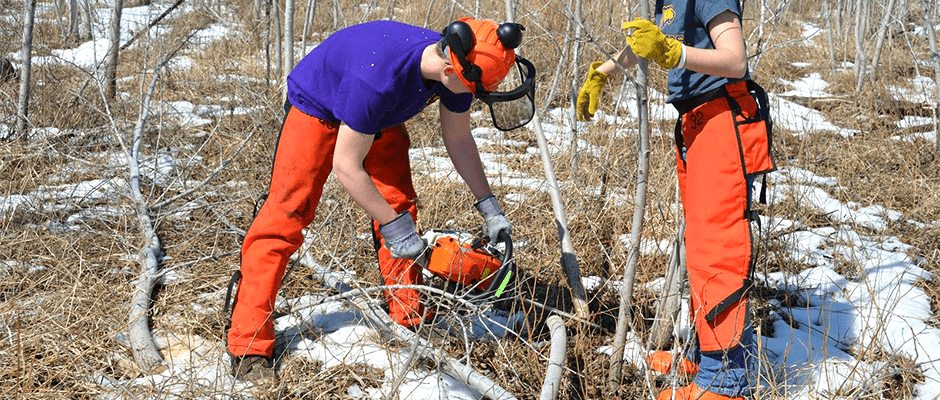
Along with professional conferences, participating in the Adopt a Wildlife Area project with the Wisconsin Department of Natural Resources keeps student chapter members busy. During the month of February, 30 Pointers became chainsaw certified through the program. This also included multiple work days in the project area to allow members to practice their new skills.

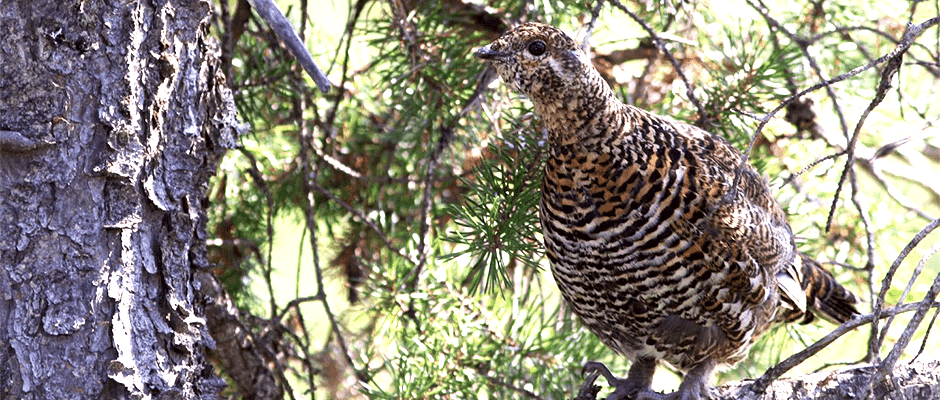
The UWSP Student Chapter organizes over a dozen student-led research projects on an annual basis, a unique characteristic that sets them apart from any other student chapter of The Wildlife Society. Project permits are under faculty or other wildlife professionals and the data gathered is frequently presented or published. Some of the research projects that took volunteers into the field this semester included the woodpecker project, ruffed grouse project, lagomorph project, waterfowl project, and whitetail deer project. Students involved in the saw whet owl project presented data from the fall season at both the Midwest Fish and Wildlife Conference and the Izaak Walton League local chapter meeting. Unrelated to research, McKenna Hammons, previous student chapter Treasurer, initiated the showing of the Aldo Leopold film “Green Fire” in early March.

The UWSP Student Chapter has numerous goals for the future and a dedicated group of student members to pursue them!

BioBlitz joins BLM, citizen scientists in New Mexico desert

The Bureau of Land Management Las Cruces District recently sponsored its first Bioblitz at the Dripping Springs Natural Area, attracting volunteers from the surrounding communities to learn about the biodiversity of the Organ Mountains. The Natural Area is part of the Organ Mountains-Desert Peaks National Monument and is a popular site and great source for science.

With the help of 114 citizen scientists, the BLM recorded over 130 species of plants, lizards, moths, butterflies, bats, birds and small mammals, despite the uncharacteristically cold spring day.

During the bird hikes, citizen scientists recorded 26 species of birds that are commonly seen in the area. During the process of banding birds, the team was able to record migrant birds that are not easy to see or hear. Such birds typically will not sing since they are not in their breeding grounds. Plus, they travel long distances, so the birds try to conserve their energy, only stopping to feed quickly and continue on their journey. Two of the birds recorded were the gray flycatcher (Empidonax wrightii) and the orange-crowned warbler (Oreothlypis celata).

The migration route of the two species passes through southern New Mexico, but they are more frequently found in riparian areas near the Rio Grande instead of the mountains. The gray flycatcher is especially rare. According to citizen scientist records, the last gray flycatcher sighted at the natural area was in September 2016. However, there have been other sightings in the northern portion of the Organ Mountains (the Natural Area is nestled at their base). Elsewhere in the mountains, the last sighting was in September 2017. The first record of a gray flycatcher was in October 2006. Since then, there have been only 28 sightings.

For the Bioblitz bat program, a BLM expert conducted acoustic monitoring of the bats using a SonoBat program on her Microsoft Surface tablet and a Pettersson M500 microphone. There are some limitations to this surveying method since some bat species have a lower detection rate than others, and it is difficult to quantify abundance. This method is better served to determine species composition. The upsides to it, though, are that no permit is required and it is not invasive. This has been of special concern recently since the emergence of white-nosed syndrome, as catching bats in mist nets can further spread the fungus that causes the devastating disease.

Citizen science opens the doors of scientific inquiry to anyone who has an interest. Anyone can make a meaningful contribution to science, regardless of their expertise. At this event, while the highest number of observations was made by a BLM botanist; the second highest was made by a 6th grader!

At the end of the event, everyone who volunteered came away with a sense of accomplishment and the affirmation there is so much more life in the Chihuahuan Desert and our local mountains than they realized. All they had to do was look for it.

From this Bioblitz and future ones, the BLM will be able to generate a list of flora and fauna to help the agency make management decisions and educate visitors. The BLM is also teaming up with a local geographer and poet to convert its biodiversity inventory into a “poetic inventory,” connecting art to science in order to provide a different perspective on the natural environment.

The Bureau of Land Management is a Premier Partner of The Wildlife Society.