JWM study: Could culling deer populations impede disease management?

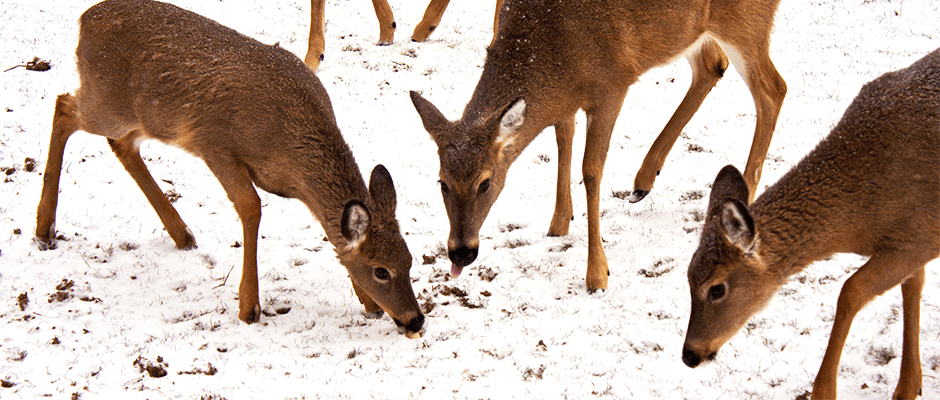
Removing groups of deer to manage wildlife diseases may unintentionally create opportunities for diseases to move between groups, according to new research focused on the social response of white-tailed deer (Odocoileus virginianus) after culling. Researchers in southern Illinois found that disruptions in social structure caused remaining juvenile deer to shift their home range and increase contact with neighboring groups, potentially enhancing disease transmission of chronic wasting disease (CWD) and other diseases.

“In 2002 [CWD] popped up in Illinois. Last year was the first case in Michigan, and it’s been reported in a number of different states that aren’t connected to Colorado and Wyoming where CWD was originally found,” said Marie Tosa, a former graduate research assistant at Southern Illinois University Carbondale and first author of a new study in the Journal of Wildlife Management.  Managing the disease’s spread has been focused on population density control, but so far, not much progress has been made. “The prevalence rate has stayed constant instead of going down,” Tosa said.

CWD can remain within the environment for years, potentially infecting individuals as they move into territories where localized group removal has occurred. Additionally, remaining members of culled groups, or remnant members, may join or increase contact with surrounding groups, increasing potential for diseases to spread between groups. According to Tosa, simple models of disease transmission do not account for social disruptions caused by management interventions or disease mortality.

To determine how the social structure of white-tailed deer is impacted by these disruptions, Tosa and her colleagues studied deer in four areas of southern Illinois from 2011-2014. The researchers identified social groups of deer and tagged one individual from each group. They also fitted the tagged individual with a GPS collar. For every six groups identified, they removed one group and left only the tagged individual behind. The researchers measured home range size, space-use fidelity, and shifts in space of remnant individuals toward the control groups, as well as the pre-removal and post-removal direct contact frequency between remnant and control individuals.

Their results showed there was little change in space use and reduced contact duration between remnant adult females and the control groups. However, remnant juveniles strayed further and increased their spatial overlap with neighboring groups. Tosa says these findings indicate that responses to social disruptions differ by age, with the increased movement of juvenile deer potentially enhancing transmission to uninfected groups.
“This is such a difficult topic because we don’t know enough about CWD and how it spreads: how many contacts are required for a deer to get infected, or how many times a deer needs to go to a bait pile or someplace where another infected animal has been in order to be infected,” Tosa said. “More studies like this one need to be done to help us understand how management strategies impact the remaining deer population.”

Tosa and her colleagues recommend removal of entire social groups for disease management, when feasible, to reduce between-group transmission.


Lindsey Stone has a master’s degree from Miami University in environmental science with a focus in applied ecology and conservation biology. She is passionate about community based conservation and adaptive management strategies.
Habitat restoration begins at Shuswap Lake, BC

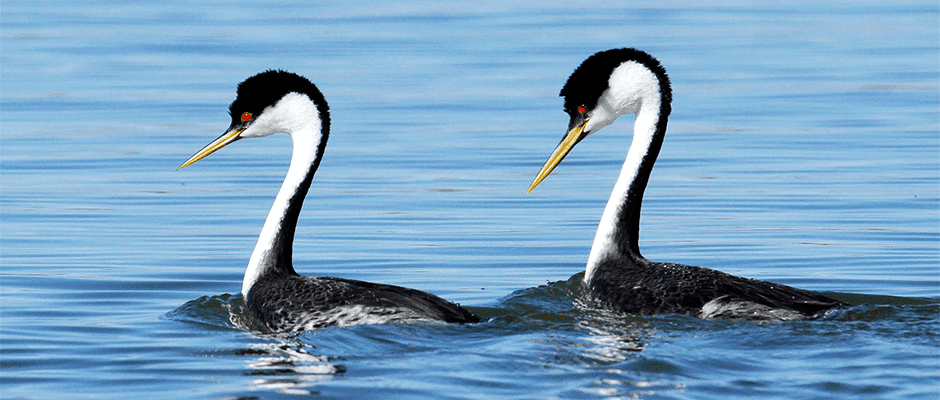
A habitat restoration project has begun on the banks of Shuswap Lake, less than a kilometer from Salmon Arm, British Columbia. The project, organized by the Salmon Arm Bay Enhancement Society, aims to recover populations of Western grebe (Aechmophorus occidentalis). The Western grebe is native to the Shuswap, but populations of the bird have been declining in recent years. Biologists believe habitat loss is contributing to these declines – so restoration efforts at Shuswap Lake are focused on creating new nesting opportunities for the birds. The project is excavating areas along the shoreline to create a more diverse habitat with room to plant cedar, cottonwood, and other trees that grebes use for nesting. Other species are also expected to benefit from the restoration project, which should also attract turtles, bats, waterfowl, and fish.

Read more about the project from CBC News.

New study to track Cook County turtles and habitat use

Future generations of turtles in the Chicago area have new hope thanks to Forest Preserves of Cook County, Friends of the Chicago River, and USDA Wildlife Services.  For many aquatic turtles, the loss of suitable nesting habitat and high predator densities has limited their ability to reproduce.  Increased invasive plant density has restricted turtle nesting to confined areas and the activity is predictable to predators.

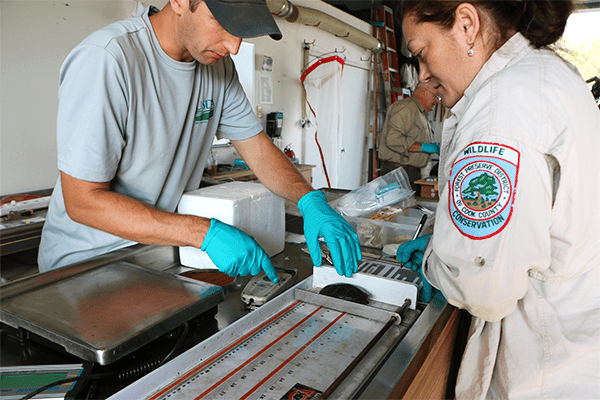
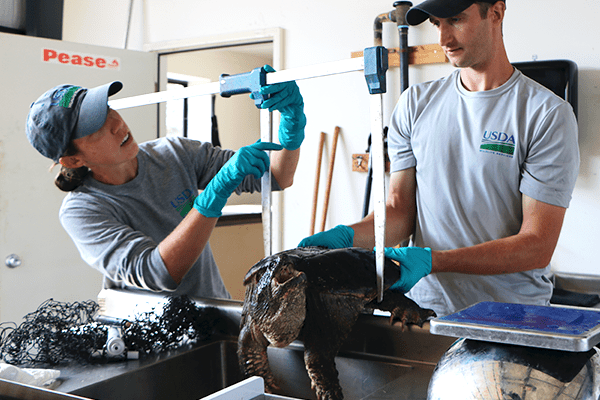
a.USDA Wildlife Services’ Wildlife Specialist Hannah O’Malley and Wildlife Biologist John Hartmann take measurements on a common snapping turtle as part of a new project being conducted by USDA Wildlife Services, Forest Preserves of Cook County, and Friends of the Chicago River. ©Stacina Stagner, Communications Manager, Forest Preserves of Cook County

a. USDA Wildlife Services’ Wildlife Specialist Hannah O’Malley and Wildlife Biologist John Hartmann take measurements on a common snapping turtle as part of a new project being conducted by USDA Wildlife Services, Forest Preserves of Cook County, and Friends of the Chicago River. ©Stacina Stagner, Communications Manager, Forest Preserves of Cook County

Lost habitat accompanied by abundant meso-predator populations has left turtle eggs and hatchlings vulnerable.  To minimize these challenges, by removing invasive shrubs and trees Friends of the Chicago River is restoring potential turtle nesting sites, which helps turtles find new nesting sites unknown to predators.  Some of the species benefitted include southern painted, common snapping, and spiny softshell turtles.

a.USDA Wildlife Services’ Wildlife Biologist John Hartmann, Biologist Melina Frezados (Forest Preserves of Cook County), and Senior Wildlife Biologist Chris Anchor (background, Forest Preserves of Cook County) take measurements on a southern painted turtle as part of a new project being conducted by USDA Wildlife Services, Forest Preserves of Cook County, and Friends of the Chicago River. ©Stacina Stagner, Communications Manager, Forest Preserves of Cook County

a. USDA Wildlife Services’ Wildlife Biologist John Hartmann, Biologist Melina Frezados (Forest Preserves of Cook County), and Senior Wildlife Biologist Chris Anchor (background, Forest Preserves of Cook County) take measurements on a southern painted turtle as part of a new project being conducted by USDA Wildlife Services, Forest Preserves of Cook County, and Friends of the Chicago River. ©Stacina Stagner, Communications Manager, Forest Preserves of Cook County

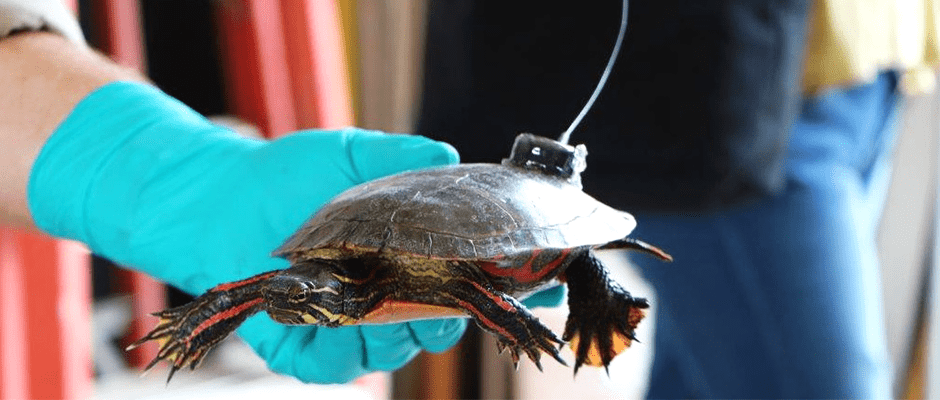
In order to monitor restoration efforts, biologists from Forest Preserves of Cook County and USDA Wildlife Services captured turtles near the restored habitats and attached transmitters to the their shells, which allows tracking after release.  Blood samples were taken and data was recorded on each turtle’s size, weight, and sex.  The nesting ecology, reproduction, and predation rates of turtle eggs and hatchlings at the restored sites will be monitored by staff.

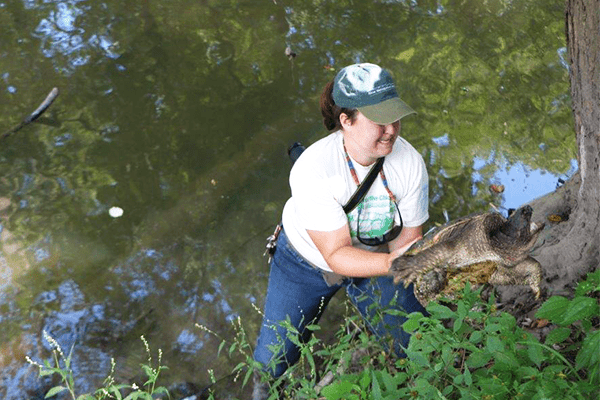
a.Conservation program specialist Claire Snyder (Friends of the Chicago River) works to safely release a common snapping turtle. ©Stacina Stagner, Communications Manager, Forest Preserves of Cook County

a. Conservation program specialist Claire Snyder (Friends of the Chicago River) works to safely release a common snapping turtle. ©Stacina Stagner, Communications Manager, Forest Preserves of Cook County

Wildlife Services is a Strategic Partner of TWS.

TWS Give Back Program: Engaging more wildlife professionals

Beginning Dec. 1, when professionals, early-career professionals and retired TWS members renew their memberships, they’ll have the opportunity to “Give Back” to the wildlife profession by gifting a six-month complimentary TWS membership to an active wildlife professional of their choice to introduce that person to the many benefits that TWS has to offer. One of many significant announcements at the TWS Annual Conference in Raleigh by TWS chief operating officer Ed Thompson, this program was arguably one the biggest, creating quite a stir and plenty of positive buzz among attendees.

“Members have expressed how difficult it is to put the true value of a TWS membership into words when encouraging other professionals to join,” Thompson said. “By allowing them to pass along the complete TWS experience, the Give Back program provides members with a simple way to demonstrate that value.”

Over the past two years the Society has significantly improved the benefits of TWS membership, but those who aren’t members of the Society (at the main/international level) likely do not know how much they are missing. During that same time period, the Society’s student membership has continued to grow, but the number of professionals has remained mostly stagnant. So in order to grow and strengthen the TWS network of professionals and increase collaboration opportunities for all members, the new Give Back program specifically targets individuals who are active wildlife professionals to receive these introductory memberships.

Nominees, should they choose to accept their gift membership from a TWS member, will experience all the same benefits as members, including but not limited to:

  • The Wildlife Professional bimonthly magazine
  • Free online access to all TWS publications (The Journal of Wildlife Management, Wildlife Monographs and Wildlife Society Bulletin)(effective Jan. 1, 2017)
  • Weekly editions of the eWildlifer newsletter, including featured TWS Talks presentations
  • Networking through the TWS Online Member Directory (launching in December)
  • Ability to join any and all working groups
  • Ability to pursue certification opportunities
  • A variety of members-only discounts, including $200 off TWS Annual Conference registration
  • And much more!

If you renew online, you will immediately have the opportunity to nominate an active wildlife professional. If you renew through TWS’ paperless automatic renewal program or mail in a paper renewal form, you will receive an email with a link that can be used to submit your nomination.

The nomination process is easy:

  • Provide the name and email address of the nominee.
  • TWS will send an email on your behalf inviting the person to accept your gift.
  • The nominee accepts the gift by simply providing a mailing address (to receive The Wildlife Professional magazine).
  • The nominee receives a welcome email with member login information. You receive an email confirming that the person has accepted your gift so that you can stay in touch and continue to encourage your nominee to join at the end of the six months.

Before your renewal date sneaks up on you, start thinking about who you can nominate. It may be a friend or colleague in your organization or agency; a respected peer at a different organization; a TWS local chapter or section member who isn’t a TWS member (at the main, international level); or anyone you believe would benefit from a TWS membership and would be a valuable addition to our network of wildlife professionals.

“If every professional, early-career professional and retired member nominates an active professional for this special opportunity, nearly 7,000 people will experience TWS membership through this new program during the upcoming year,” Thompson said. “The Give Back Program is an amazing opportunity to significantly grow our membership, providing all TWS members with a wider and more diverse network for professional development and collaboration.”

Cuckoos reveal mystery migration route

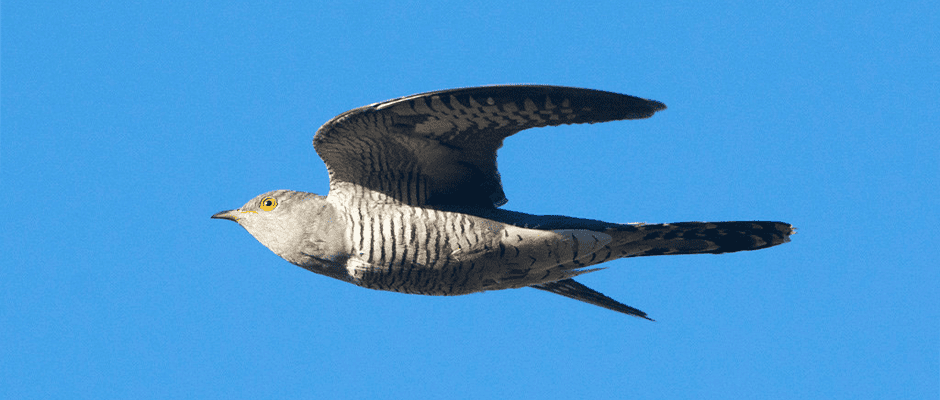
Three common cuckoos (Cuculus canorus) recently made an extraordinary journey across three continents, revealing the species’ previously unknown winter migration route. The birds, named Flappy McFlapperson, Skybomb Bolt, and Meng zhi juan, were fitted with satellite trackers in Beijing, China and monitored by the Beijing Cuckoo Project. Many anticipated the birds’ journey would end in southern Asia or India, but Skybomb defied expectations when he flew non-stop for four days over the Indian Ocean – more than 2,300 miles – to arrive in Somalia. Flappy reached Africa a few days after Skybomb, but took a more cautious route along the Arabian peninsula coastline. Meng zhi juan remains close to the west coast of India, possibly about to start his own flight to Africa.

Researchers expect the birds will return to the Beijing region in May.

A similar study is using satellite tags to track mangrove cuckoos (Coccyzus minor) in Florida. The Avian Research and Conservation Institute is hoping to learn more about the species’ unknown seasonal movements.

Read more about the Beijing cuckoos at The New York Times and the mangrove cuckoo study at the Santiva Chronicle

California Chapter to host CWB® workshop

Certified Wildlife Biologist® workshop on December 3, 2016

The California Central Coast Chapter of TWS and the Western Section of TWS will be hosting a Certified Wildlife Biologist® workshop on December 3, 2016 from 9am to 3pm in Goleta, CA.

Student registration is $10 and professional registration is $20. Please bring the following with you to the event:

  • Resume
  • Detailed job descriptions (for past and present positions)
  • College transcripts (unofficial is fine for the workshop, but official copies are needed for the actual application)
  • Course descriptions (a college catalog is helpful, or download them from your University’s web-site)
  • List of recent professional development events attended (i.e. conferences, workshops, trainings and symposia)
  • USB memory stick (“thumb drive”) or a blank CD to simplify file transfer
  • Laptop (fully charged), if possible

Click here for more information and to register. Click here for more information on The Wildlife Society’s certification program.

Sowing seeds for pollinators

Pollinators at several special sites will be buzzing with excitement come spring thanks to wildflower plantings taking place this fall. As part of The Wildlife Society’s partnership with Feed a Bee, a series of pollinator-approved plantings is scheduled to take place with partners across the country in the coming months. Among these unique locations are a research department investigating pollinators at Texas Tech University, a therapeutic boarding school with its own bee hives and a family-owned citrus grove.

At the annual conference in Raleigh this October, The Wildlife Society (TWS) announced these plantings would occur in regions where its members are particularly passionate about promoting pollinator health. Existing Feed a Bee partners will plant native wildflowers this fall in:

  • Lubbock, Texas
  • Scott City, Kansas
  • Flanagan, Illinois
  • Fort Pierce, Florida.

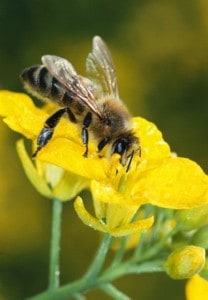
bee-on-flower-8As a result of these plantings, more than 25 acres of additional forage for pollinators will be established nationally, giving our hardworking allies more sources of nutrition as they buzz from plant to plant. Various local organizations, in addition to TWS members, will have the chance to play a part in the plantings by hand scattering seeds across dedicated plots, with additional acres planted afterward. Educational stations and workshops will also accompany the plantings, providing community members and local growers more information on the latest research in bee health and how to establish their own pollinator patch.
First up is an especially engaging planting with Texas Tech University in Lubbock, Texas, where students will share new research about role of native bees in pollination. The second planting will occur at McCarty Family Farms in Scott City, Kansas, a family-owned, award-winning dairy. As a partner of Feed a Bee, these sites place a great emphasis on protecting our pollinators.

Next, the tour heads to Salem4youth, a long-standing partner located in Flanagan, Illinois. Community members will enjoy rotating through four learning stations offering firsthand access to information that is especially of interest to local farmers. Finally, as we bring in the holiday season, the final planting event takes place in Fort Pierce, Florida, with The Packers of Indian River. This Feed a Bee partner is a fully operational grove – producing, packing and distributing citrus produce of many kinds. The event will include a tour of the grove, where the family has been growing quality produce since 1928.

We’re overjoyed to announce these upcoming planting events with some of our most crucial partners. Additionally, we are thankful to have The Wildlife Society’s hand in conveying the important message about pollinators’ role in our ecosystem. We look forward to celebrating these industrious insects and hope to see you there!

To learn more about the Bayer Bee Care Program, visit beehealth.bayer.us.

Bayer Bee Care is a Premier Partner of The Wildlife Society. 

UNR Student Chapter promotes local engagement, diversity

Fall marks an exciting new beginning for the UNR Student Chapter and its new board. This year, the club’s goal is to increase membership through outreach and educational activities. The club has also added a new position, Social Media Liaison, in order to keep our members well-informed about all upcoming events.

Thanks to the high attendance of wildlife professionals at the barbecue mixer this September, several guest speakers will be making an appearance at UNR club meetings. This will give students an insight on what jobs are available and what they can do while they’re still in college to achieve their future goals.

Several UNR board members have attended workshops offered by the Western Section of The Wildlife Society and have shared their experiences with the club. By sharing these experiences, we hope to encourage students to participate in both the Western Section and the Nevada Chapter.

Several UNR Student Chapter members participate in a fall hike. ©UNR Student Chapter

Several UNR Student Chapter members participate in a fall hike. ©UNR Student Chapter

Another important goal for this year’s student chapter is to increase cultural, ethical, and racial diversity within the field of wildlife. Part of our efforts has included volunteering at the Center for Student Cultural Diversity at UNR. Our hope is to reach out to future college students and encourage them to pursue careers in wildlife.

The club has already held true to its word to be more active by planning several meetings, hosting group hikes, participating in UNR Field Day, and hosting “study group” socials to help prepare for the student conclave in March. UNR brought home second place in the Quiz Bowl portion of conclave last year; our goal for this year is to bring home first.

Our upcoming events include volunteering at the Fall Fish Festival in South Lake Tahoe, participating in a mock interview event hosted by the UNR Range Club, and continuing to offer our services wherever they are needed. As always, we encourage Nevada Chapter members to interact with the student chapter – whether it’s to recruit volunteers or plan future events. We can be reached by email at unr@tws-west.org.

This article originally appeared in the Nevada Chapter of TWS’ Fall/Winter 2016 newsletter, which can be downloaded here.

The smell of marine plastic may attract seabirds

A recent study from the University of California, Davis might help explain why some seabirds eat so much plastic debris. While it’s widely thought that birds visually mistake plastic for food, the study found that smell may also trick the birds into ingesting plastic floating on the ocean’s surface.

Birds of the order Procellariiformes — the albatrosses, shearwaters and petrels — are highly olfactory seabirds that spend most of their time foraging over the open ocean, using their sense of smell to find squid, fish and zooplankton, like krill.

Previous studies have shown that some Procellariiformes species are responsive to the chemical smell of dimethyl sufide (DMS), using it as a foraging cue to locate krill. When krill and other zooplankton feed on algae, the algae releases DMS; thus, for some seabirds, the presence of DMS indicates the presence of food.

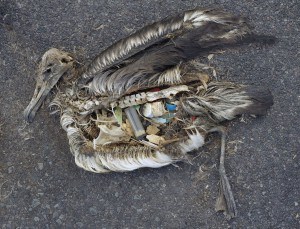
An albatross with a stomach full of plastic. ©USFWS/Chris Jordan

An albatross with a stomach full of plastic. ©USFWS/Chris Jordan

Floating plastic debris often becomes coated in DMS-producing algae, and researchers at the University of California, Davis wanted to test if ocean plastics acquire the chemical signature of DMS while in the marine environment.

Graduate student Matthew Savoca and his team tied bags of the three most common types of plastic found in marine debris — high-density polyethylene, low-density polyethylene and polypropylene — to buoys off the coast of California.

After three weeks, chemical testing found DMS in each sample at concentrations that seabirds can detect, confirming that plastic acquires a DMS signature after less than a month in the marine environment. This result suggests that ocean plastic presents, in addition to a possible visual cue, a scent cue that further encourages olfactory seabirds to consume plastic.

The researchers also wanted to understand if DMS responsiveness could be used to predict plastic consumption for Procellariiformes species. Analyzing previous data on plastic ingestion for 13,350 individuals across 25 seabird species, researchers found that DMS responsiveness had a significant positive effect on the frequency of plastic ingestion. The results also showed that DMS-responsive seabirds ingest plastic debris five times more frequently than birds that don’t respond to DMS.

The albatross has become an ambassador for seabird plastic consumption, largely due to Chris Jordan’s photographs of albatross carcasses full of plastic on Midway Atoll in the Pacific. But the study results show that shearwaters and petrels are among the species most susceptible to plastic ingestion. These birds are also mostly understudied because they nest in difficult-to-access underground burrows and are less charismatic than albatross.

Researchers hope their results will inform future monitoring efforts and elucidate the need to direct limited resources toward species most at risk for plastic ingestion, rather than common or charismatic species.

The study was published in the journal Science Advances.

USFWS finalizes impact statement on eagle take permits

The U.S. Fish and Wildlife Service has finalized a programmatic environmental impact statement (PEIS) that analyzes the potential impacts of a proposed revision to bald and golden eagle take permits. Proposed in May 2016, the revision would extend the maximum duration of take permits, which authorize energy projects to incidentally harass, harm, or kill eagles, from 5 to 30 years. Energy developers would be required to minimize impacts on eagles whenever possible and commit to compensatory mitigation measures.

This is the second time USFWS has proposed this revision: the first 30-year take permit rule was finalized in 2013. A district court, however, overturned the rule last year, finding that USFWS violated the National Environmental Policy Act (NEPA) when the agency determined the permit revisions were categorically excluded from NEPA review. This month’s final PEIS is expected to address some of the concerns raised in the court ruling, thereby advancing the efforts to finalize the permit revisions.

Read more about 30-year take rule and the court decision.

Update, Dec. 14: USFWS has issued a final rule revising bald and golden eagle take permits.