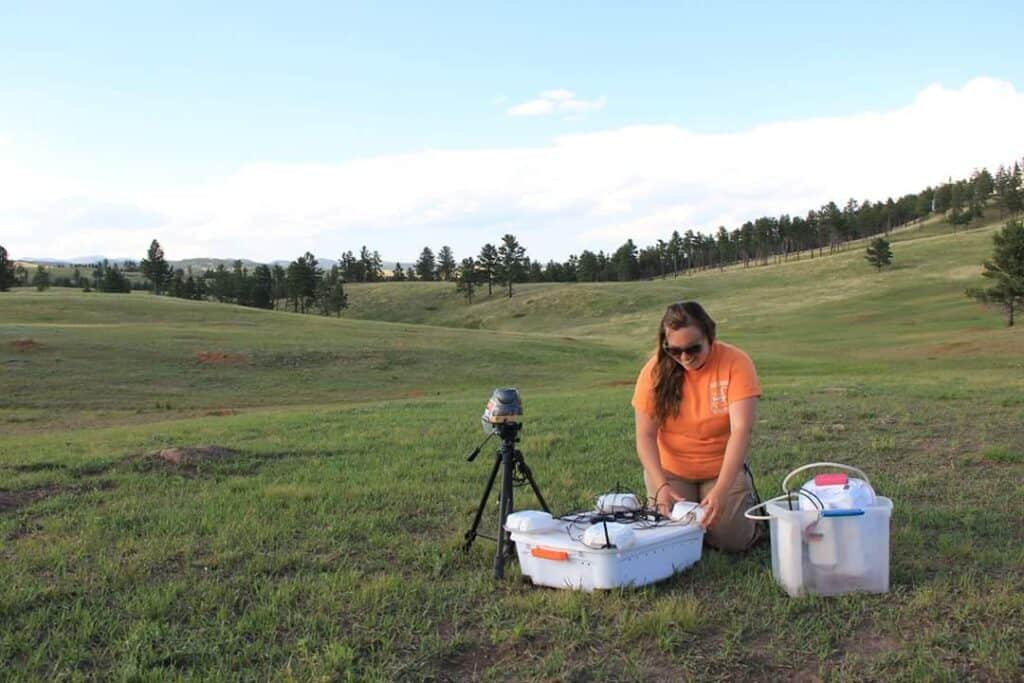
Large-scale grassland conservation efforts have helped increase the threatened American burying beetle population.
In a Working Lands for Wildlife-affiliated project, Caleb Roberts, a U.S. Geological Survey research ecologist and unit leader at the Arkansas Cooperative Fish and Wildlife Research Unit, studied population counts of the species taken by the Nebraska Game and Parks Department. He and his colleagues specifically looked at populations in the state’s Loess Canyons Experimental Landscape from 2007 to 2019.
The research showed that maintaining intact, highly connected grasslands is the most effective way to conserve the American burying beetle (Nicrophorus americanus). Scale and spatially explicit conservation tactics were also important for managing for small species like the beetle, the team found.
The American burying beetle’s range once included 25 U.S. states and even Canada. Today, most remaining populations live on privately owned grasslands in Nebraska, Kansas, Texas, Oklahoma, Arkansas and South Dakota.
First listed as federally endangered in 1989, the beetle’s status was changed to threatened in 2020. These nocturnal carrion beetles play an important role in ecology by helping recycle nutrients. Its presence or absence can also help land managers gauge the overall health of an ecosystem.
The U.S. Fish and Wildlife Service and partners released five Hawaiian crows on Maui recently in an effort to return the species to its historical range. After years of preparation by the USFWS, Hawaii’s department of land and natural resources division of forestry and wildlife and the University of Hawaii, experts released two females and three males that had been in conservation centers for months. Also known as “alala,” Hawaiian crows (Corvus hawaiiensis) went extinct in the wild in 2002 due to habitat loss, predation and disease. “The translocation of alala to Maui is a monumental step forward in conserving the species and a testament to the importance of partnership in reversing biodiversity loss,” Megan Owen, vice president of conservation science at the San Diego Zoo Wildlife Alliance, told The Guardian.
Warm cities may provide the best conditions for the spread of invasive lanternflies. Spotted lanternflies (Lycorma delicatula), native to Asia, first arrived in the U.S. in 2014 in Pennsylvania. They have since spread across the Northeast and into the Midwest and Southeast. Scientists tapped into the citizen science platform iNaturalist to learn more about why the insects are doing so well in New York City. “Cities tend to have milder winters, creating favorable conditions for species that otherwise would only be able to live in hot, tropical climates,” said Kristin Winchell, an assistant professor of biology at New York University who studies ecology and evolution in urban environments, in a press release. “Cities are also highly connected places where trade happens, and organisms may end up on shipments in planes or boats traveling between cities.” After looking at nearly 20,000 photos of lanternflies taken between 2014 and 2022, the team found that nymph and adult lanternflies were showing up earlier each year and remaining active later. This longer active time means more time to reproduce and spread, Winchell said. Winchell and her colleagues hope this information can help with monitoring and mitigation of spotted lanternflies and other invasive species.
Growing up, I was always outdoors. Whether it was going on hikes, hunting and fishing with my dad, or just watching the critters in my backyard, I was always entertained by what surrounded me.
But the moment I knew I wanted to become a wildlife biologist was during my junior year of high school.
I always loved my general science classes. Unfortunately, my high school did not offer any environmental courses. Back then, the only environmental-related jobs I heard of were game wardens and park rangers. While those options were always in the back of my mind, I knew it wasn’t quite what I was looking for.
I had a lot going on at the time for a high schooler: Advanced Placement classes, working five days a week and attending daily after-school activities. While I enjoyed all of this, the routine and busyness of it all drove me into a rut.
Kirstin Palumbo helps her professor, Carol Bocetti, capture and PIT tag Delmarva fox squirrels (Sciurus niger) to monitor their population at Maryland’s Blackwater National Wildlife Refuge in May 2018. Credit: Courtesy Kirstin Palumbo
That fall, I went hunting with my dad. I remember sitting in the tree stand, watching the sunrise early in the morning, when the feeling of both relief and excitement came over me. The feeling that I had made me realize that my happiness and my passion were rooted in the outdoors.
I knew that I wanted to be the one to investigate the impacts that actions had on the environment. I wanted to be the one who knew the science behind how different species interacted. I wanted to be the one that was able to better educate people about the wildlife around them.
Kirstin Palumbo attended the joint AFS-TWS Conference in Reno, Nevada in October 2019, as a member of the California University of Pennsylvania Student Chapter. Credit: Kirstin Palumbo
That beautiful, serene morning, I realized that whatever path I chose for my future, I had to help the environment that helped pull me out of that rut.
Wildlife Vocalizations is a collection of short personal perspectives from people in the field of wildlife sciences.
Submit your story for Wildlife Vocalizations or nominate your peers and colleagues to encourage them to share their story. For questions, please contact tws@wildlife.org.
While current manatee populations in Florida are threatened, their populations are higher than they ever historically were.
Records show that manatee (Trichechus manatus) populations grew and began expanding across the Florida Peninsula during the same documented periods of human population increases, anthropogenic landscape changes, and social and policy changes. But with an increase in humans, they face new problems like pollution and algal blooms. The U.S. Fish and Wildlife Service initially listed them as endangered in the 1970s, and they were recently downlisted to threatened in the 2017.
“What we can say for sure is that manatees are sparsely represented in the archeological and historical records until the 1700s and 1800s,” said Thomas Pluckhahn, a professor in the Department of Anthropology at the University of South Florida.
Pluckhahn, a co-author of a new study on manatees published in PLOS One, pored over records of manatee remains at archeology sites, as well as historical accounts of manatee sightings from newspapers and journals ranging from 12,000 BC through the mid-20th century. He attributes manatee population growth to a few factors, including warming ocean waters.
Florida manatees increased with human presence in Florida. Credit: Carol Grant, USFWS
Temperature fluctuations
Pluckhahn said there was a centuries-long cold spell called the “Little Ice Age” that began in the 1200s and lasted into the 1800s. He said that the effects of this are often debated, but studies of corals in the Caribbean suggest that water surface temperatures during that time were lower in the winter.
“Manatees are subject to cold stress even today, but you can imagine with the water temperature even a couple of degrees colder in the winter that would have been a limiting factor in their populations,” he said.
Though the impacts of anthropogenic climate change on manatees are a mixed bag, warmer waters surrounding Florida have helped the species.
“It’s made things more hospitable for manatees,” Pluckhahn said. “Manatees need warm water. After going through newspaper accounts of when they started to be spotted more often in South Florida, they were being seen in yacht basins, canals and shallow water.”
Residents in the Miami area even noticed that manatees were populating industrial outflows—such as those surrounding power plants—because of the warmer water, he said.
“We started building more and more power plants, and now those areas are critical refuges for manatees,” Pluckhahn said.
As power plants go offline, the U.S. Fish and Wildlife Service, the Florida Fish and Wildlife Conservation commission and other partners are also working to implement a warmwater habitat action plan.
New neighbors
Despite an increasingly complicated relationship between manatees and Florida’s growing population, the influx of power plants to support infrastructure isn’t the only human action that has helped the aquatic mammals.
Pluckhahn said that another reason for manatees’ growing populations can be attributed to Florida enacting legal protections for the species. Additionally, the creation of protected areas like Everglades National Park allowed manatees to expand their range.
“Manatees and humans are thoroughly entangled, and people love them,” he said.
It’s that love for manatees that has also benefited Florida in the way of tourism dollars—though there’s always the possibility that it could be too much of a good thing.
“Manatees benefited from the increasing population of Florida, and the Anthropocene was good for them up to a point,” Pluckhahn said. “Today, they aren’t benefiting as much, especially with the increase of algal blooms, the loss of seagrass and pollution.” Boat strikes also continue to be a major problem for manatees.
Pluckhahn said that on the east coast of Florida, due to the loss of seagrass meadows, resource managers have had to resort to supplementing manatee diets with lettuce.
A better future
Even though manatees may be better off in the modern era according to historical accounts, Pluckhahn said that he does not suggest the species shouldn’t be protected.
In fact, some people argue the species should be uplisted from threatened to endangered. “We don’t want this research to argue that manatees shouldn’t be listed as endangered,” he said. “They were downlisted, and that hasn’t worked out very well. Our point with this research was that it’s important to protect them, especially because we, as humans, value them.”
Pluckhahn added that examining historical evidence of the species could further improve their health and numbers.
“Even if we can’t get back to a historical baseline, there’s a value in understanding how manatee populations have developed and how we want to plan for the future,” he said.
Although California recently banned the use of anticoagulant rodenticides, turkey vultures in the state still have evidence of exposure to the chemicals in their bodies. Researchers studied the vultures’ exposure to eight different types of rodenticide in southern California from 2016 to 2021. The team found 11% of the birds they studied were exposed to anticoagulant rodenticides. “The presence of rodenticides in the blood of a few individuals is just the tip of the iceberg and demonstrates that these compounds are still out there,” said Miguel Saggese, a faculty member at the College of Veterinary Medicine at Western University of Health Sciences and an author of a recent study on the turkey vultures (Cathartes aura). Saggese and his colleagues said that these findings may mean that other more vulnerable raptor species like burrowing owls (Athene cunicularia), white-tailed kites (Elanus leucurus) and California condors (Gymnogyps californianus) could potentially be exposed.
The Wildlife Society granted Gilia Patterson and Sadie Roth the Best Oral Presentation and Best Poster Presentation awards, respectively, during the TWS Annual Conference in Baltimore. The Society will provide each winner with a complimentary registration for the 2025 TWS Annual Conference in Edmonton.
Gilia Patterson (left) was awarded Best Oral Presentation for her research on estimating population size from genetic data.
Analyzing population sizes with genetics
Patterson, a PhD candidate in the University of Oregon’s Institute of Ecology and Evolution, earned Best Oral Presentation for her work entitled, “A Spatially Explicit Close Kin Mark-Recapture Method for Estimating Population Size from Genetic Data.”
“We developed a new method of looking at population size from genetic data,” Patterson said.
Often, scientists use genetic samples taken from hair or scat at multiple time points to decipher what animal is passing through and to extrapolate population size.
But these samples can provide genetic information about relatives, too, Patterson said. “It can tell you if you captured the same individual or its parent or sibling.”
Patterson said that scientists haven’t broadly used these so-called “close kin mark-recapture methods” up to this point, primarily because they don’t often account for spatial information.
“Most often, relatives are located close together, and when you’re sampling some parts of the landscape more than others, the estimate can be biased,” she said. “But we developed a spatial version of close kin mark-recapture that gives unbiased estimates, even when you sample some areas more intensely than others.”
Patterson said biologists can use this method when they are conducting capture-recapture work but aren’t getting many recaptures. Genetic information from relatives can fill in some of the gaps. She also said agencies can use this method to manage harvested populations—they can input hunter harvest data from individuals and relatives into their model to learn more about population sizes.
Patterson said this was her second TWS Annual Conference, and she appreciates the chance it provided to talk to so many different people, which in turn can help make her research better.
“I really want the methods I’m working on to be useful, and I want them to advance conservation, which means it’s important for me to learn what type of data people have and what issues they’re running into,” she said.
Patterson felt surprised upon learning that her presentation was recognized as Best Oral Presentation.
“I went to a lot of good talks,” she said. “I spend a lot of time on my computer writing code, and to have my research be so well received felt amazing.”
Sadie Roth was awarded Best Poster Presentation for her research on amphibian pathogens in the Sonoran Desert. Courtesy Sadie Roth
Tackling an amphibian pathogen
Roth, a PhD candidate at Texas Tech University, was presented with Best Poster Presentation for her work entitled, “Dynamics of the Amphibian Pathogen Batrachochytrium dendrobatidis (Bd) in the Sonoran Desert.”
The poster presentation covered Roth’s research on the dynamics of Bd in the Sonoran Desert. “This pathogen can devastate amphibian populations, and understanding the conditions under which it most threatens species in this system can help us better predict the timing and location of outbreaks in the future,” she said.
Roth found that Bd occupancy probability and prevalence were highest in years with lower rainfall, which indicates that the threats of Bd and drought could work synergistically to threaten amphibians in this system.
This was also Roth’s second TWS Annual Conference.
“I really enjoyed the presentations I attended, and I feel like I learned a lot that I can use to improve my own research,” Roth said. “On top of that, it is always great to meet other researchers and hear about their work.”
Roth said she was honored to be recognized for her poster presentation and greatly enjoys the visual storytelling that goes into a poster.
“I’m glad that others appreciated the way I chose to present this work,” she said. “I saw so many great posters at TWS, and I am very proud to be a part of this year’s excellent poster session.”
The U.S. Fish and Wildlife Service is moving forward with Canada lynx conservation by taking two steps. The Service is proposing to revise the current habitat designation for the species. The new habitat designation would cover more than 19,000 square miles in Colorado, Idaho, Montana, New Mexico, Washington and Wyoming. In addition, collaboration between the Service and state, Tribal and federal partners resulted in a newly proposed Canada lynx (Lynx canadensis) recovery plan addressing threats like climate change. The proposed rule will be published in the Federal Register on Nov. 29. The Service will review public comments by Jan. 28.
Through The Wildlife Society’s partnership with the National Association of University Fisheries and Wildlife Programs (NAUFWP), students from over 20 universities were given discounted registration rates for the TWS Annual Conference in Baltimore, Maryland. The discount allowed those who may otherwise have been unable to afford registration a chance to attend and further their professional careers.
“The discount on registration provided by NAUWFP helped immensely in my ability to obtain the funds necessary for my students to attend The Wildlife Society Annual Conference in Baltimore,” said Heather Mathewson, an associate professor at Tarleton State University (TSU). “By providing the discount, NAUWPF clearly demonstrates that student involvement at the conference is important to the association, and it furthers the association’s mission to contribute to student education and promotion of opportunities for students.”
As a result of the partnership, TWS provided over $7,000 in discounts to student attendees. Additionally, for every 10 NAUFWP registrants, TWS gave a free registration to a local student from Historically Black Colleges and Universities, including Howard University, Morgan State University and the University of Maryland, Eastern Shore.
The mission of the NAUFWP is to represent, strengthen and advocate for all college and university programs educating fish and wildlife conservation and management professionals. With aligning missions, TWS and NAUFWP have formed a Strategic Partner relationship to further enhance both organizations’ efforts in support of wildlife education and the development of the next generation of wildlife professionals.
TWS and NAUFWP share a goal of creating a better leadership pipeline for students pursuing studies and careers in wildlife. Through this partnership, TWS hopes to reach and engage with more students while keeping its finger on the pulse of the evolving academic and professional landscape in wildlife.
Since 2023, TWS has increased student participation in the conference by more than 130% and university participation by 114%.
Conference attendees check out poster presentations during the 2024 TWS Annual Conference. Photo by Katie Perkins/TWS
“We, at the National Association of University Fish and Wildlife Programs, view the success over the last two years of our students taking advantage of member benefits as a great step forward,” said John Carroll, President of NAUFWP. “We are the beginning of the pipeline of future professionals in wildlife conservation. Getting those students front-facing at the most important venue for wildlife professionals simply makes them more competitive and known in the field even before they enter the job market.”
Carroll said that he views the partnership with TWS to be more than transactional.
“We see this support of our students as just one of a growing number of ways we are working together to strengthen the future wildlife professional workforce.”
Mathewson’s students at TSU agree that the ability to attend the TWS Annual Conference is beneficial to their academic and future careers in conservation.
“Attending The Wildlife Society’s conference is an exciting opportunity for me to grow academically and professionally,” said Grace Soechting, a graduate student at TSU. “It’s a chance to learn from experts in wildlife conservation, hear about the latest research, and discover new ideas that inspire my work.”
Alex Hoxie, also a graduate student at TSU, added that the conference allows for valuable in-person meeting opportunities and a chance to share new ideas and research.
“Attending the conference is important to me because it gives me the opportunity to communicate my master’s research with a wide range of wildlife professionals, which brings in new ideas and perspectives that will help me refine my research,” Hoxie said. “I serve as the communications chair for the Habitat Restoration Working Group (HRWG). Being able to meet in person with leaders in the HRWG and other working groups has strengthened our communication and collaborative potential, which I will put to good use in the next year.”
If this work supporting students resonates with you, consider donating or becoming a partner to help sustain these initiatives today.
Florida scrub-jays are nesting earlier than they used to as a result of warming winters, which is impacting their populations. Scientists recently looked at long-term data on the federally threatened bird species from 1981 until 2018. They found that as winters have warmed, Florida scrub-jays (Aphelocoma coerulescens)are not only moving their nesting up a week, but their offspring are also declining. The researchers speculate that the earlier nesting allows more opportunities for snakes to prey on jay nests. “There is significantly more snake activity in warmer weather,” said Sahas Barve, lead author of the study and director of avian ecology at Archbold, in a press release. “And snakes are the primary nest predator.”