



Share this article
Wildlife Featured in this article
- Bighorn sheep
- Cougar
- Coyote
- Elk
- Feral horse
- Gray wolf
- Grizzly bear
TWS2025: Feral horses out-eat Alberta ungulates, cattle
As an additional prey item for wolves, bears and cougars, equids may artificially boost predator numbers in the area
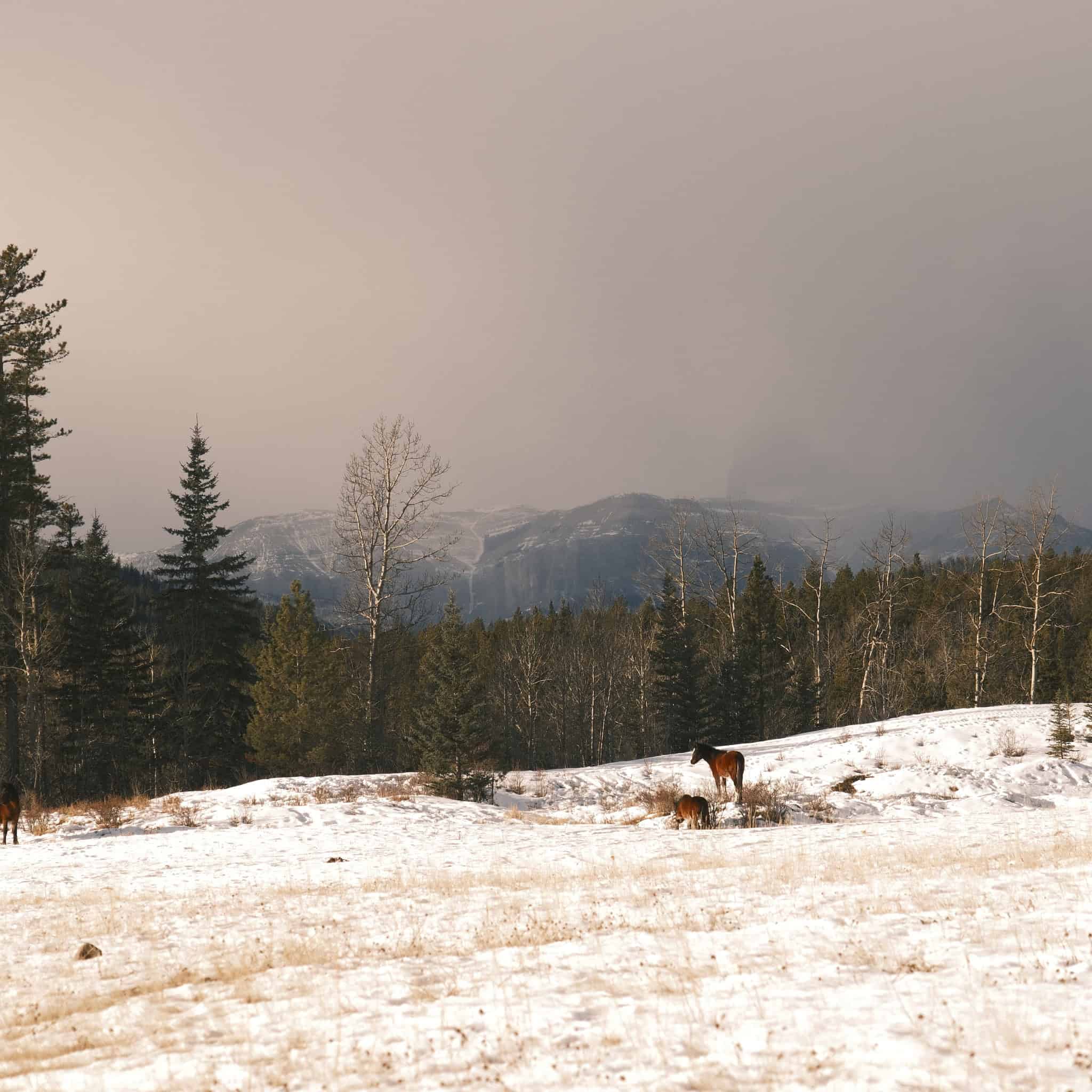
Feral horses may outcompete native ungulates and cattle in the grasslands of Alberta east of the Rocky Mountains.
Their presence may also artificially subsidize predators like bears and wolves in the area, who may in turn consume more elk and bighorn sheep.
“We found evidence that feral horses may be affecting native species both in apparent competition and competition for forage,” said TWS member Birch Gano, a master’s student at the University of Montana.
Wildlife professionals have published a great deal of research on the effects that feral horses (Equus caballus) have on native wildlife and plants in the western United States. But less work has been conducted on their ecological impact in Alberta, where they number around 1,500 individuals.
Horses off the ranch
Gano, who grew up in Alberta in the foothills of the Rockies, was studying elk (Cervus canadensis) at the Ya Ha Tinda Ranch, a Parks Canada ranch where horses are kept for the winter for wardens for neighboring Banff National Park and researchers going into the backcountry. Aside from the corralled area for domesticated horses, the ranch has nearly 4,000 hectares that elk and bighorn sheep (Ovis canadensis) use. “It’s a very popular spot to take horses and go riding,” Gano said. “In the summer, it’s pretty busy with recreation.” The elk there are partially migratory, heading to the east of the ranch where they often encounter feral horses in the spring and summer.
Gano wondered how the presence of so many horses in the area might affect the native ungulates. “Driving out to the study area, it was crazy to see how many horses there were,” she said.
Her supervisor at the University of Montana didn’t want to touch the topic due to controversy over feral horses, but Gano decided to analyze data that researchers had been collecting in the area for the past 10 years as part of a long-term elk project at Ya Ha Tinda. Researchers had been monitoring the area using 23 trail cameras since 2013. Gano supplemented this data by collecting scat from ungulates, domestic cattle and carnivores at the ranch from 2022 to 2025.
In ongoing research Gano presented at the 2025 TWS Conference in Edmonton, Alberta, she has found that feral horse diet overlaps significantly with native elk and bighorn sheep, especially in the winter and spring, in areas east of Ya Ha Tinda. Elk also seemed to avoid the areas that feral horses foraged in, missing out on good feeding opportunities.

But the feral horses and domestic cattle had an advantage over native ungulates. Scat analysis revealed that they made meals of more nonnative forage plants like dandelions and clover, which native ungulates don’t eat. This behavior helps horses outcompete the native ungulates and boosts the spread of these plants, as the horses spread the seeds around more widely.
“It’s like this whole ecological arms race,” Gano said.
Horse meat menu
Gano also wondered whether horses themselves were on the menu for predators in Alberta. Analysis of carnivore scat revealed that every predator in the area ate horses at least occasionally. “Horses were a big part of [the] carnivore diet,” Gano said.
Horse represented a quarter of the gray wolf (Canis lupus) diet and about a third of grizzly bears’ (Ursus arctos horribilis) meat diets.
Horses were only found in about 5% of cougar (Puma concolor) scat and in about a quarter of coyote (C. latrans) scat. The latter is likely mostly scavenging, Gano said, as coyotes are probably too small in most cases to prey on horses.
Some of the other predators could just be scavenging some of their horse meat—it’s difficult to say based just on scat analysis. “Likely, cougars are killing their own prey as well as wolves,” Gano said.
While this situation may seem like native predators are weeding out the population of an invasive species, Gano said that this injection of prey may boost the number of some predators, which may then feed on more native prey as well as horses. This dynamic is already well-known in parts of northern Alberta, where an influx of white-tailed deer (Odocoileus virginianus) is driving an increase in wolf numbers, which then prey on more caribou (Rangifer tarandus) as a secondary prey item.

Gano said it’s too early to tell for sure whether feral horses are causing a similar problem with predators, elk and bighorn sheep in her study area, but “wolf and grizzly predation are the leading cause of declines in the elk populations,” she said. “[Our study] is a stepping stone into unraveling this apparent competition pathway that we know in Alberta so well.”
The fact that there may be competition between feral horses and native species in Alberta is a wake-up call for wildlife managers in the province, which currently does nothing to control numbers there. “They are currently evaluating different management trade-offs,” Gano said.

Header Image: The ecological impact of feral horses isn’t well known in Alberta. Credit: Matt Wallace
Related Posts
JWM: Night lizard numbers ‘remarkably stable’ despite drought
Invasive ants are a new threat for reptiles endemic to Channel Islands
New Look! The Winter 2026 issue of The Wildlife Professional
The winter issue of the magazine features a new design with TWS’ new brand
Why has Missouri succeeded in wild pig control?
While other areas struggle against an overwhelming invasion, one state’s holistic approach to control has revealed that control is possible