



Share this article
Wildlife Featured in this article
- Eastern hellbender
Kentucky streams no longer heaven for hellbenders
Environmental DNA study reveals the large salamanders’ stream occupancy is down by more than half
Hellbenders in Kentucky have likely disappeared from more than half of the streams they previously lived in.
A new environmental DNA (eDNA) study tested new and historic sites for Eastern hellbenders (Cryptobranchus alleganiensis). Researchers found only 44% of streams with past records of hellbenders currently have hellbender eDNA.
“It’s loss of habitat, through and through,” said TWS member Sarah Tomke, a postdoctoral researcher in disease ecology at the University of Pennsylvania School of Veterinary Medicine and lead author on the study. “The rivers have changed, and the quality isn’t what it used to be.”
Out of the 90 sites sampled, the team only detected hellbender eDNA at 22 of them. “I was really hoping for more,” Tomke said.
Searching for the snot otter
Historically, the hellbender range covered most of Kentucky. But waterways have changed a lot in the past several decades, with silt covering the bottom of many streams. Runoff and sedimentation from mining, development and agriculture fill up the nooks and crannies in the rocks that the salamanders rely on to hide and lay their eggs. “It touches every single life stage,” Tomke said.
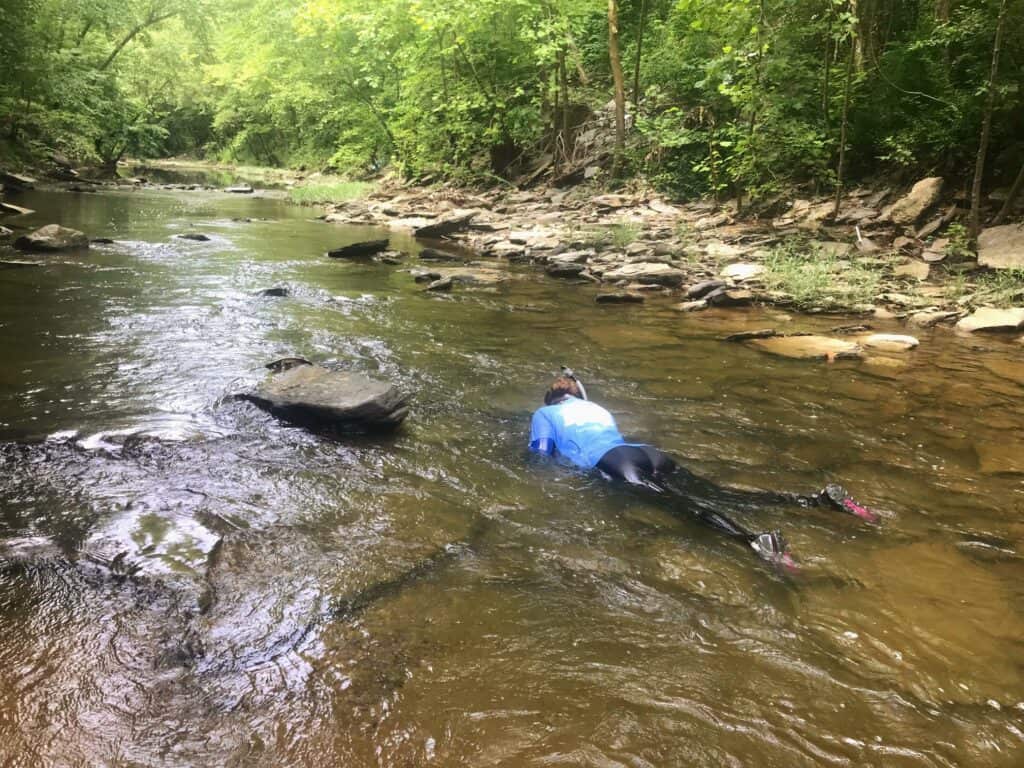
Courtney Hayes, a wildlife biologist at KDFWR, said the lack of knowledge is due in part to their cryptic nature. “Sightings are so rare that the species requires a lot of time and effort to study,” she said. Traditional surveys include snorkeling in shallow montane streams, peering under rocks for the animals. Sometimes crews of five or six people must lift up huge boulders in their search, which can be disruptive to the streambed.
But eDNA is much easier, and faster. For a study published recently in Freshwater Biology, Tomke and her advisor Steven Price with the University of Kentucky Department of Forestry and Natural Resources sampled 90 sites, including 27 with historical sightings. They found only 22 sites with hellbender eDNA.
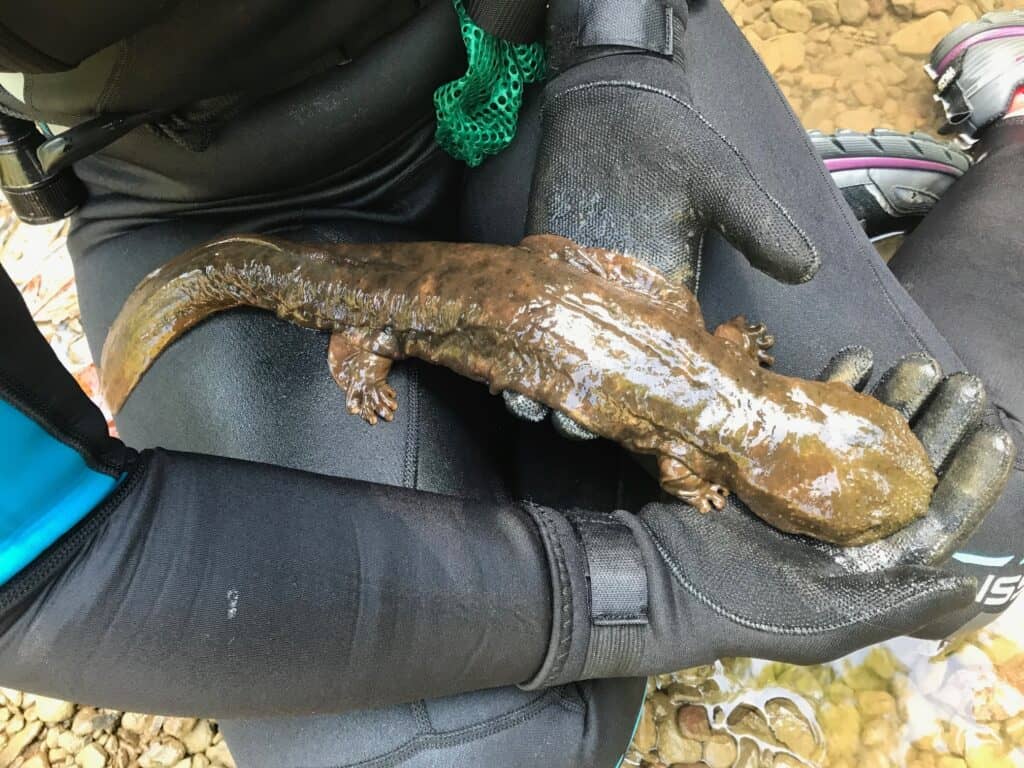
Tomke then used occupancy modeling to analyze what factors influenced hellbender presence. She found that stream substrate was most important, and that hellbenders were more likely to be in streambeds made of gravel or cobble with big, chunky rocks or bedrock. “You’ll find then under enormous rock slabs the size of the hood of a car,” she said. The females find a mate who has a large den under a rock. They lay their eggs and take off. The male—known as a denmaster—will guard them until hatching. They can live up to 25 years in the wild and even more in captivity. “They can spend their entire life under that one rock.”
Tomke sampled three times throughout the year to determine which environmental factors affected detection. She found the fall was the worst time to sample for eDNA as an excess of organic matter interfered with the molecular analysis of the water samples, making the eDNA more difficult to detect. But salamanders are a lot more active during the breeding season in late August and early September, which leads to more genetic material in the water. Tomke found that was the best time for eDNA detection.
Making sense of declines
Because most of the sites were in good-looking streams in the Appalachians, Tomke expected to see more positive results. But it was clear that the declining quality of Kentucky’s streams is having an effect on hellbenders.
Tomke said that stream habitat restoration is our best attempt to preserve hellbenders in the state. “Our stream quality has drastically declined across the country—this isn’t just a Kentucky problem,” Tomke said. Indeed, research in Virginia has shown that upstream tree cover was the major factor in determining whether male denmasters cannibalized their eggs before hatching downstream—possibly because tree cover improved the water chemistry and decreased silt levels.
Eastern hellbenders are currently up for listing under the Endangered Species Act in all of the 15 states where they’re found. The Ozark subspecies (C. a. bishopi) was listed as federally endangered in 2011.
While Hayes said KDFWR still doesn’t have a great grasp on the current range of hellbenders in Kentucky, she said that the results of the study made the team more hopeful that hellbenders still persist across the state, despite declines. After the study, KDFWR successfully captured hellbenders at one stream where Tomke had detected eDNA, just at a different location along the stream. They also trapped hellbenders at another eDNA positive site that had historical records of the species.
While they haven’t found any new populations using eDNA so far, Hayes said this is partly due to the fact that they use eDNA in combination with historical records to create sampling strategies that prioritize areas where the likelihood of finding hellbenders is high. “For example, streams with a historical record and positive eDNA results will be higher priority for further surveys than a stream with a historical record and negative eDNA results,” Hayes said.

Hays said that KDFWR doesn’t currently consider positive eDNA results as confirmation of hellbender presence, but rather a tool for creating more targeted, cost-effective snorkeling and live trapping sampling strategies. “We are hoping to continue following Sarah’s methodology of eDNA collection and analysis as we locate areas that appear to have good habitat for hellbenders but we have not been able to confirm their presence or absence yet,” Hayes said.
While still present in many streams, hellbenders are long living. But there is only one known actively reproducing population of hellbenders in the state, which is “really scary,” Tomke says. Besides of the environmental implications of losing any species, Tomke doesn’t want to see the hellbenders completely disappear for another reason: “Hellbenders have been essentially unchanged for millions of years,” she said. “To me, they are these ancient creatures that I don’t want to go away.”

Header Image: A hellbender in a Kentucky stream. Credit: Sarah Tomke
Related Posts

Speeding toward NEPA reform
House passes significant alterations to NEPA permitting provisions
More than 60,000 penguins starve to death in South Africa
Following sardine stock collapse from overfishing and the climate crisis, penguins have nothing to eat
Agency’s move likely to ignore indirect wildlife impacts
Proposed shift in ESA consultation processes could narrow analysis of project impacts