



Share this article
Has Trump admin affected ecological research and management?
Survey reveals broad concern over harm to U.S. science—but some support federal changes
On Jan. 20, 2025, the Trump administration started restructuring the federal workforce and making policy changes that marked a sharp departure from long-standing operational norms. In response, The Wildlife Society, along with 13 other scientific societies, groups and organizations, created a nationwide survey to assess some of the initial impacts of these policies on members. The survey echoes long-held fears that these changes have had devastating consequences for science and reveals the emerging extent of the damage. The survey results provide the first systematic documentation of how recent federal policy changes have affected scientific research.
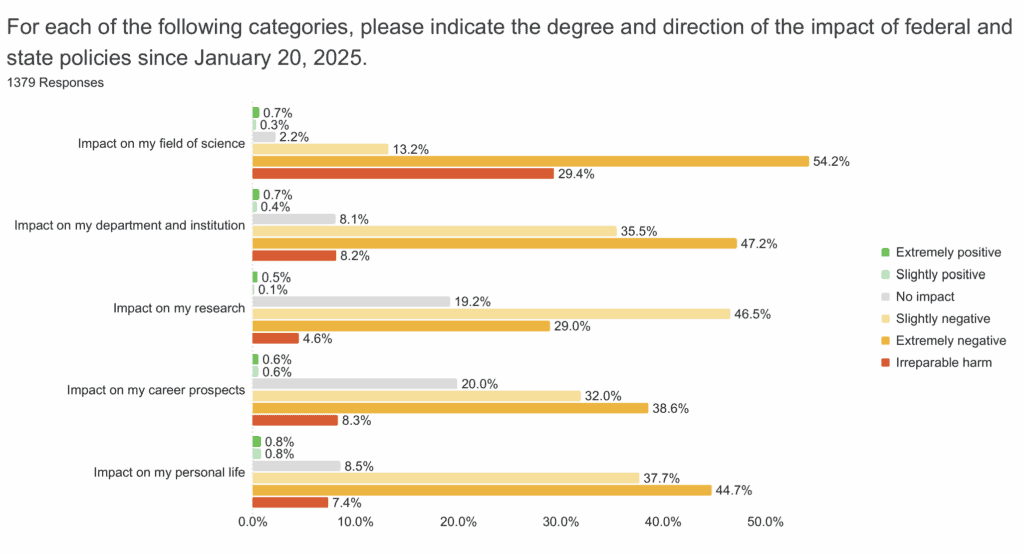
The anonymous survey was distributed by the professional societies to tens of thousands of scientists in ecology, evolution and marine science in professional societies, which captured nearly 1,400 responses across career stages and sectors, including academia, nonprofits and federal agencies. Approximately 20% of respondents were TWS members. Results show 83% of respondents said federal policies had either an “extremely negative impact” or caused “irreparable harm” to their field.
A small minority—2%—was in support of the administration’s changes. But most of the responses paint a grim picture of how recent federal policy changes have impacted scientific research and training programs that ultimately will trickle down to how conservation and management actions can be informed and implemented.
To the majority, science is under siege
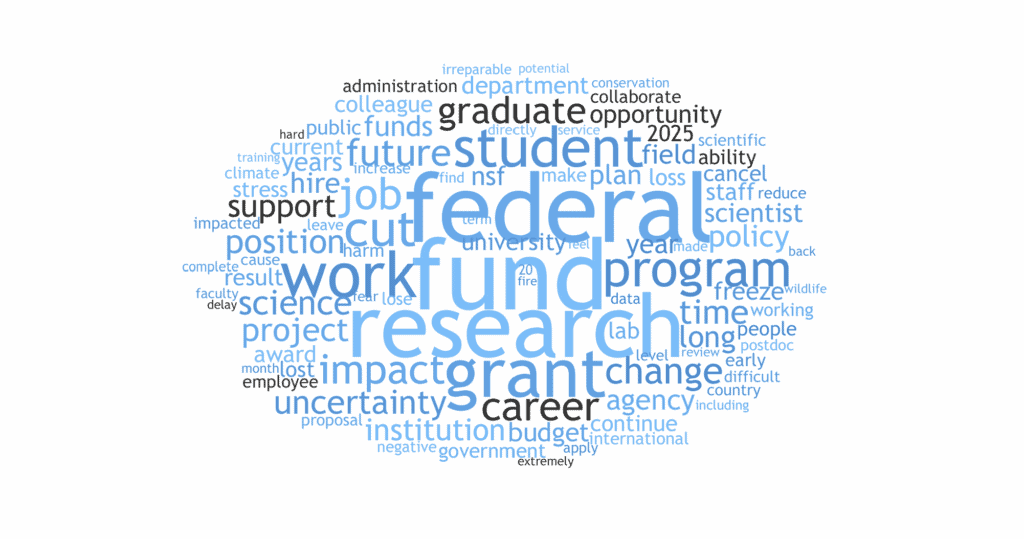
In open-ended survey responses, scientists described widespread disruptions to research, job insecurity, censorship and the erosion of institutional expertise. Their concerns cut across sectors, career stages and disciplines, but the perspective was clear. To them, recent federal actions are undermining the foundations of American science.

To many, silence is now part of science. Nearly half of all respondents (48%) mentioned being silenced in scientific communications, expressing that they felt pressured to self-censor language in reports, grant proposals and public communications. Commonly silenced terms included “climate change,” “climate models” and even “diverse.” Some respondents raised alarms about the integrity of federally produced data. They expressed concern that censorship and political interference could distort scientific objectivity and integrity and erode public trust.
“Already, we hear about data being created to support the desired research outcomes, which is illegal and violates every tenet of scientific inquiry,” wrote one respondent.
Disruptions to scientific work were also widespread. Respondents cited concerns about research that supports public priorities, such as food security, flood mitigation, disease surveillance and wildlife conservation, being disrupted or halted. Due to the restructuring, fieldwork has been frequently abandoned since January due to travel restrictions, delays in grant processing, or the firing of key federal collaborators.
Respondents also felt that the reduction in force across agencies has hollowed out staffing and expertise. Several respondents noted gaps in legal compliance, risk assessment and basic operational capacity, with fears that more people will leave due to the working environment.
“We cannot afford to lose more federal employees due to low morale and stress,” wrote one respondent.
Across career stages, scientists expressed deep concern about a severe early-career bottleneck. Respondents cited cuts to training programs, reduced graduate admissions, rescinded offers and rising competition for limited jobs alongside better opportunities overseas as driving the fears.
“I worry that we will be losing out on a generation of gifted researchers and conservationists,” another respondent wrote. “Although I do not think the harm is irreparable at this point, it may be by the end of the administration, or at least it will take much longer to repair the damage done, likely decades.”
Another wrote, “My entire department hired just one graduate student this year because although our funding has not yet been cut, the threat that it might be cut means that we cannot commit to paying graduate students in the future; so the threat of funding cuts has essentially the same effect as actual funding cuts because it makes it impossible to plan or to commit to future expenditures.”
The survey questions did not assume that all impacts were harmful and included options to indicate whether impacts were negative, neutral or positive. Like any survey, there is potential for bias. Those most negatively affected by recent policies may have been more likely to respond, while others, such as government employees, immigrants or members of marginalized groups, may have chosen not to respond due to fear of retaliation.
Supporters stand by the restructuring
The 2% of respondents that welcomed the administration’s changes expressed the belief that recent federal policies have been beneficial.
“Useless research and programs that can’t self-fund or attract funding no longer can rely on [government] funding to continue and thus are shutting [down],” one respondent wrote. “This positive effect has been that people who never should have been working in this industry [are] now out of it.”
Another lauded “positive” changes. “We now have an administration in office that is working hard to actually do something positive for this country … strong foreign policy, deporting illegal immigrants, strengthening our economy, resetting fair trade policy, etc. The future of my research is bright and shiny!”
Respondents in support of the changes noted that some recent policies could result in stronger candidate pools, greater nonfederal funding attention to conservation, benefits to the removal of red tape, and benefits to changes in diversity, equity and inclusion programs.
One respondent commented that they had seen increases in efficiency in the federal system. “Prior to this, it would take months of nonstop calling and emailing to get a simple answer,” the respondent remarked. “It was very evident these employees were not working on these permits or consultation efforts. This has made consulting much less stressful, with federal employees once again doing their jobs.”
These voices serve as a reminder that not all in the profession view these disruptions as harmful. In fact, some see them as necessary course correction.
Can we come back from this?
Some respondents believe the damage to U.S. science may already be beyond repair.
“It is terrifying to see the loss of scientific expertise that is draining out of the U.S. right now. It is so much like watching how Lysenkoism destroyed biological research in the USSR,” one respondent wrote, referring to Soviet biologist Trofim Lysenko’s mid-20th century political campaign against genetics and science-based agriculture.
Respondents who thought the harm was already irreparable cited disruptions to time-sensitive data collection or training opportunities, damaged career prospects, and harm to constituents caused by the loss of institutional knowledge in the federal government as reasons why the current perceived damage could not be undone. A self-identified contractor highlighted how cuts to infrastructure restoration would prevent them from completing projects that would reduce damage from heavy flooding in their Midwest state. “Irreplaceable harm has been caused because the public will not be able to depend on the accuracy of information in federal reports and publications,” the individual wrote.
Some fear the worst is yet to come, warning that continued rejection of science for political reasons could cause lasting damage.
“Since Jan. 20, I have observed the state grow bolder with its willingness to reject scientific information that does not conform with its desired policies,” a respondent wrote.

Header Image: A gray wolf (Canis lupus) walks through the snow at Yellowstone National Park. Credit: Jim Peaco/YellowstoneNPS
Related Posts

The invasive reach of social media
A tiny fraction of social media users steers the conversation on invasive species online
Congress is nullifying resource management plans
This creates uncertainty around the future management of federal public lands

Government slashes funding for environmental groups encouraging diversity
Environmental organizations lose funding, even after some removed language from their websites