



Share this article
Wildlife Featured in this article
- Western honey bee
Hungry honey bees out-hustle native pollinators
In one of the world’s hot spots of bee biodiversity, scientists are overwhelmingly finding one introduced species
San Diego is a global hot spot of bee diversity—or at least it should be. A new study shows that introduced honey bees take around 80% of available pollen, leaving hundreds of native bee species to forage on the scraps.
“The entire life cycles of bees are dependent on pollen and nectar,” said Dillon Travis, an environmental consultant and former doctoral researcher at the University of California San Diego, where he conducted the study. “They are inexorably tied to floral resources.”
The paper, published recently in Insect Conservation and Diversity, quantifies the pressure that nonnative western honey bees (Apis mellifera) put on native bees through competition for resources.
How honey bees came to dominate
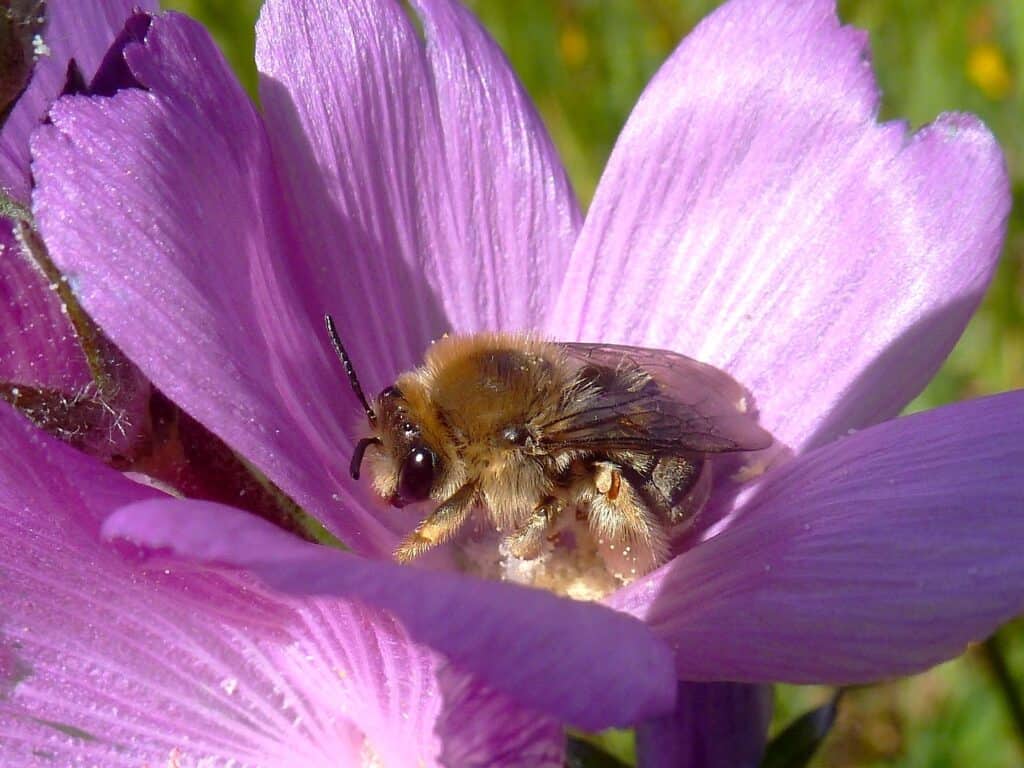
Typically, species increase in biodiversity closer to the tropics. But bees don’t follow this rule. Bee diversity is clustered in Mediterranean Europe, the Middle East and the U.S. Southwest. These sandy, dry spots with open vegetation are attractive to bees and have accumulated many species over millennia. “Bees like dry places with areas with large floral blooms,” said Keng-Lou James Hung, another author on the study and an assistant professor at the University of Oklahoma.
When he first came to San Diego to study native bees as a doctoral student at the University of San Diego, Hung said he trained himself to “just tune out” all the honey bees he saw that were unrelated to his project at the time. But that led him to ignore about 90% of all the bees he saw.
Through conversations with his mentors, he realized that honey bees deserved more attention. “My mentors were convinced that this is where the real story was at,” he said. “And I found out that they were right.”
When European colonists first brought the bees to North America in the 1800s, they quickly became feral, escaping beekeepers and reproducing in the wild. But they weren’t well-adapted to the hot, dry climate of the American Southwest, and their population numbers stayed relatively in check. Then, in the 1950s, people brought western honey bees native to southern Africa (A. mellifera scutellata) to South America to pollinate farms. “They’re the same species but a different lineage that is better adapted to hot climates,” Hung said.
Once the bees from Africa escaped cultivation and started mating with the European lineages, they began migrating northward, and scientists first documented them in California in 1994. These hybrid honey bees are much better suited for San Diego’s environment and quickly came to outnumber native pollinators.
Hung’s prior research found that honey bees comprise up to 90% of insect visitors to blooming plants in the area. “It’s almost insignificant, the number of native pollinators we have,” Travis said.
A bee’s life
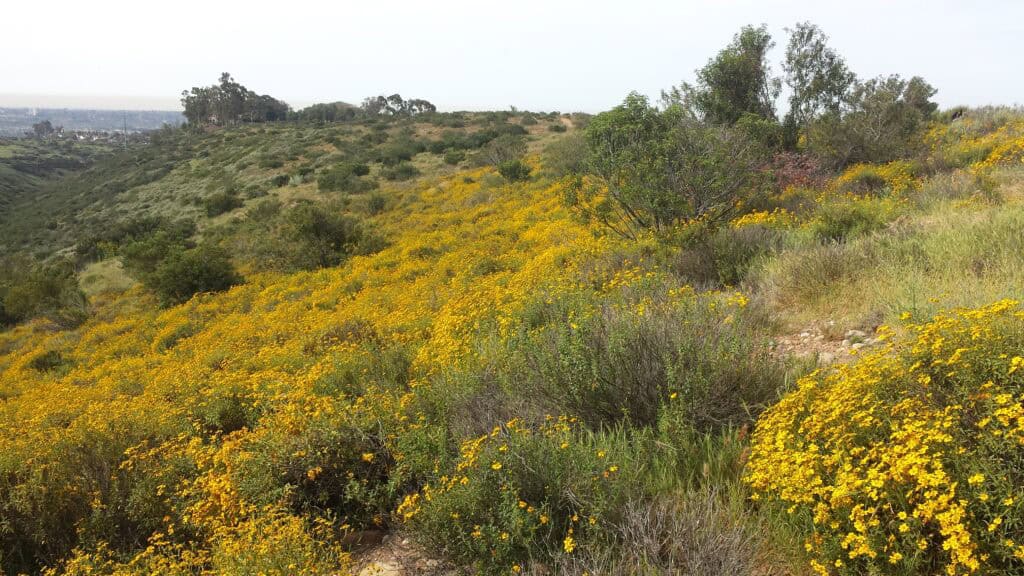
To determine how many resources honey bees were taking that native pollinators would otherwise leverage, Travis and Hung headed to San Diego’s coastal sage scrub ecosystems. Travis looked at how much pollen honey bees were removing. The night before a field day, he went out and marked flowers that were just about to bloom, covering them in chiffon bags. He returned to the field the next day and uncovered the flowers one by one, allowing a single honey bee to visit the flower before collecting the bloom for lab analysis. He gathered flowers that had been exposed to pollinators for the entire day and collected other flowers before they had been visited at all as points of comparison.
Travis didn’t have to wait more than 10 minutes for a honey bee to visit each of the exposed flowers so he could collect them. That hasn’t been the case when the researchers were conducting projects studying native bees.
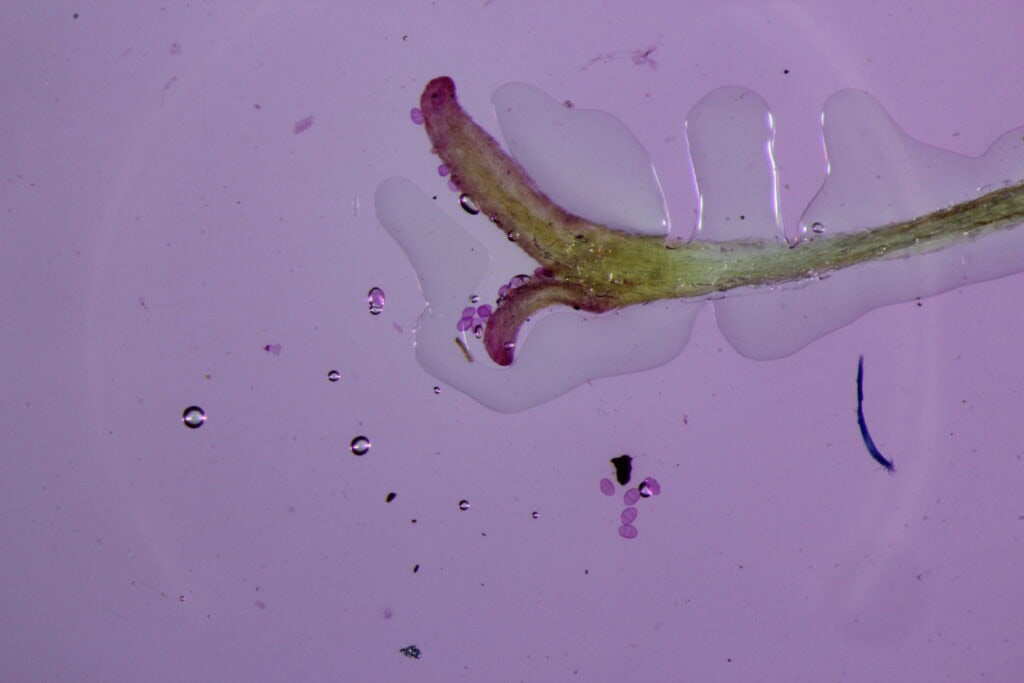
Travis brought the flowers back to the lab, where his research team used a microscope to count individual pollen grains that would help them determine how many the honey bees harvested. “I had an army of undergraduates to help me out, and they made this work possible,” he said.
Looking at flowers from three plant species common in the coastal sage scrub ecosystem—black sage, white sage and distant phacelia—Travis found that in just two visits, honey bees can remove up to 60% of a flower’s available pollen. Within the first day that it’s open, 80% of that pollen will be gone.
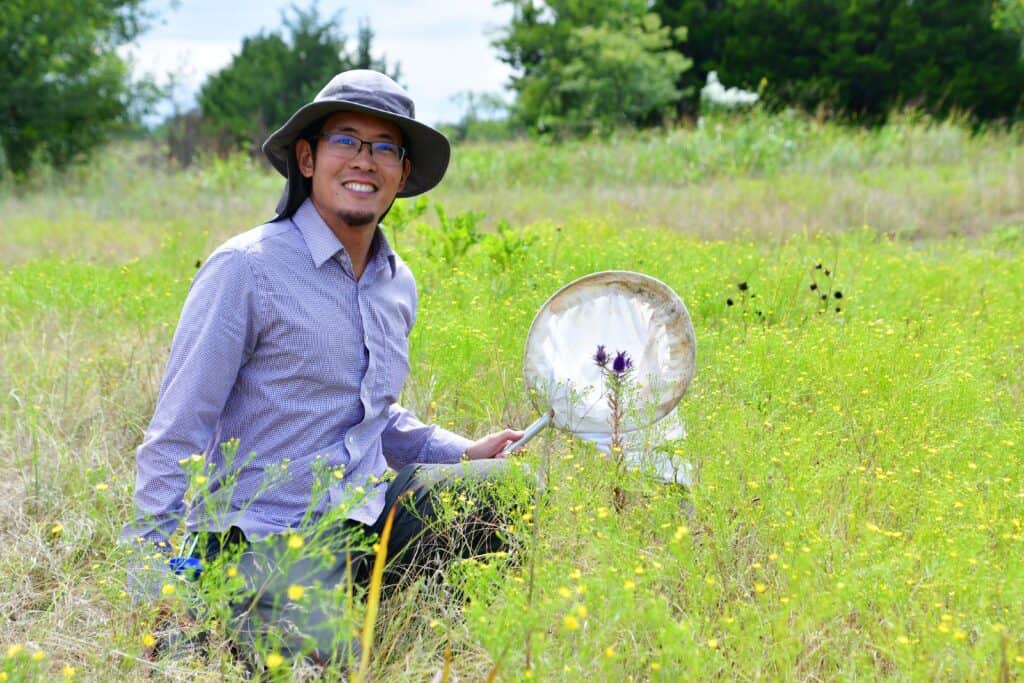
Hung also spent time in the field to determine the number and size of pollinator visitors to coastal sage scrub flowering bushes. “We were able to do pretty intricate calculations on the average size of bees,” he said. “With all this information, we were able to estimate how heavy [all the honey bees are] versus how heavy all the other native bees are combined.”
Hung and Travis then determined how much pollen was needed to produce a bee of a given size and species. He found that honey bees represented around 98% of all bee biomass around San Diego, indicating about 98% of all floral resources in the region were going to honey bees. The resources they take from one hectare of coastal sage scrub daily could feed thousands of native bees.
The researchers estimated that if these floral resources were dedicated to native pollinators—and if the main limitation of native bee populations is food availability—native bee numbers could be up to 50 times greater than they are now.
The honey bee effect
Honey bees didn’t evolve with coastal sage scrub plants, unlike native pollinators. These plants are the foundation of the ecosystem, providing key habitat for a variety of wildlife, and the bees help the plants reproduce through pollination. “If you chisel away at the bedrock of your building, the whole thing’s going to collapse on itself,” Travis said.
In their goal to understand how honey bees are affecting native pollinators, Travis and Hung have run up against a common problem in ecology. “We don’t have a baseline understanding of what the environment looked like before honey bees were introduced,” Travis said.
Nonetheless, “I would not be surprised if native bee diversity is taking a hit,” Hung said.
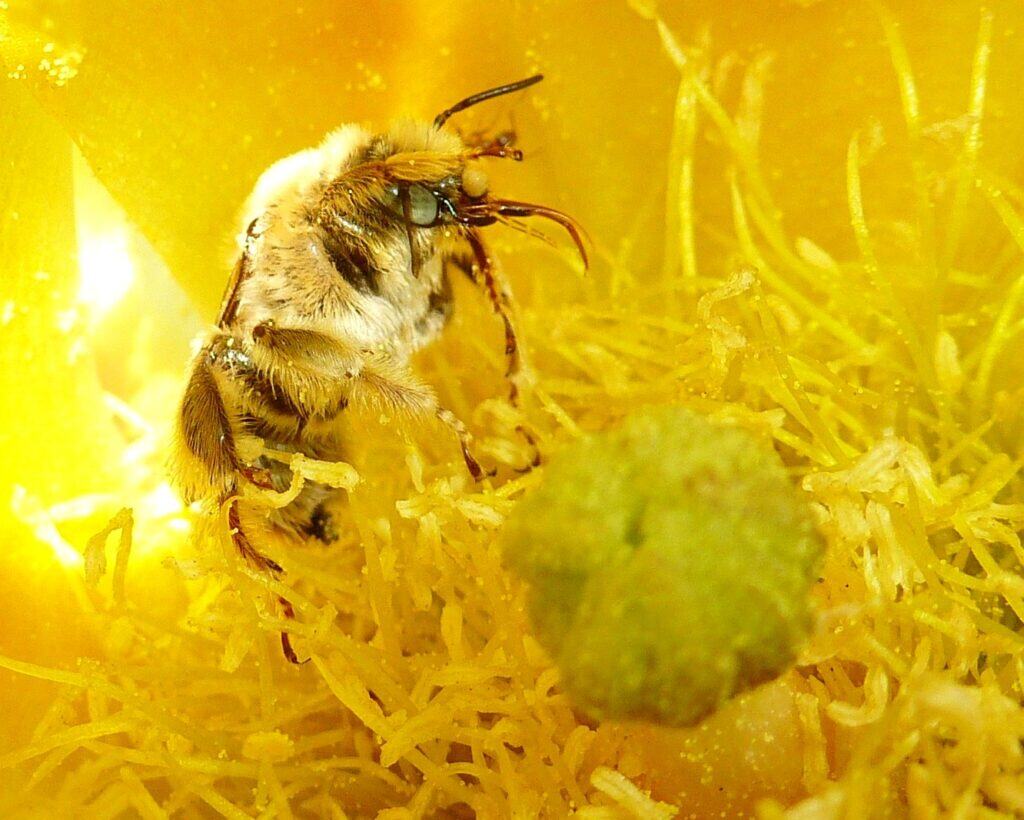
Hung is alarmed by how resilient the honey bee is. “It’s a very, very good competitor,” he said. They are effective at foraging in patchy, inconsistent, unreliable environments. “With climate change, we’re going to create landscapes that more and more favor honey bees and more disadvantage native bees,” Hung said. Less than 10% of historic coastal sage scrub exists now.
“Our study adds evidence that some management action needs to be done,” he said. “Right now, the ratio of honey bee biomass to that of all native bees combined—of which there are 700 species in San Diego—is 50 to one,” Hung said.
While Hung and Travis note that honey bees are important for the economy, there are some management actions that can be taken in vulnerable, biodiverse areas like San Diego.
“The vast majority of people I talk to aren’t aware that honey bees aren’t from here,” Travis said. “We need to stop looking at honey bees as wildlife in the U.S. but as a managed species like chickens or cattle.” Travis quoted a popular maxim in pollinator ecology: “Keeping honey bees to ‘save the bees’ is like keeping chickens to save the birds.”

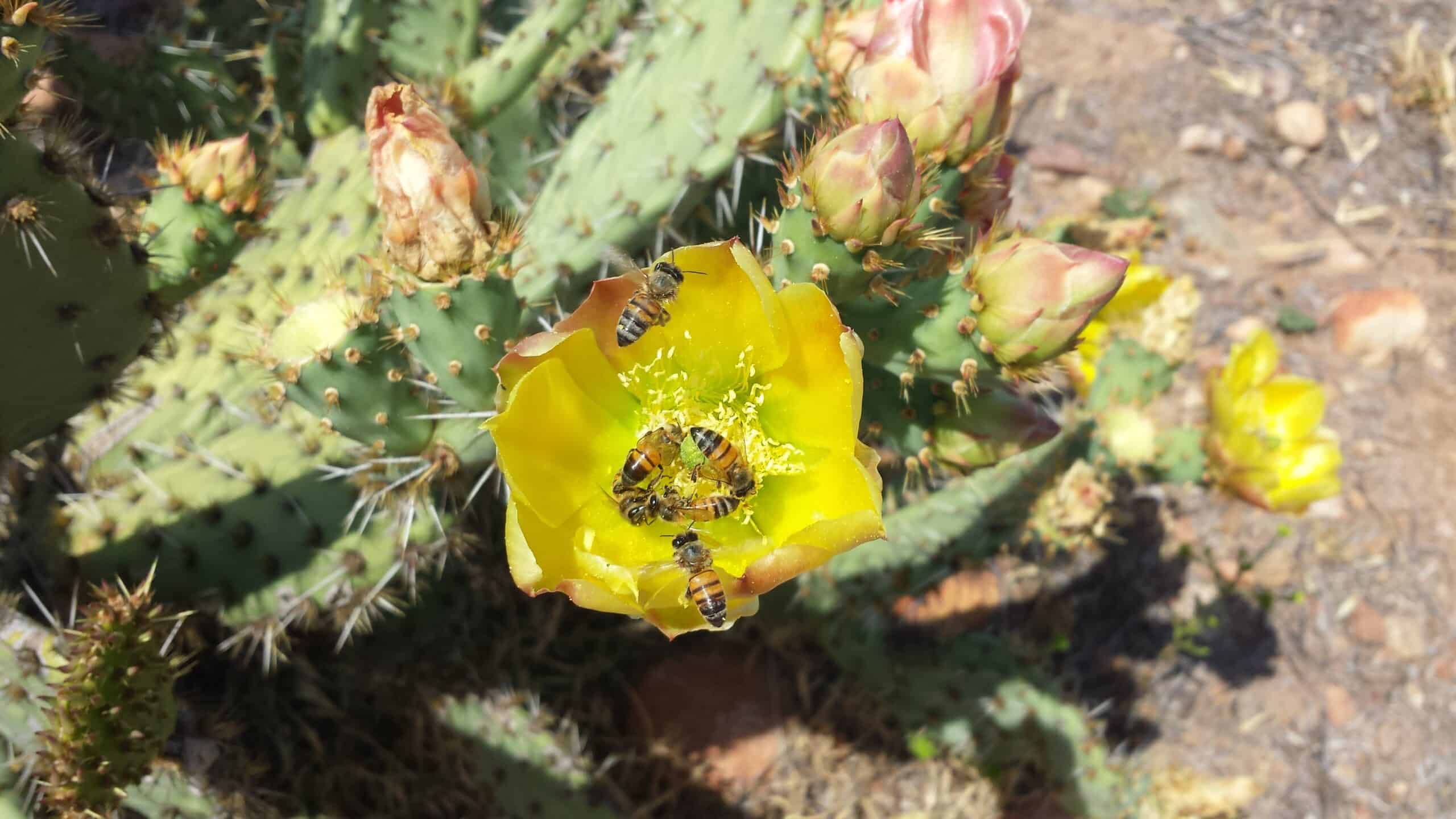
Header Image: Western honey bees feed on a prickly pear cactus. Credit: Keng-Lou James Hung
Related Posts
Why has Missouri succeeded in wild pig control?
While other areas struggle against an overwhelming invasion, one state’s holistic approach to control has revealed that control is possible

Birds avoid spotted lanternflies fed on invasive plants
Spotted lanternflies that feed on the tree of heaven are unpalatable to birds
Listen: Conservation trouble in paradise
How wildlife managers are fighting invasives and restoring native habitats in the U.S. Virgin Islands