



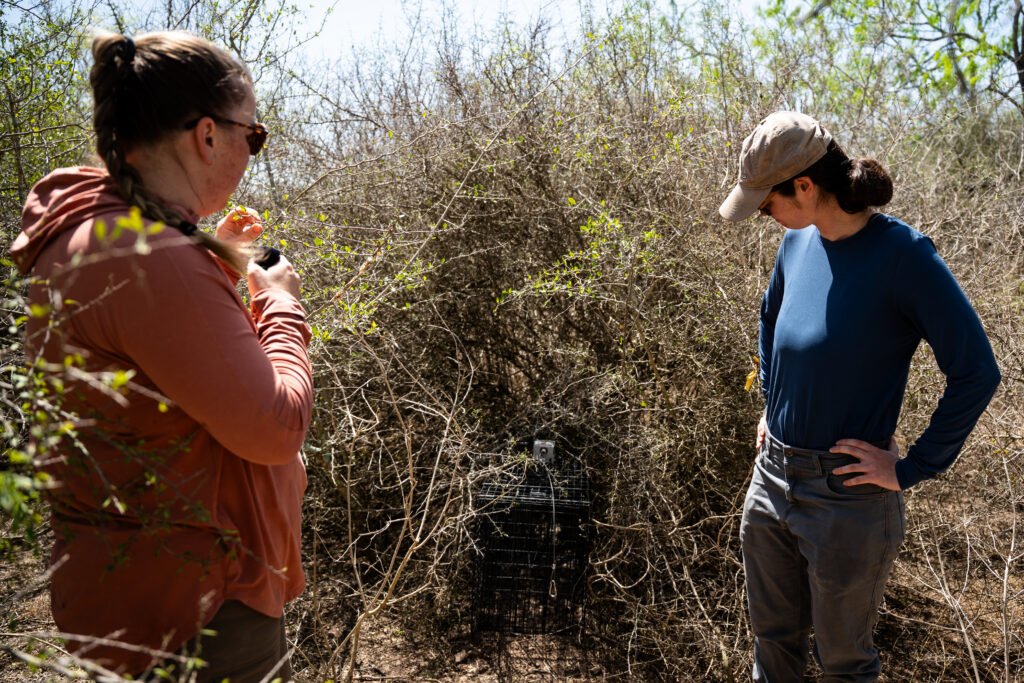

Under the warming South Texas sun, I walked sandy-bottom trails through scrubby, thorn-ridden vegetation early in the morning just to learn that while there may be more than one way to catch a cat, a lure doesn’t work.
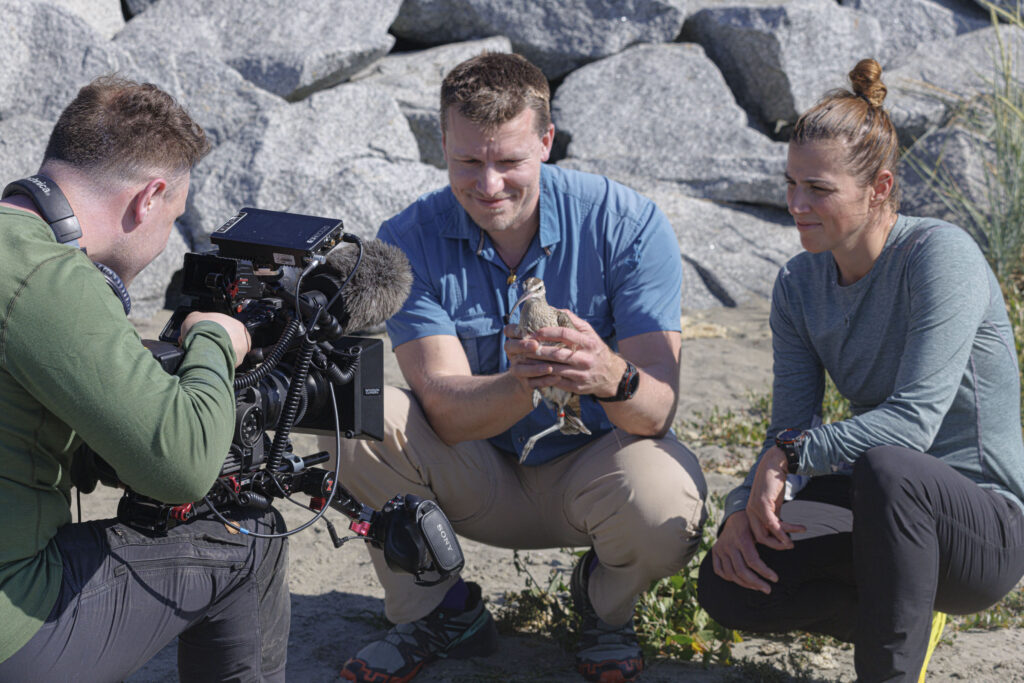
The more than 27,000 acres of land that make up the East Foundation’s El Sauz Ranch are about the only foothold that ocelots (Leopardus pardalis) have in the U.S. There are around 20 ocelots on this ranch and likely less than 120 in all of Texas, but to keep a good count of this small population, researchers like TWS member Lindsay Martinez, a research program coordinator at the East Foundation, and field technicians Haylee Pearce and Meghan Murphy must develop good strategies to capture the elusive cats in this Tamaulipan thornscrub ecosystem.
For years, East Foundation, in partnership with Caesar Kleberg Wildlife Research Institute at Texas A&M University-Kingsville, has attempted to trap ocelots for research on their health, behavior, population status and more. The team makes the rounds through the mesquite every morning at the crack of dawn and again in the afternoon, checking a series of traps set out on the landscape. One day in early March, they took me into the field to check ocelot traps and talk about their survey work. Unadvisedly, I’d worn shorts—the thornscrub scratched up my legs as we walked through the bush.

The crew just shows up at the beginning and end of the shift—the real workers are out in the landscape all day and night. The team places live pigeons (Columba livia) in the back compartment of the traps as bait in an effort to draw ocelots in for an easy meal. The team makes sure the birds are fed and left with plenty of water, hay and a perch. The ocelots can’t actually get to the pigeons, which are locked in the back compartment of the cage, but they can see and hear them. “We make sure that [the pigeons] are looking OK,” Murphy said. “If any aren’t eating or are pacing or seem stressed, we’ll replace them with another pigeon.”
The researchers continued the pigeon bait method but also added on lures to some traps for a study published recently in Wildlife Society Bulletin to determine how well the extra lures attracted cats. While all traps tried to bait carnivores with pigeons, the team added ocelot urine, civet musk, shiny ribbons or a hanging CD in an effort to boost trap success.

The verdict? None of these elements worked well. The traps without such lures had just as much success in trapping ocelots, bobcats (Lynx rufus) or coyotes (Canis latrans) and didn’t exclude nontarget species like raccoons (Procyon lotor) at a higher rate. “We’ve had a couple fun interactions,” Murphy said. “A couple of them would kind of bat at the visual lures.” But overall, they didn’t really do their job well.
Then again, not trapping ocelots is a daily occurrence for ocelot trappers. The team only catches a cat about once every two weeks, on average. And when they do, the animals can sometimes get feisty. “I love them, but they are so hard to sedate sometimes,” Pearce said. “We had one male last year that we should have named him Peter Parker—he was hanging off the ceiling.”

The team is now looking at studying capture-related stress in ocelots as part of an effort to inform field techniques and the upcoming ocelot conservation breeding program. They hope that this ongoing work can bring more attention to smaller cats—big species like lions or tigers get all the conservation attention. “You see a lot of efforts to conserve the charismatic large cat species, which is absolutely a 100% necessary and wonderful work, but there’s not a lot of attention on small cat conservation efforts,” Murphy said.
The work they are doing, discussed recently at length in an episode of “Our Wild Lives,” the podcast of The Wildlife Society, can hopefully draw more attention to this remarkable species. “We’ve seen a boom in interest in ocelots,” Pearce said. “People are pretty excited about it.”

TWS journals are a benefit of membership in The Wildlife Society. Wildlife Society Bulletin, which is our only open access journal, is published four times annually. It is one of the world’s leading scientific journals covering wildlife science, management and conservation, focusing on aspects of wildlife that can assist management and conservation.
Join today for access to TWS’ journals and all the other great benefits of TWS membership.
Article by Joshua Rapp Learn

