


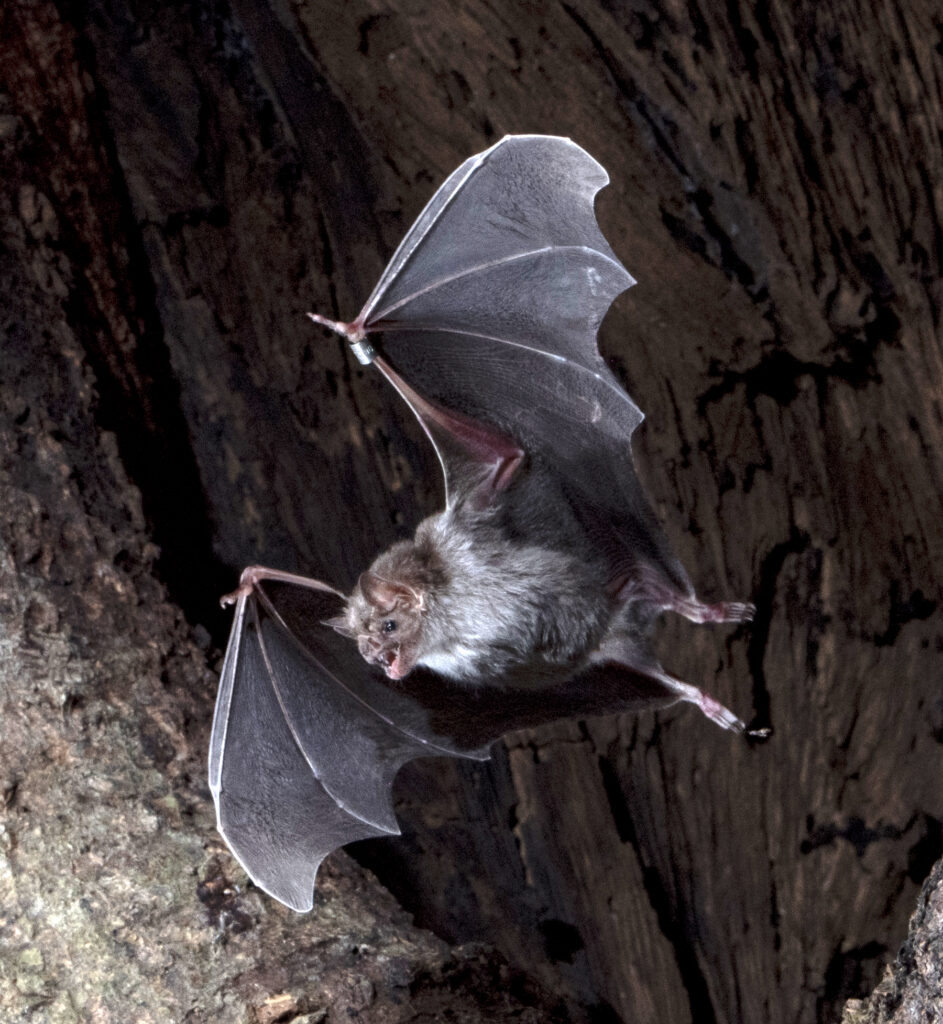

Windmills have killed an estimated 18 million bats in four and a half decades in the lower 48 states.
“In recent years, since 2021, 1.5 million fatalities may be occurring annually,” said Charles Labuzzetta, a quantitative ecologist with the U.S. Geological Survey.
These wind-energy developments are particularly deadly when placed near rivers, mineshafts or karst formations, or in the Appalachian Mountains. Policymakers can use the data to inform permitting decisions.
Four decades of bat deaths
A number of studies have looked at bat deaths in individual areas. In a study published recently in the Proceedings of the National Academy of Sciences, Labuzzetta led a team that analyzed data on bat fatalities from wind turbines in the lower 48 states from 1981 to 2024.
They used statistics, which included actual carcasses reported at wind farms, to estimate the number of deaths across all wind farms, many of which are never discovered or reported by wind facility staff.
The team estimated that some 18.7 million bats were killed in collisions in that time period. From 2021, the number was about 1.5 million per year.
“The bat fatalities are far more alarming than we thought,” said TWS CEO Ed Arnett, who studied bat fatalities at wind facilities for eight years at Bat Conservation International. He said this research corroborates his own work from more than a decade ago on bat fatality numbers.

These numbers were roughly comparable to the number of bats killed by white-nose syndrome (WNS), though turbines usually affect migratory species more, while WNS is more deadly for cave-roosting species.
“The magnitude of total fatalities might be the same,” Labuzzetta said.
In some areas, the turbine data reflected the impact of that disease. Co-author Bethany Frid, a supervisory biologist at the USGS and a coordinator for the North American Bat Monitoring Program, said that certain species were killed less in some areas after WNS reached the area—likely because populations of those species had taken a hit from the disease in those areas.
What bat species do wind turbines affect the most?
Rather than just looking at numbers overall, this new study also looked at species-level impacts. They found that, as other studies have shown, migratory species strike turbines more than cave-dwelling species.
The three species killed the most were hoary bats (Lasiurus cinereus), silver-haired bats (Lasionycteris noctivagans) and eastern red bats (L. borealis)—all species that range widely across the contiguous U.S.
Species listed on the U.S. Endangered Species Act also showed up dead at some turbines, though numbers were often lower. Species like northern long-eared bats (Myotis septentrionalis) and Indiana bats (M. sodalis) were among listed species, as were tricolored bats (Perimyotis subflavus), currently proposed for listing.
What turbine areas are the deadliest for bats?
The team also found that certain areas were worse than others in terms of bat strikes. Consistent with other research, they found that areas in the Appalachian Mountains were particularly high risk for bat deaths. Turbines near mine shafts or karst formations conducive to caves also had a high fatality rate, as bats often use these areas to roost. Finally, riverside turbines were particularly deadly, as they see a lot of bat activity. “Water is an important resource for not just drinking but foraging as well,” Frid said.
The team also found that turbines that swept close to the ground were associated with more fatalities for certain species like hoary bats, silver-haired bats, Seminole bats (L. seminolus), little brown bats (Myotis lucifugus) and tricolored bats. Turbines with longer blades that swept through more airspace were associated with more fatalities for species like hoary bats, big brown bats (Eptesicus fuscus), eastern red bats, silver-haired bats and evening bats (Nycticeius humeralis).
“There may be differences in how various species move through the airspace and in how much their flight paths overlap with the area swept by the turbine blades, influenced by factors such as ground clearance and total rotor‑swept area,” said Labuzzetta, though he added more data is needed to verify this.
Finally, the researchers found that curtailment efforts involving turning turbine blades parallel to the wind and slowing them down during low wind-speed periods when bats are more likely to fly helped to reduce collision-related deaths for some species, such as hoary bats.
Arnett said this research proves curtailment works to reduce bat strikes. He added that the results support the need for industry to implement broad-scale curtailment strategies to mitigate bat deaths.
One way to improve the rollout of such strategies is to have better economic analysis of planned wind developments that take curtailment into account, Arnett said. That will give a better idea of how much turbine energy is reduced if they are turned off during the riskiest times for bat strikes, allowing companies and utilities to factor those mitigation costs into their agreements and economic projections.
Using their findings, the team created risk maps that highlighted these hot spots for bat strikes. Policymakers—and the wind industry—could use the maps to decide on better wind energy placement.
“The ability to predict these sites ahead of build-out has always eluded us,” Arnett said. But, he said, this study gives a better roadmap for balancing mitigation—including avoidance of some sites—and sustainable wind power.
Article by Joshua Rapp Learn

