

Art is a powerful tool to inspire a love and appreciation of nature—and generate real change in the world around us.
“There’s something about art that connects with people,” said Fidel Hernandez, the outgoing president of The Wildlife Society, in his introduction to the plenary presentation at the 33rd Annual TWS Conference in Des Moines, Iowa. “It wasn’t Aldo Leopold’s science writing, but his prose, that launched a conservation movement,” he said.
Though Leopold was an accomplished scientist, his works, including the famous and universally loved “A Sand County Almanac,” inspired everyday people to develop their own intellectual and moral relationship with the natural world.
This year’s plenary remembers titans of art and conservation like J.N. Ding Darling and Aldo Leopold, who used their artistic gifts to spread their love of the natural world.
Julia Galloway is a conservation artist and Regents professor at the University of Montana whose talk, “Endangered Species: An Artist’s Contribution,” covered an ambitious years-long project to document the endangered, threatened and recovered species of the United States.
Enchanted by the work of John James Audubon, she began to incorporate his prints into her pottery. Her life changed when she learned that human disturbance kills a wandering albatross (Diomedea exulans) once every 25 minutes. She then pivoted her work toward endangered species, exploring personal responsibility and what her generation “had to apologize for.”
Inspired by Act Up’s AIDS Memorial Quilt, which visualized the magnitude of the catastrophe of the AIDS epidemic, Galloway wanted to create a similar work of art that would bring visibility to the number of declining species. “When something is so visible, you cannot deny it anymore,” she said.
Her first iteration of the project began with a series of plates painted with a mirror-like finish that reflected the viewer’s own “ghost-like reflection” back on themselves. She was surprised by how angry the viewers were about the loss of these species and decided to expand her series to the whole country and try to harness that energy for change.
Using bicycle spokes flattened on each end, Galloway has carved hundreds of urns—a powerful symbol of death and remembrance—with images of endangered, threatened and recovered species.
The species that have recovered will be displayed without their lids, Galloway said, to show there’s a possibility for restoration and repair.

When her project is complete, which will take nearly a decade, Galloway plans to exhibit the more than 1,100 urns in museums, botanical gardens and zoos on a decade-long tour across North America.
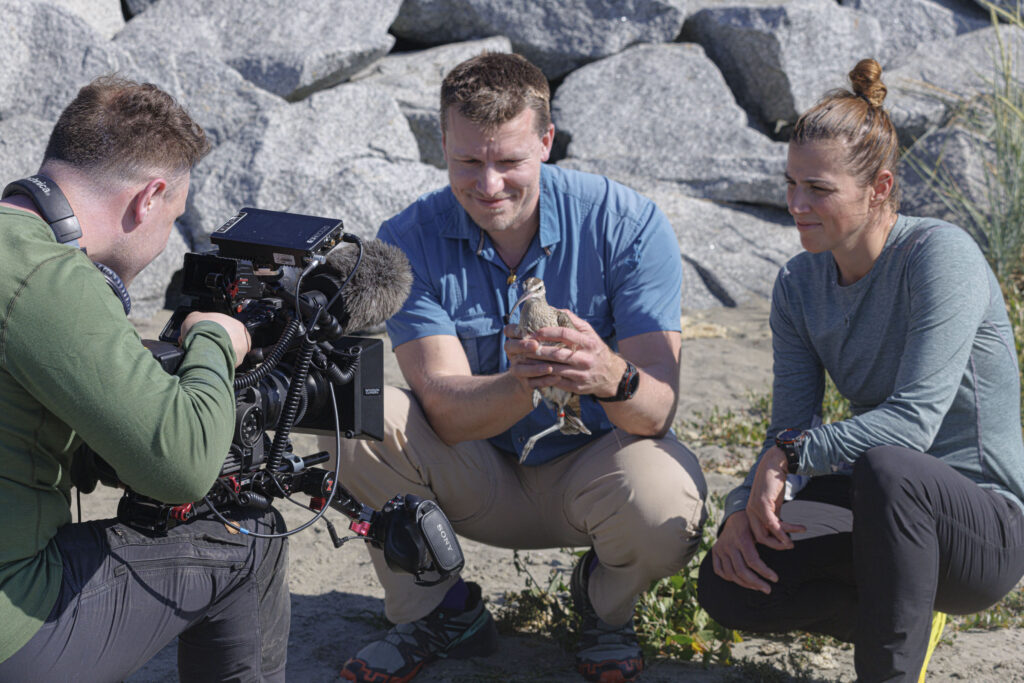
Ben Masters shared his own connections with wildlife and storytelling from a different angle. He studied wildlife biology at Texas A&M University before forging a career as a filmmaker at his production company, Fin and Fur Films, which has produced films for some of the biggest names in entertainment like Netflix, National Geographic and Disney+.
Masters began his talk with a clip of his film “Deep in the Heart II: Texas Rivers,” a feature documentary narrated by native Texan Ethan Hawke.
The clip Masters showed was about another “native Texan”: the Texas fatmucket (Lampsilis bracteata), a small, freshwater mussel native to Central Texas.
Masters said it’s important to craft messages and stories with individual audiences in mind to bring people together and change the way they think about the natural world. In the case of “Deep in the Heart II,” Masters and his team wanted to target Texans. His tactic has proven successful; in less than a week on Apple TV, the documentary is the third-most watched on the platform. “People love wildlife,” he said. “And Texans love Texas.”

Masters also shared tips for successful collaborations between filmmakers and wildlife biologists and emphasized their importance. “The way we learn all these things is by calling people like you,” he said to the audience.
He finished his talk with a clip from another project showing a mountain lion (Puma concolor) female teaching its three kittens how to hunt—with a group of feral hogs (Sus scrofa) as an example.
To bring the keynote speech to a close, Debbie Ng, a Duke University Global Fellow in Conservation Biology and Policy and a National Geographic Explorer spoke about the power of storytelling for conservation. “Stories create social permission to care,” she said.
Ng grew up in Singapore, where she experienced the extirpation of flying foxes from her home country as their fruit tree homes were cut down and fell asleep listening to rain hitting the zinc roofs of homes in her neighborhood. “You would feel all the rhythms of nature,” she said. “There was no separation from it.”
As her wildlife career developed, she began to work with coral reefs around Singapore. Two decades ago, one reef south of downtown Singapore was slated to be buried to create more land on which to build an oil refinery. She set out on a research vessel to document the final moments of the reef. She encountered a clownfish attacking her in an effort to defend its eggs in a nearby anemone. “This mother was going absolutely crazy,” she said. “‘Lady, just chill out,’” she thought.
Soon, a siren went off—the signal that the land reclamation would start. Ng climbed back onboard, and the research vessel left before barges began their work.
“With the pull of a lever, a loud, thundering sound roared in the water,” Ng said. “In a moment, that sound silenced the reef forever. That mother fish was not fighting anymore.”
The experience inspired her to write a comic, “The Bravery of the Clownfish.” She uses this story to tell a powerful message about conservation and connect with people on land that don’t always think about what’s under the water.
“I remember the spirit she had until her very last moment on the planet,” Ng said of the fish.